

If you're taking a blood thinner like warfarin, aspirin, or rivaroxaban, and you've started sprinkling turmeric on your eggs or popping curcumin capsules for "inflammation"-stop. There's real, documented risk here, not just a vague "maybe." This isn't about avoiding "unnatural" chemicals. It's about one common spice turning your carefully managed medication into a ticking time bomb.
How Turmeric Actually Thins Your Blood
Turmeric isn't just a yellow spice. Its active ingredient, curcumin, is a powerful biochemical actor. Research from a 2012 study published in PubMed (PMID: 22531131) shows curcumin doesn't just nudge your blood's clotting system-it actively interferes with key proteins that make clots form. Specifically, it inhibits thrombin and factor Xa, two of the most important players in the clotting cascade. That's the same mechanism some prescription drugs like rivaroxaban use, but without the precision.Here's the kicker: curcumin also reduces platelet aggregation. That means it stops your blood cells from sticking together, which is another major way clots form. So you're getting a double hit-slowing down the chemical clotting process and making platelets less sticky. That's not mild. That's pharmacologically significant.
And it's not just the spice. Most turmeric powder contains only 2-8% curcumin. But supplements? Those can be 95% curcumin. A single capsule might deliver more active compound than you'd get from a whole teaspoon of curry powder. And nobody knows exactly how much is safe when you're already on blood thinners.
The Real-Life Danger: INR Above 10
In 2018, Medsafe New Zealand issued a public warning based on a real patient case. The person had been on warfarin for years. Their INR-a blood test that measures how long it takes your blood to clot-was stable at 2.5, safely within the target range of 2-3.5. Then they started taking a turmeric supplement.Within weeks, their INR shot up to over 10.
That's not a typo. Ten. For context: an INR above 5 is considered dangerous. Above 8, the risk of spontaneous bleeding skyrockets. An INR of 10 means your blood takes *ten times longer* to clot than normal. This isn't theoretical. This person could have bled internally-brain, gut, kidneys-without even tripping or bumping into anything.
The Welsh Medicines Information Centre (WMIC) confirmed this isn't an isolated case. They documented another patient who developed acute kidney injury after taking 15 or more spoonfuls of turmeric powder daily for ten days. Their tacrolimus level (a critical drug for transplant patients) spiked to 29 ng/mL, far beyond safe limits. Turmeric was interfering with how their liver processed the drug.
These aren't anecdotes. They're clinical reports published in medical literature. And they're happening because people assume "natural" means "safe."
Which Blood Thinners Are Riskiest?
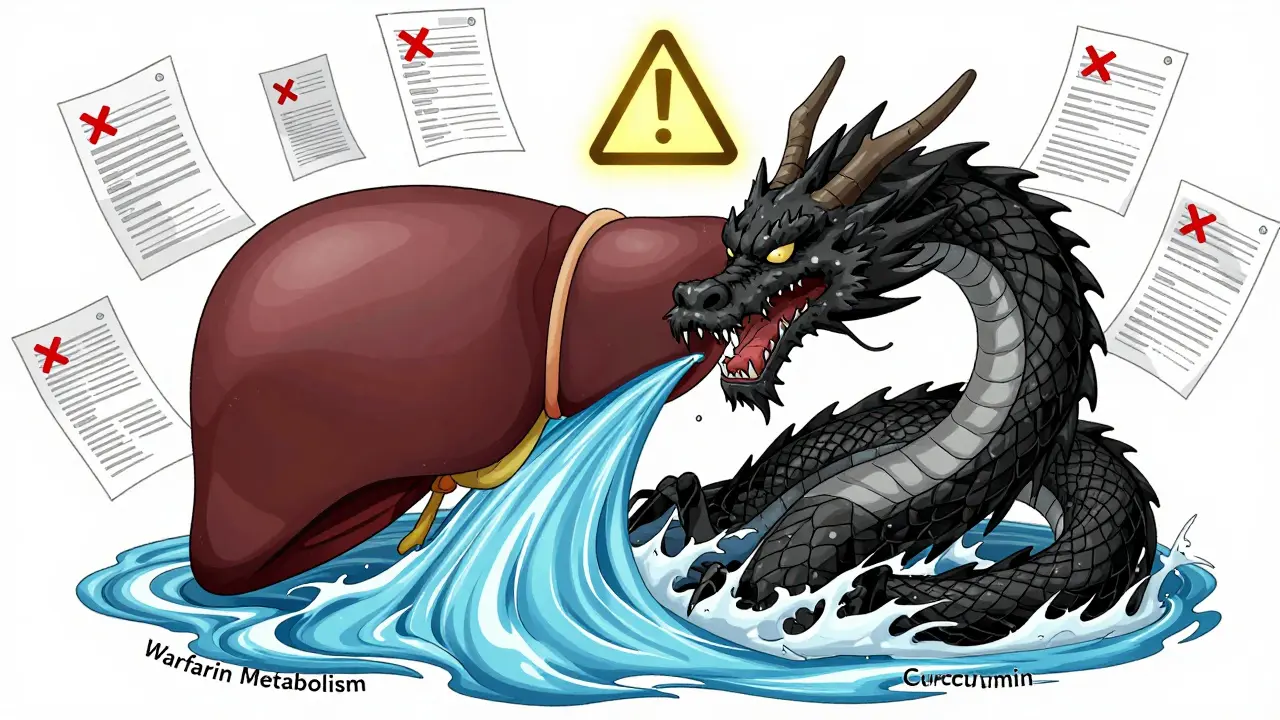
All blood thinners can interact, but some carry higher danger.- Warfarin (Coumadin): This is the biggest red flag. Warfarin has a narrow therapeutic window. A tiny change in dose or metabolism can send your INR into the danger zone. Curcumin doesn't just add to its effect-it can block how your body clears it from your system. That's why the WMIC updated their guidance in October 2024 to say curcumin "might decrease the clearance of warfarin."
- DOACs (rivaroxaban, apixaban, dabigatran): These newer drugs are often seen as "safer," but turmeric still interferes. The British Heart Foundation explicitly warns that high-dose curcumin could interact with these too.
- Aspirin, clopidogrel (Plavix), NSAIDs: These aren't just for pain. They're antiplatelet agents. Turmeric does the same thing. Combine them, and you're stacking up effects. That's not synergy-it's overload.
The Mayo Clinic Health System, Healthline, and Medsafe all agree: turmeric supplements can dangerously enhance the effects of these drugs. The result? Bleeding that's harder to stop. Bruising you didn't notice. Nosebleeds that won't quit. Blood in your urine or stool. In worst cases-brain hemorrhage.
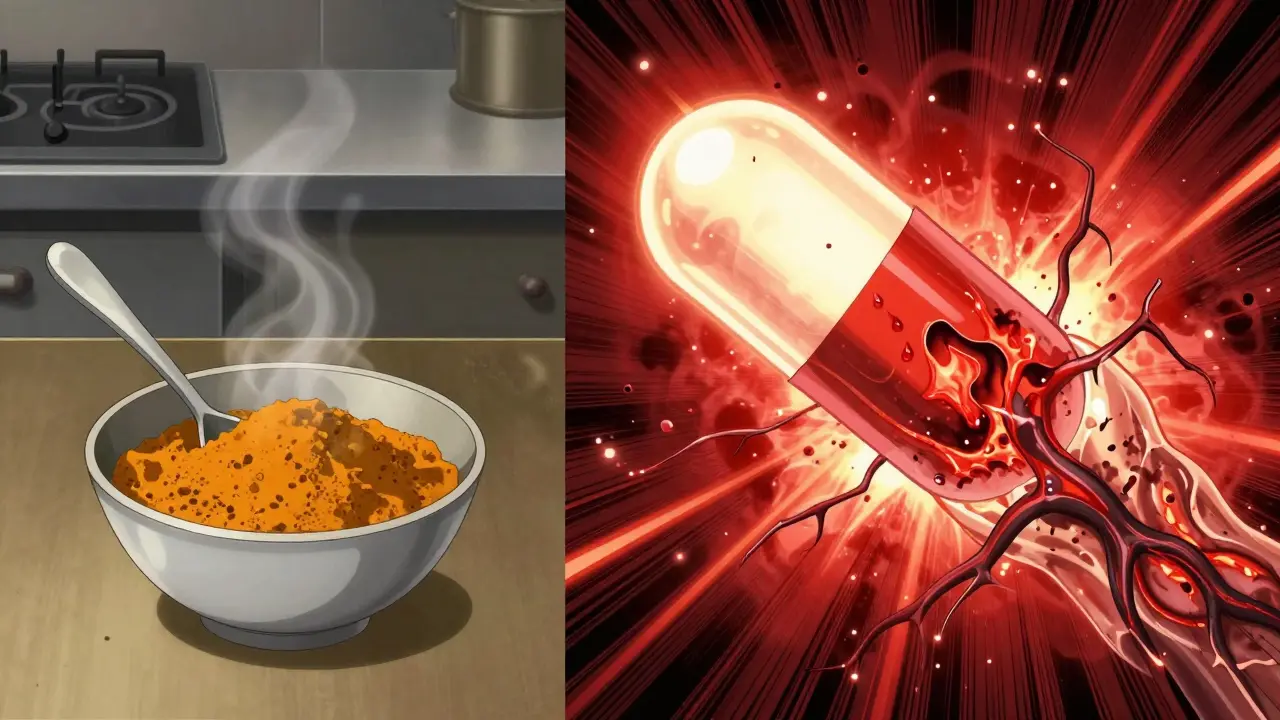
Why Supplements Are Worse Than Spices
Eating turmeric in food? A pinch in your curry or golden milk? The risk is low. You're not getting enough curcumin to trigger a measurable effect.But supplements? That's a different story.
One capsule might contain 500mg of curcumin. A teaspoon of turmeric powder? Maybe 20mg. That's a 25-fold difference. And supplements aren't regulated like drugs. One brand's "500mg curcumin" might actually be 120mg. Another might be laced with fillers or other herbs. There's no standardization. No testing. No guarantee.
And here's the silent risk: many people don't even tell their doctors they're taking supplements. They think it's harmless. Or they forget. Or they assume their doctor "knows." But doctors don't automatically ask about turmeric. They ask about prescriptions. Not powders.
What You Should Do
If you're on a blood thinner:- Stop taking turmeric supplements immediately. This isn't a "maybe." It's a clear medical warning from multiple health authorities.
- Don't assume "natural" is safe. Turmeric is a potent bioactive compound. It interacts with your liver enzymes, your clotting factors, and your kidneys. It's not a vitamin.
- Inform your doctor. If you've been taking turmeric, tell them. Even if you stopped last year. They need to know your history.
- Get your INR checked. If you're on warfarin and have taken turmeric recently, your doctor should test your INR right away.
- Wait two weeks before surgery. The Mayo Clinic recommends stopping turmeric supplements at least two weeks before any procedure. Bleeding risk doesn't vanish overnight.
And if you're thinking about starting turmeric for joint pain, inflammation, or "detox"? Don't. Talk to your doctor first. There are safer, better-studied options. Your health isn't worth gambling on a spice.
What About Turmeric in Food?
Eating turmeric as a spice in meals? That's fine. A teaspoon or two in a curry, soup, or smoothie won't deliver enough curcumin to cause an interaction. The dose makes the poison.But if you're drinking turmeric lattes daily with a concentrated powder, or adding it to every meal in large amounts, you're crossing into supplement territory. You're not eating a spice-you're self-prescribing a drug.
Bottom Line
Turmeric isn't evil. It's not poison. But when you're on a blood thinner, it becomes a hidden danger. The science is clear. The case reports are real. The warnings from Medsafe, WMIC, and the Mayo Clinic aren't guesses-they're based on patients who bled dangerously because they didn't know.There's no safe middle ground here. If you're taking warfarin, clopidogrel, rivaroxaban, or any other anticoagulant, avoid turmeric supplements entirely. No exceptions. No "I'll take a little." One capsule could change your life-or end it.
When in doubt, assume it interacts. Always talk to your doctor before adding anything new to your routine. Your blood doesn't care if it's "natural." It only cares if it can clot.
Can I still use turmeric as a spice in cooking if I'm on blood thinners?
Yes, using turmeric as a spice in normal cooking amounts-like a teaspoon in curry or soup-is generally safe. The amount of curcumin you get from food is too low to significantly affect blood clotting. The real risk comes from concentrated supplements, powders, or extracts that deliver much higher doses.
How long does it take for turmeric to affect blood thinners?
Effects can show up in as little as a few days to a couple of weeks. In the documented case from Medsafe, a patient's INR rose from stable levels to over 10 within weeks of starting turmeric supplementation. Because the body's clotting system responds gradually, symptoms might not appear immediately, but the risk builds silently.
Is there a safe dose of curcumin if I'm on warfarin?
There is no established safe dose of curcumin for people taking warfarin or other blood thinners. Even small amounts in supplements can interfere with drug metabolism and clotting. Because curcumin affects multiple pathways and supplement quality varies wildly, experts advise complete avoidance rather than trying to find a "safe" amount.
What should I do if I've already taken turmeric supplements while on blood thinners?
Stop taking the supplement immediately. Contact your doctor or pharmacist right away. They may need to check your INR (if you're on warfarin) or monitor for signs of bleeding like unusual bruising, nosebleeds, or dark stools. Do not wait for symptoms to appear-by then, it may be too late.
Are there safer alternatives to turmeric for reducing inflammation?
Yes. Omega-3 fatty acids from fish oil (in medically approved doses), ginger (in normal culinary amounts), and regular physical activity are better-studied and safer options. Always check with your doctor before starting any new supplement, even ones considered "mild."
Don't risk your health because something sounds natural. Blood thinners are precise tools. Turmeric supplements are wild cards. Keep them apart.
Ethan Zeeb
March 5, 2026 AT 06:09My dad was on warfarin for AFib. Started taking turmeric capsules because his buddy said it "reduces inflammation." Two weeks later, he blacked out in the shower. Turned out his INR was 11.5. ICU for three days. They had to reverse it with plasma. He's lucky he didn't bleed out. This isn't a "maybe." It's a death sentence waiting for a label.
Stop pretending "natural" means safe. Turmeric is a drug. And you're not the first idiot to think otherwise.
Darren Torpey
March 5, 2026 AT 09:35Man, I wish I'd seen this before I started my "golden milk" habit. I've been drinking two cups a day for six months. My wife keeps telling me I'm bruising like a banana. I thought it was just aging. Now I'm terrified. I just tossed the whole jar. No more "wellness" nonsense. My blood doesn't need a rave party.
Thanks for the wake-up call. This is the kind of info that should be on every supplement bottle. Not just buried in fine print.
Jane Ryan Ryder
March 6, 2026 AT 18:52Oh wow. A medical article that doesn't sound like a pharmaceutical ad. Who'da thunk it?
Guess what? Your "natural" turmeric is just a poorly regulated knockoff of rivaroxaban. And you're the dumbass who paid for it.
Next time, try not to be a walking clinical trial. Just sayin'.
PS: I'm not a doctor. But I play one on Reddit.
Chris Beckman
March 7, 2026 AT 09:52So like... I read this and I'm like okay but what about the 2019 study from UCLA where they said curcumin was safe with low dose warfarin? I think they had like 400 people? I'm pretty sure I saw it on a blog. I saved the link but my computer crashed. Anyway, I think it's fine if you take like one capsule a day. My cousin's neighbor's dog took it and lived. So yeah. Maybe it's chill.
Also, I don't trust doctors. They're just in it for the money. My naturopath says turmeric is holy water.
Also also, I take 4000mg a day. My knees feel great. So maybe this is just fearmongering. Just saying.
Richard Elric5111
March 7, 2026 AT 15:32The ontological dilemma posed by the confluence of phytochemical bioactivity and pharmacological anticoagulation warrants a hermeneutic unpacking of the epistemological boundaries between dietary supplementation and therapeutic intervention.
Curcumin, as a polyphenolic modulator of hepatic cytochrome P450 isoenzymes, particularly CYP2C9 and CYP3A4, exerts a non-linear, dose-dependent inhibition of warfarin metabolism, thereby elevating plasma concentration beyond the therapeutic window. This is not an interaction-it is a pharmacokinetic cascade.
The notion of "natural" as benign is a semantic fallacy rooted in Romantic idealism. Nature is indifferent. Hemorrhage does not discriminate between synthetic and botanical origin.
Therefore, the ethical imperative is not to question the science-but to interrogate the cultural episteme that equates botanical origin with safety.
- Richard Elric5111, PhD (Philosophy of Medicine)
Betsy Silverman
March 8, 2026 AT 12:38I’ve been on Plavix for my stent. My sister gave me a turmeric supplement for my arthritis. I took it for a month. I started getting nosebleeds every morning. I thought it was dry air. Then I read this post. I stopped it immediately. Nosebleeds stopped in three days.
Don’t wait for a hemorrhage to learn this lesson. I’m so glad I found this before it was too late.
Also-yes, you can still use turmeric in your curry. Just don’t turn your kitchen into a pharmacy.
Ivan Viktor
March 9, 2026 AT 15:34So let me get this straight. You’re telling me that a spice I’ve been putting in my rice for 30 years is now a deadly drug because someone decided to powder it and sell it for $29.99?
Yeah. I’ll stick to my curry. But I’m not touching those capsules. They look like something a cult would hand out at a solstice ritual.
Also, why is there no FDA warning on the bottle? Just saying.
Anyway, thanks for the heads-up. I’m not dying for a placebo.
Zacharia Reda
March 11, 2026 AT 13:52Big respect to whoever wrote this. This is the kind of post that saves lives.
I’m a nurse. I’ve seen two patients in the ER with INRs over 9 because of turmeric supplements. One was a 68-year-old grandma who thought "herbs are safe." She bled into her abdomen. Took 12 units of blood to stabilize her.
Don’t be that person.
And if you’re thinking "I’m healthy, I don’t need to worry"-you’re not. You’re just lucky so far. Luck runs out.
Stop. Talk to your doctor. Get your INR checked. It takes five minutes. It could save your life.
tatiana verdesoto
March 13, 2026 AT 10:38I’m so glad this exists. My mom is on warfarin. She’s been taking turmeric capsules for "joint pain" for two years. I didn’t know this was a thing. I just told her to stop. She cried. Said I was "taking away her natural healing."
I showed her the Medsafe report. She’s now terrified. We’re going to her doctor together tomorrow.
Thank you for putting this out there. People need to hear this from someone who cares, not just a cold medical article.
Jessica Chaloux
March 15, 2026 AT 01:39OMG I’m so scared 😭 I’ve been taking 1000mg daily for my RA. I’ve been bruising like crazy. I thought I was just clumsy. I just threw my bottle in the trash. I’m calling my doctor right now. I’m so dumb. I thought "natural" meant "no side effects." 😭😭😭
Thank you for saving me from myself.
Raman Kapri
March 15, 2026 AT 14:10Western medicine is obsessed with control. You take a drug, you get a number. You take a spice, you get a panic. This is not science-it is pharmaceutical colonization of traditional medicine.
Curcumin has been used safely for 5000 years in India. You think your INR is the only metric that matters?
Perhaps the problem is not turmeric-but your fragile, over-medicated system.
And why do you assume every supplement is equal? You don’t know the source. You don’t know the dose. You don’t know the context. You just fear what you don’t understand.
Tildi Fletes
March 16, 2026 AT 07:46As a clinical pharmacist specializing in anticoagulation therapy, I can confirm: curcumin inhibits CYP2C9 and P-glycoprotein, both critical for warfarin and DOAC clearance. The interaction is well-documented in the Journal of Clinical Pharmacology (2021), Annals of Pharmacotherapy (2020), and the American Journal of Health-System Pharmacy (2019).
There is no safe threshold. No "low dose" exemption. The variability in supplement bioavailability makes dosing unpredictable. Even 100mg of curcumin has been shown to elevate INR in sensitive individuals.
Stop self-experimenting. Your liver doesn’t care about your intentions. It only cares about the substrate.
Siri Elena
March 18, 2026 AT 01:05Oh honey. You didn’t just take turmeric. You took a one-way ticket to the ER. Did you also start drinking kombucha while on Eliquis? Because that’s basically the same level of "I have no idea what I’m doing."
"Natural" is just marketing with a leaf emoji. You wouldn’t put raw foxglove in your tea, would you? No? Then why are you putting 95% pure curcumin in your body?
Next time, maybe ask your doctor before turning your kitchen into a clinical trial.
Divya Mallick
March 19, 2026 AT 07:40THIS IS WHY WESTERN MEDICINE IS BROKEN. You reduce centuries of Ayurvedic wisdom into a single biomarker. INR? Please. Your blood doesn't live in a lab. It lives in your body. And your body knows what it needs.
My aunt in Jaipur has been on warfarin for 12 years. She takes 2 tsp of turmeric paste daily with honey. Her INR? Stable. Her joints? Pain-free. Her doctor? Proud of her.
So who are you to say it’s dangerous? You don’t know her. You don’t know her life. You don’t know her genetics.
This is cultural imperialism wrapped in a PubMed abstract.
Pankaj Gupta
March 20, 2026 AT 22:32I understand the concern. But blanket statements like "avoid all supplements" are unhelpful. There are individuals on stable anticoagulation who take low-dose curcumin without issue. The key is monitoring.
Instead of fear, we need education: test INR before and after starting, track bruising, report symptoms. Not all patients are the same.
Also, many people use turmeric for arthritis because NSAIDs cause GI bleeding. Are we really saying we’d rather they take ibuprofen than turmeric?
Let’s replace panic with precision.