
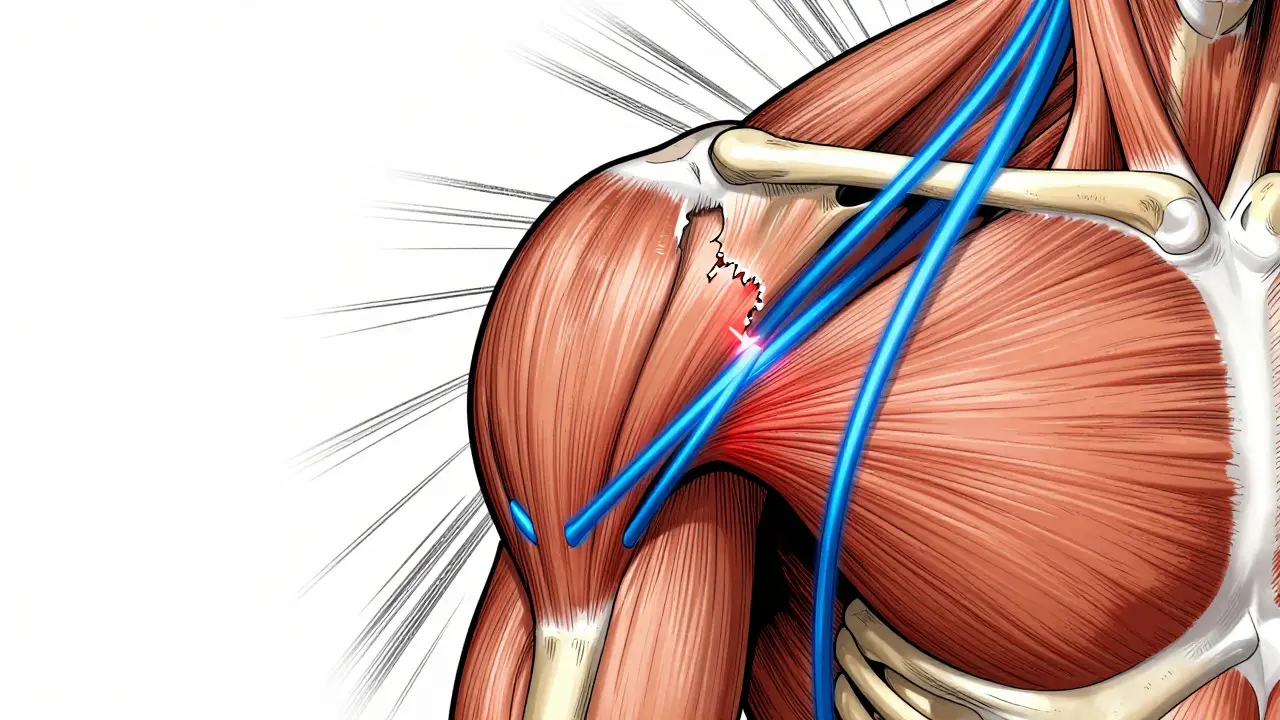
Shoulder pain is tricky. It can feel like a dull ache that won’t go away, or a sharp sting when you reach for your coffee mug. If that pain has persisted despite rest, you might be dealing with a rotator cuff tear, which is an injury to the group of four muscles and tendons that stabilize the shoulder joint. These injuries are incredibly common, affecting millions of people annually. In fact, about 250,000 surgical repairs are performed in the United States each year. But here is the good news: not every tear requires surgery. Understanding the path from diagnosis to recovery-whether that involves imaging, physical therapy, or an operation-is key to getting your life back.
Understanding the Rotator Cuff Anatomy
To understand the tear, you first need to know what is tearing. The rotator cuff isn't just one muscle; it is a team of four. These include the supraspinatus, infraspinatus, teres minor, and subscapularis. Think of them as the suspension cables on a bridge, keeping the head of your upper arm bone (the humerus) firmly seated in the shallow socket of your shoulder blade. When one of these tendons frays or snaps, stability goes out the window. This often leads to impingement, where the tendon gets pinched between bones, causing inflammation and pain.
Injuries can happen suddenly-a heavy lift gone wrong or a fall onto an outstretched hand-or they can develop slowly over time due to wear and tear. As we age, blood flow to these tendons decreases, making them more prone to degeneration. By age 60, studies show that more than half of asymptomatic individuals have some form of rotator cuff abnormality. So, having a tear on an image doesn't always mean it’s the source of your current pain. Context matters.
The Diagnostic Process: Physical Exams and Imaging
Your journey usually starts with a physical exam. Your doctor will check your range of motion and strength. They’ll likely perform specific tests like the Empty Can test or the Hawkins-Kennedy test to isolate shoulder pain. While X-rays are almost always taken first, remember this: X-rays show bone, not soft tissue. They are great for spotting arthritis or bone spurs that might be irritating the tendon, but they cannot see the tear itself.
This is where advanced imaging comes in. You have two main options: Magnetic Resonance Imaging (MRI) and Ultrasound. Both are effective, but they serve different purposes.
| Feature | MRI | Ultrasound |
|---|---|---|
| Accuracy for Full-Thickness Tears | 91-95% | 87-91% |
| Cost (Approximate) | $500-$1,200 | $200-$400 |
| Patient Comfort | Lower (confined space) | Higher (open environment) |
| Dynamic Assessment | No (static images) | Yes (real-time movement) |
| Contraindications | Metal implants, claustrophobia | None |
MRI remains the gold standard for detailed anatomical mapping. It uses proton density-weighted sequences to highlight tendon abnormalities with high contrast. If you are heading toward surgery, surgeons prefer MRI because it provides a complete "road map" of the shoulder, including any associated labral tears or bone issues. However, if you have metal implants or severe claustrophobia, MRI might not be an option. In those cases, expert ultrasonography is a powerful alternative. It allows the physician to watch the tendon move in real-time, which is invaluable for assessing dynamic impingement. Plus, it’s significantly cheaper and faster.
Conservative Treatment: Rehabilitation Protocols
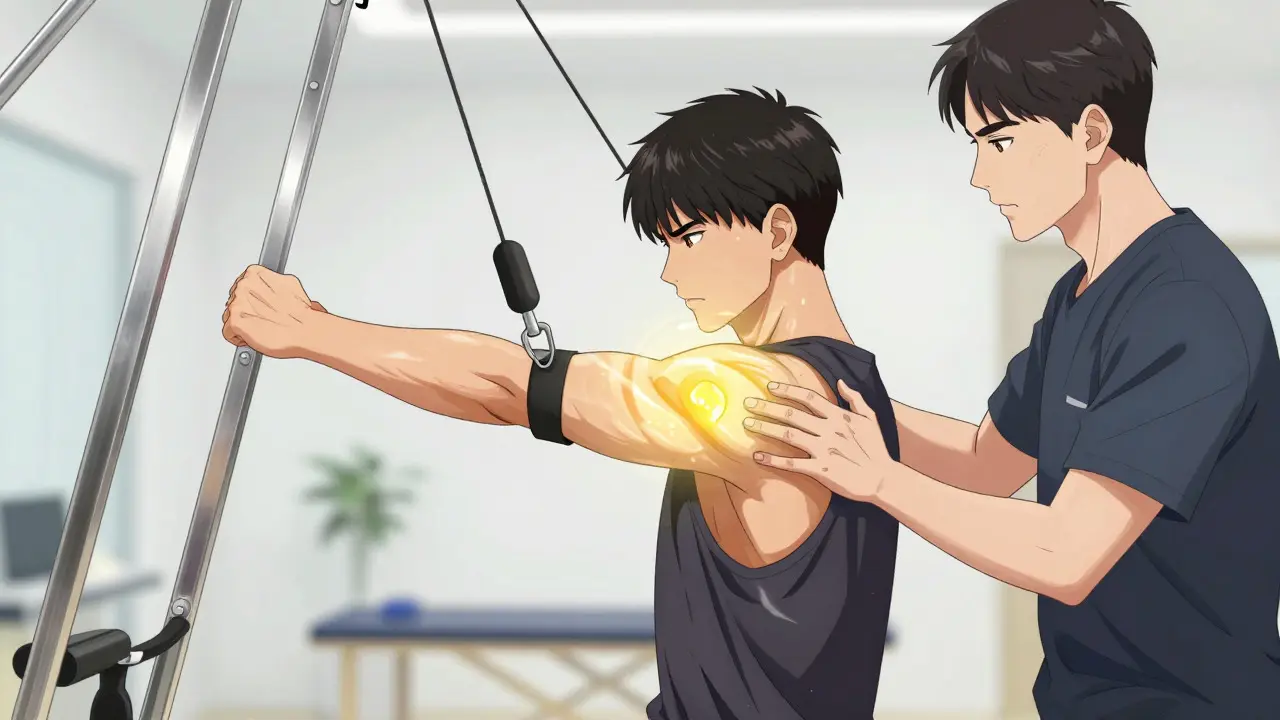
Before considering surgery, most guidelines recommend a trial of conservative management. For partial-thickness tears, especially in older or less active patients, structured rehabilitation alone can lead to functional recovery in up to 85% of cases. The goal here is not necessarily to heal the tear structurally, but to restore function and reduce pain by strengthening the surrounding muscles.
Rehabilitation typically follows a phased approach:
- Phase 1 (Weeks 1-6): Passive Range of Motion. During this initial stage, the focus is on preventing stiffness without stressing the healing tendon. A physical therapist moves your arm for you. You might use pendulum exercises or gentle stretching. The idea is to keep the joint lubricated while protecting the repair site.
- Phase 2 (Weeks 6-12): Active-Assisted Exercises. Now you start helping your own arm move. You might use a pulley system or a cane to lift your arm, gradually taking more control. Light resistance bands may be introduced to begin re-engaging the rotator cuff muscles.
- Phase 3 (After Week 12): Strengthening. Once the tendon has healed sufficiently, the focus shifts to building strength. This includes external rotation exercises, scapular stabilization drills, and progressive resistance training. The aim is to return to daily activities and sports-specific movements.
Consistency is crucial here. Skipping sessions or pushing too hard too soon can derail progress. Work closely with your physical therapist to ensure you’re doing the exercises correctly. Poor form can strain other parts of the shoulder, leading to new problems.
Surgical Options: Arthroscopic vs. Open Repair
If conservative treatment fails after 6-8 weeks, or if you have a large, full-thickness tear and are young and active, surgery might be the next step. The primary goal of surgery is to reattach the torn tendon to the bone so it can heal.
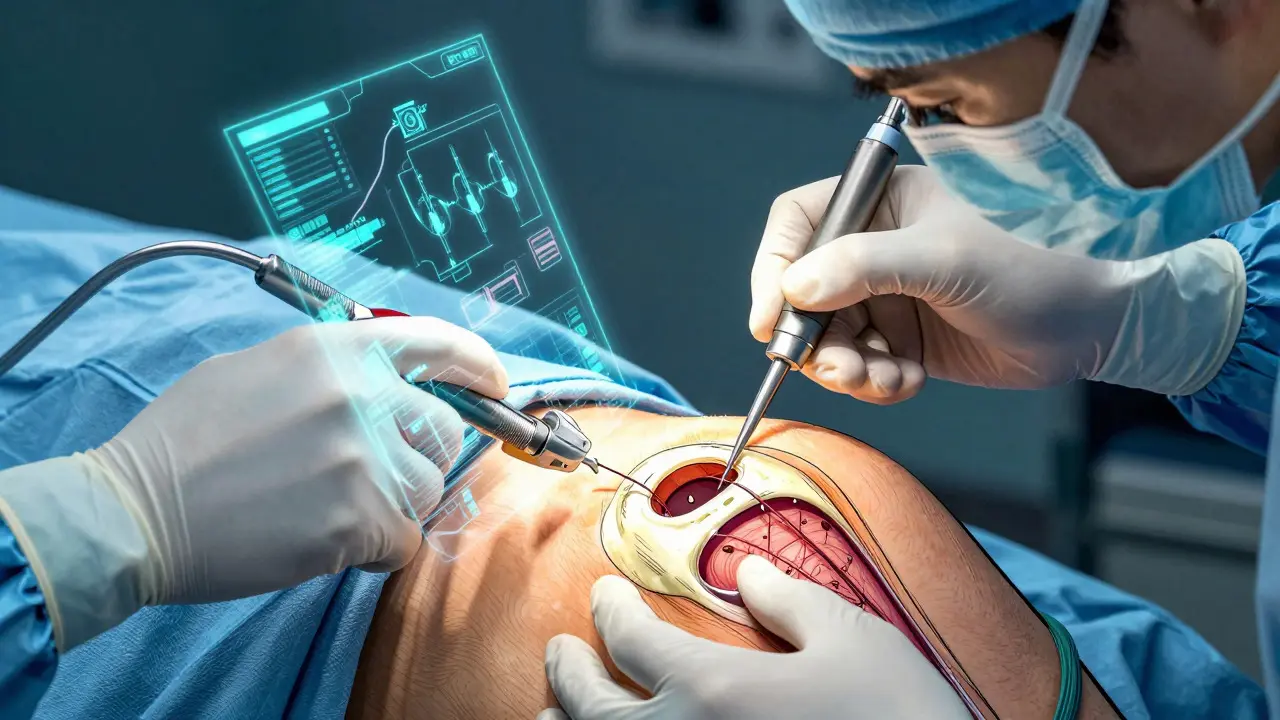
Today, arthroscopic surgery is the dominant method, accounting for about 90% of repairs. This minimally invasive technique involves small incisions and a camera, allowing the surgeon to visualize the inside of the shoulder on a monitor. Benefits include less post-operative pain, lower complication rates (around 7.2% compared to 10.3% for open surgery), and a faster return to daily activities. Recovery time has also decreased significantly, dropping from 6-12 months with traditional open surgery to 4-6 months with modern arthroscopic approaches.
Mini-open repairs are another option, combining arthroscopy with a small incision to directly visualize the tendon. Traditional open surgery is rarely used now, reserved for complex revisions or massive tears requiring extensive reconstruction. Emerging techniques, such as patch augmentation for massive tears, are showing promise in cases where the tendon is too retracted or degraded for a simple repair.
Post-Operative Recovery and Long-Term Outlook
Surgery is just the beginning. Post-operative rehabilitation is critical for success. Modern protocols allow for earlier passive motion, starting immediately after surgery rather than waiting weeks. This helps prevent frozen shoulder, a common complication. However, protecting the repair is paramount. You’ll likely wear a sling for several weeks to limit movement while the tendon heals to the bone.
Long-term outcomes are generally positive. Studies show an 82% patient satisfaction rate at five years post-arthroscopic repair. However, retear rates are a reality. Small tears (<1cm) have a low retear risk of around 12%, while large tears (>3cm) face a much higher risk of up to 27%. Factors like smoking, diabetes, and poor bone quality can negatively impact healing. That’s why following your surgeon’s advice on lifestyle modifications is just as important as doing your exercises.
Emerging therapies like platelet-rich plasma (PRP) injections are being explored as adjunctive treatments. While some patients report benefits, evidence remains mixed. A 2021 Cochrane Review found only moderate support for PRP efficacy, so it’s not yet considered a standard of care. Similarly, machine learning algorithms are being tested to improve diagnostic accuracy on MRIs, potentially helping doctors distinguish between partial and full-thickness tears with greater precision.
Frequently Asked Questions
How long does it take to recover from rotator cuff surgery?
Recovery varies based on the size of the tear and the surgical technique. With modern arthroscopic repair, most patients return to activities of daily living within 4 to 6 months. Full strength and return to heavy labor or overhead sports may take 6 to 12 months. Consistent participation in physical therapy is essential for meeting these timelines.
Is MRI better than ultrasound for diagnosing a rotator cuff tear?
Both are highly accurate. MRI provides a more comprehensive view of the entire shoulder anatomy, making it ideal for surgical planning. Ultrasound is excellent for dynamic assessment, is less expensive, and has no contraindications like metal implants. For many patients, ultrasound is a sufficient first-line diagnostic tool, especially if surgery is not immediately planned.
Can a rotator cuff tear heal without surgery?
Yes, particularly for partial-thickness tears or in less active individuals. Structured physical therapy can strengthen surrounding muscles and compensate for the tear, leading to significant pain relief and functional improvement in up to 85% of cases. Surgery is typically reserved for full-thickness tears in active patients or those who fail conservative treatment.
What are the risks of rotator cuff repair surgery?
Common risks include infection, stiffness, and nerve injury, though these are rare with arthroscopic techniques. The most significant concern is retearing of the tendon, which occurs in about 12% of small tears and up to 27% of large tears. Smoking and diabetes increase these risks.
When should I see a doctor for shoulder pain?
You should seek medical attention if shoulder pain persists for more than a few weeks, prevents you from sleeping, or significantly limits your range of motion. Sudden weakness or inability to lift your arm after an injury warrants immediate evaluation to rule out a acute tear or fracture.