

Getting a generic medication approved isn’t just about filling a prescription. For providers, it’s a daily grind of paperwork, phone calls, and digital portals - all to get a $5 drug covered so a patient can actually take it. In 2025, generic medications are the backbone of affordable care, yet nearly 9 out of 10 commercial insurance plans still require prior authorization for at least some of them. Why? Because insurers aren’t just trying to stop overuse - they’re trying to control which generic version gets prescribed, how much is dispensed, and for how long.
Why Do Generics Need Prior Authorization at All?
It sounds backwards. Generics are cheaper. They’re proven. They’re everywhere. So why do providers still have to jump through hoops just to get a patient’s omeprazole or metformin approved? The answer isn’t about safety. It’s about money - and control. Insurance companies and pharmacy benefit managers (PBMs) use prior authorization to steer patients toward the cheapest version of a drug on their formulary. If a plan prefers Teva’s generic lisinopril over Mylan’s, they’ll block the Mylan version unless the provider explains why the patient needs it. Same with quantity: if the plan allows 30 tablets, but the patient needs 90 for a 90-day supply, you need approval. Or duration: proton pump inhibitors are often capped at 8 weeks unless you prove ongoing need. According to the American Medical Association, 28% of all prior authorization requests are for generic drugs. That’s not because they’re risky - it’s because there are so many options. And insurers want you to pick the one they pay the least for.The Step-by-Step Process: What Providers Actually Do
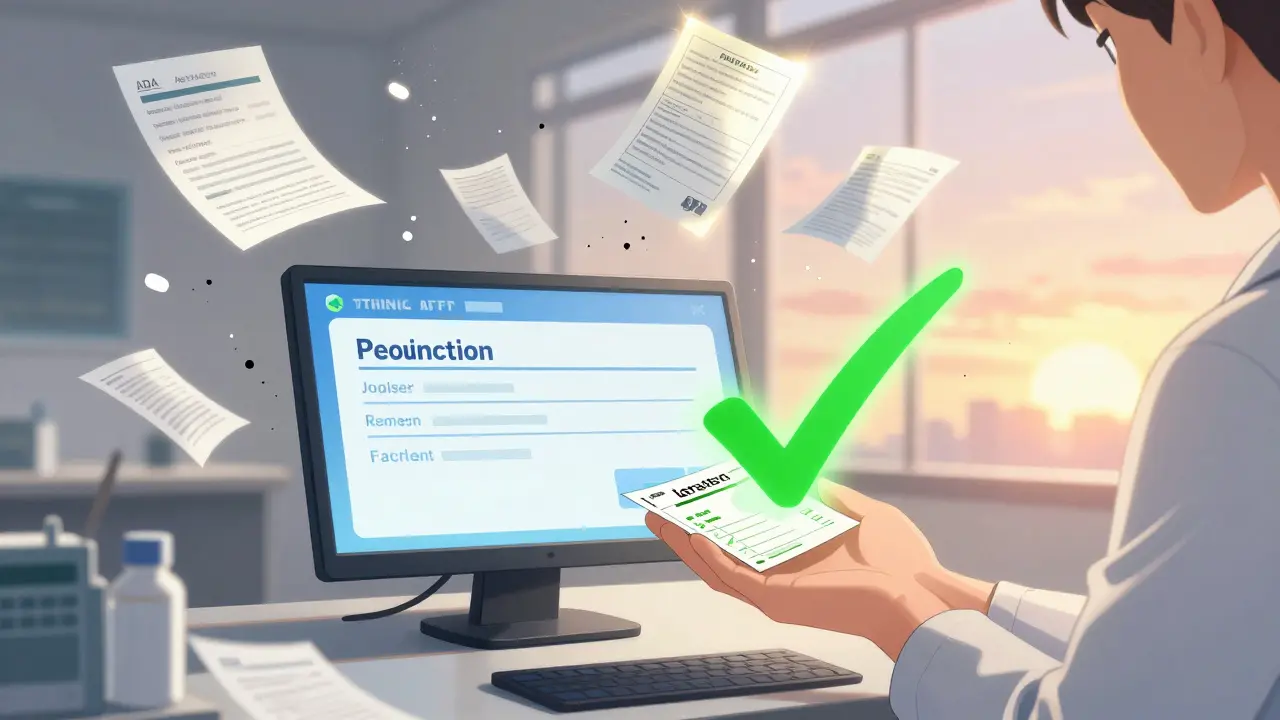
Here’s how it works on the ground:- Identify the restriction. Check the plan’s formulary. Is the generic you prescribed on the preferred list? Is there a quantity limit? A duration cap? If yes, you’re in prior auth territory.
- Gather documentation. This isn’t just a note. You need clinical proof: lab results, diagnostic reports, past treatment records. If a patient had an adverse reaction to the preferred generic, document it. If they’ve failed two other drugs, show the records. The Pennsylvania Department of Human Services says you need chart notes, test results, and anything that proves medical necessity.
- Submit electronically. Over 78% of commercial insurers and 63% of Medicare Part D plans now require electronic submission through platforms like CoverMyMeds or Surescripts. Fax is fading fast - and slower. Phone requests? Rare. And if you submit the wrong form? It gets denied.
- Wait. For urgent cases (like a patient about to stop insulin), Medicaid must respond in 24 hours. For non-urgent? Most commercial plans take 5-10 business days. But if your paperwork is incomplete? That clock resets.
- Appeal or switch. If denied, you can appeal - but that adds another 10-14 days. Or you can switch to the insurer’s preferred generic, if it’s safe. But if the patient has allergies or intolerances? You’re back to step one.
Auto-approvals happen in 41% of cases - when the quantity doesn’t exceed limits and the system recognizes past approvals. But that’s only if the system has clean data. And it often doesn’t.
How Long Does It Really Take?
Time matters. A patient waiting for approval can’t take their meds. A diabetic without metformin risks complications. A heart patient without lisinopril risks hospitalization. For generics, approval usually takes 1-3 business days - faster than brand-name drugs, which can take up to a week. But that’s only if everything’s perfect. If the insurer asks for more info? It jumps to 7-14 days. And 56% of providers say they’ve had to give a short-term bridge prescription just to keep a patient stable while waiting. MGMA data shows that 68% of practices get approvals in 1-3 days when documentation is complete. But 89% of providers say documentation requirements vary wildly between payers. One insurer wants a lab result. Another wants a signed letter. Another won’t accept anything but a specific form they mailed out in 2021.
What Gets Denied - And Why
Denial rates for generic prior authorizations average 18.7%. The top three reasons?- Lack of required documentation (42%) - Missing lab results, incomplete forms, no diagnosis code.
- Failure to demonstrate medical necessity (38%) - The insurer says, “Why not use the preferred generic?” without considering the patient’s history.
- Failure to try preferred alternative (20%) - Even if the patient had a bad reaction, some plans still demand they “fail” the preferred drug first.
One physician on Sermo shared a frustrating case: a patient with metformin intolerance needed sitagliptin. The insurer denied it because ADA guidelines said metformin intolerance was enough - but their internal policy still required three failed drugs. That’s not medical logic. That’s administrative rigidity.
What Works: Real Strategies Providers Use
Providers aren’t just waiting. They’re adapting.- Use templates. Capital Rx found that providers using standardized templates for common generics (like metformin, atorvastatin, omeprazole) get approvals 32% faster. A pre-filled note with common diagnoses, lab values, and prior drug failures cuts submission time in half.
- Build relationships. Call the payer’s medical director. Know who handles your claims. Ask: “What’s your most common reason for denying generic prior auth?” That insight changes how you write your notes.
- Train your team. Medical assistants handle 78% of routine prior auth requests under physician supervision. Give them training. Give them access to payer portals. Let them track submissions.
- Use tracking tools. If you submit on Monday and haven’t heard by Friday, follow up. Don’t wait. Use tools that send alerts when a request is pending beyond the expected window.
Dr. Michael Chen on Reddit got omeprazole approved in two days because he attached the endoscopy report showing Barrett’s esophagus. That’s the key: show the clinical reason, not just the prescription.
The Bigger Picture: Why This System Is Broken
Prior authorization for generics saves insurers $4.2 billion a year, according to CMS. But it costs providers $1.2 billion in administrative overhead by 2026, warns the Congressional Budget Office. Physicians spend 16.1 hours a week on prior auth. That’s nearly two full workdays. Time that could be spent with patients. Time that could prevent hospitalizations. And the system is getting worse. In 2019, 76% of commercial plans required prior auth for some generics. By 2024, that number jumped to 89%. PBMs are now restricting coverage by manufacturer - not just by drug. If your patient has been on Teva’s generic for years, but the plan switches to Mylan, you need a new prior auth - even if the drug is chemically identical. The American Medical Association is pushing for laws to ban prior auth for generics that have been on the market over five years with multiple manufacturers. That’s reasonable. If a drug has been used safely for years, why require paperwork?What’s Coming Next
The future is automation - and it’s already here.- AI-driven approvals. McKinsey predicts 75% of generic prior auth decisions will be handled by AI by 2026, cutting approval time to under 24 hours.
- Standardized electronic systems. As of July 2024, Medicaid managed care plans must use standardized electronic transactions. This should cut processing times by 25%.
- Auto-approve pathways. Express Scripts saw a 40% increase in auto-approved generic requests in 2023. If your quantity is within limits and the patient has no red flags? The system approves it automatically.
But tech alone won’t fix this. If the rules stay arbitrary, even AI will just be faster at denying care.
Bottom Line: What Providers Can Control
You can’t control the insurance rules. But you can control how you respond to them.- Document like your patient’s health depends on it - because it does.
- Use templates. Save time. Reduce errors.
- Know your payer’s policies. Call them. Ask questions.
- Train your team. Don’t be the only one handling prior auth.
- Push back when it’s unreasonable. Use clinical guidelines. Cite ADA, AAFP, AMCP.
Generics are the most cost-effective tool in medicine. But if we let bureaucracy stand between patients and their pills, we’re not saving money - we’re sacrificing care.
Do all insurance plans require prior authorization for generic medications?
No, not all plans require it - but most do. As of 2024, 93% of commercial insurance plans, 89% of Medicare Part D plans, and 67% of Medicaid fee-for-service programs require prior authorization for at least some generic medications. The requirement depends on the drug, the quantity, the duration, and whether the plan has preferred drug lists (PDLs) that restrict which generic manufacturer they cover.
How long does prior authorization for generics usually take?
Typically 1-3 business days if documentation is complete and submitted electronically. Medicaid must respond within 24 hours for urgent cases and 14 days for standard requests. Commercial insurers usually take 5-10 business days. If the request is incomplete or requires additional information, approval can take 7-14 days or longer.
Why is prior authorization denied for generic drugs?
The most common reasons are: lack of required documentation (42%), failure to demonstrate medical necessity (38%), and not trying the insurer’s preferred generic first (20%). Even if a patient has a documented allergy or intolerance, some insurers still require them to fail the preferred drug - which goes against clinical guidelines from groups like the American Academy of Family Physicians.
Can electronic systems speed up prior authorization for generics?
Yes. Electronic systems like CoverMyMeds and Surescripts reduce processing time by 35-50% compared to fax or phone. As of 2024, 87% of major PBMs offer electronic prior authorization. Auto-approval pathways are also increasing - 41% of generic prior auth requests are now auto-approved when quantity limits aren’t exceeded and documentation is complete.
What can providers do to improve approval rates for generics?
Use standardized documentation templates for common generics, train medical assistants to handle routine requests, maintain payer-specific checklists, submit electronically, and build direct relationships with payer representatives. Providers who use templates see approval times improve by 32%. Also, always include clinical evidence - lab results, diagnostic reports, or prior treatment failures - to prove medical necessity.
Are there any new laws changing how prior authorization works for generics?
Yes. The Improving Seniors’ Timely Access to Care Act of 2023 requires Medicare Advantage plans to respond to 90% of prior authorization requests within 72 hours for standard cases and 24 hours for urgent ones - effective January 2024. As of July 2024, Medicaid managed care plans must use standardized electronic prior authorization transactions. The AMA is also lobbying for state laws to ban prior auth for generics that have been on the market over five years with multiple manufacturers.
Providers aren’t just fighting paperwork - they’re fighting delays that hurt patient outcomes. The system is flawed, but it’s not unbeatable. With better documentation, smarter tools, and more advocacy, providers can cut through the noise and get patients the generics they need - quickly and safely.
Tarun Sharma
December 22, 2025 AT 18:45Generic prior authorization is a necessary evil in resource-constrained systems. While administrative burden is high, the cost containment rationale remains valid.
Jim Brown
December 22, 2025 AT 18:51One cannot help but ponder the metaphysical paradox at play: we have commodified health to such an extent that the very molecules designed to restore equilibrium are now subject to bureaucratic arbitration. The generic drug, a symbol of scientific democratization, has become a pawn in an economic game where human need is measured in formulary tiers and rebate structures. Is this not the apotheosis of late-stage capitalism? We have optimized for cost, yet sacrificed the sanctity of care.
Cara Hritz
December 24, 2025 AT 04:45why do insurace even do this?? i mean like, generics are like 5 dollars?? why are we still doing this?? i think its just because the pBMs are lazy and dont want to update their stupid databases??
Jamison Kissh
December 24, 2025 AT 18:34It’s fascinating how we’ve turned medical necessity into a puzzle solved by administrative compliance. The system doesn’t ask, ‘What does this patient need?’ It asks, ‘Which form did you forget?’ We’ve built an infrastructure that rewards diligence in paperwork over diligence in healing. And yet, providers still show up. That’s the quiet heroism of modern medicine.
Johnnie R. Bailey
December 26, 2025 AT 15:35As someone who’s worked in both rural clinics and urban hospitals, I’ve seen this play out in real time. The real tragedy isn’t the paperwork-it’s the patient who leaves without their meds because the system moved slower than their condition. Templates help, yes. But what we need is interoperability. One form. One portal. One standard. Not 37 different ones per insurer. And while AI will speed things up, it won’t fix the heart of the problem: we treat patients like claims, not people.
Nader Bsyouni
December 28, 2025 AT 09:51Anyone else notice how the AMA and CMS always say 'prior auth saves money' but never mention how many people die waiting for their metformin? This isn't cost control this is corporate feudalism and the providers are just serfs with stethoscopes
Herman Rousseau
December 28, 2025 AT 15:33Y’all are right - this system is broken 😔 But here’s the good news: change is coming! AI auto-approvals are skyrocketing, and more docs are using templates now. Keep pushing. Keep documenting. And if you’re tired? Take a breath. You’re doing vital work. 💪🩺
Vikrant Sura
December 29, 2025 AT 21:32Generic PA is just a distraction. Real healthcare reform would be cutting PBMs entirely. This whole thing is theater.
Ajay Brahmandam
December 30, 2025 AT 18:51Been doing this for 12 years. The templates saved my sanity. Also, calling the payer rep by name? Game changer. They’re people too, just stuck in the same system. A little kindness goes a long way. 🙏
jenny guachamboza
January 1, 2026 AT 14:47Y’all know this is all just a secret way for the government to track what meds you’re on right?? Like, they’re building a database of every person on metformin and soon they’ll know who’s diabetic and then what?? Next thing you know, your insurance rates go up because you ‘chose’ to be sick 😳💊 #BigPharmaIsWatching
Aliyu Sani
January 2, 2026 AT 09:29in Nigeria we just give the drug and charge cash. no forms. no portals. no PBMs. the system here is broken but at least the patient gets the pill. i think the american model is over-engineered for control not care.
Gabriella da Silva Mendes
January 3, 2026 AT 12:05Let me get this straight - we’re letting insurance companies decide who gets their life-saving meds? And you call this freedom? This is socialist healthcare gone wrong. If you want cheap drugs, go to Canada. But don’t tell me we need more bureaucracy in America - we need less government interference, not more! 🇺🇸💊 #AmericaFirst #StopTheBureaucracy