
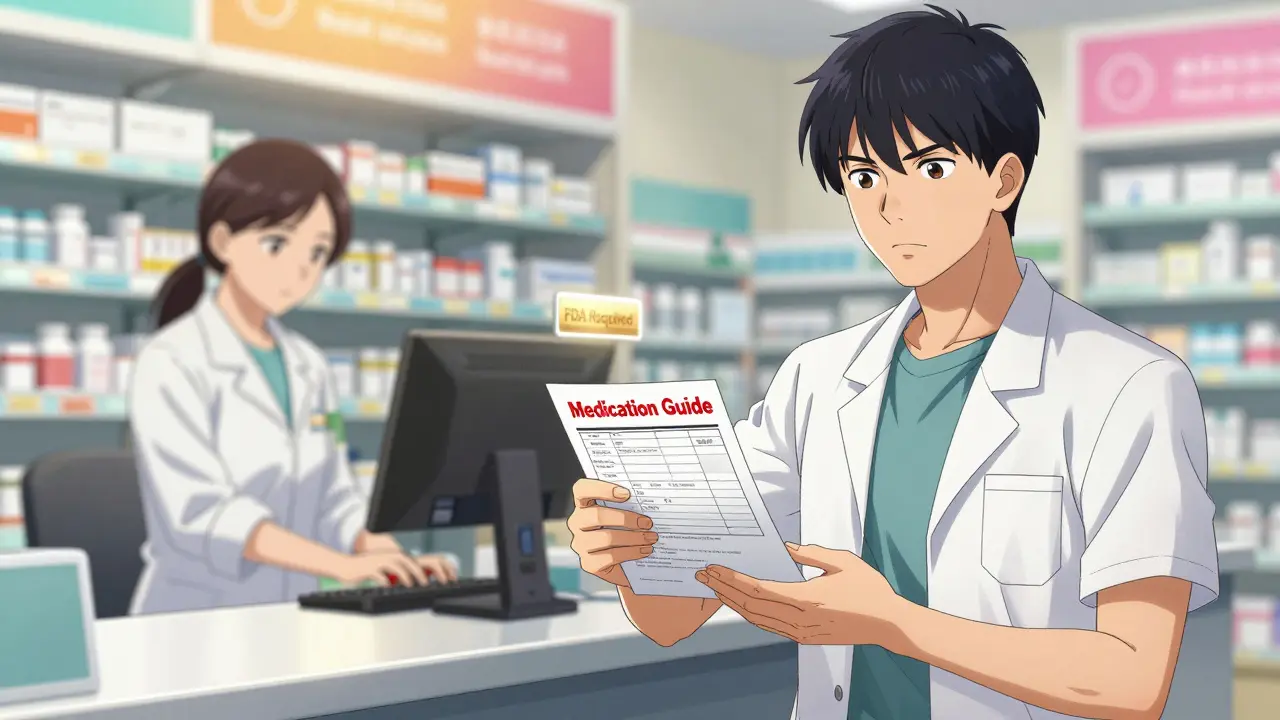
Medication Guide Eligibility Checker
Check Your Prescription Drug
Find out if your medication requires a FDA-mandated Medication Guide
What Are Medication Guides, and Why Do They Matter?
When you pick up a prescription, you might get a small paper insert with your medicine. That’s not just a leaflet-it’s a Medication Guide, a legally required safety document approved by the U.S. Food and Drug Administration (FDA). These aren’t optional. For about 150 prescription drugs-mostly those with serious risks like blood clots, liver damage, or dangerous interactions-the FDA says patients must get this information in writing. It’s meant to help you understand what could go wrong and what to watch for.
Unlike the standard pharmacy label, which lists dosage and side effects, Medication Guides focus on the big dangers: what symptoms mean trouble, when to call your doctor, and what not to mix with your drug. They’re written by the drug maker, reviewed by the FDA, and must follow strict rules: no marketing fluff, no tiny fonts, and the words "Medication Guide" must be clearly at the top. The guide must end with the exact phrase: "This Medication Guide has been approved by the U.S. Food and Drug Administration."
Your Legal Right to Get a Printed Copy
If your prescription requires a Medication Guide, you have the right to receive it-every time. The FDA’s rules (21 CFR §208.24) say pharmacists must hand you the printed guide at the time you get your medicine. Not when you ask. Not if you "remember to look for it." It’s part of the dispensing process.
But here’s the problem: many patients never get one. A 2022 survey by the National Consumers League found 43% of people who should have received a Medication Guide never got it. That’s not a mistake-it’s a violation. Pharmacists can’t skip this step because they’re busy, out of stock, or assume you "already know." If the drug requires a guide, you’re entitled to one.
And if you don’t get it? You can ask for it. Politely but firmly. Say: "This prescription requires a Medication Guide. I’d like a printed copy, please." If they say they don’t have it, ask if they can print it on the spot. Most chain pharmacies have digital systems that let them print guides instantly. Independent pharmacies should have access to them too-manufacturers are required by law to supply them.
You Can Request an Electronic Copy Instead
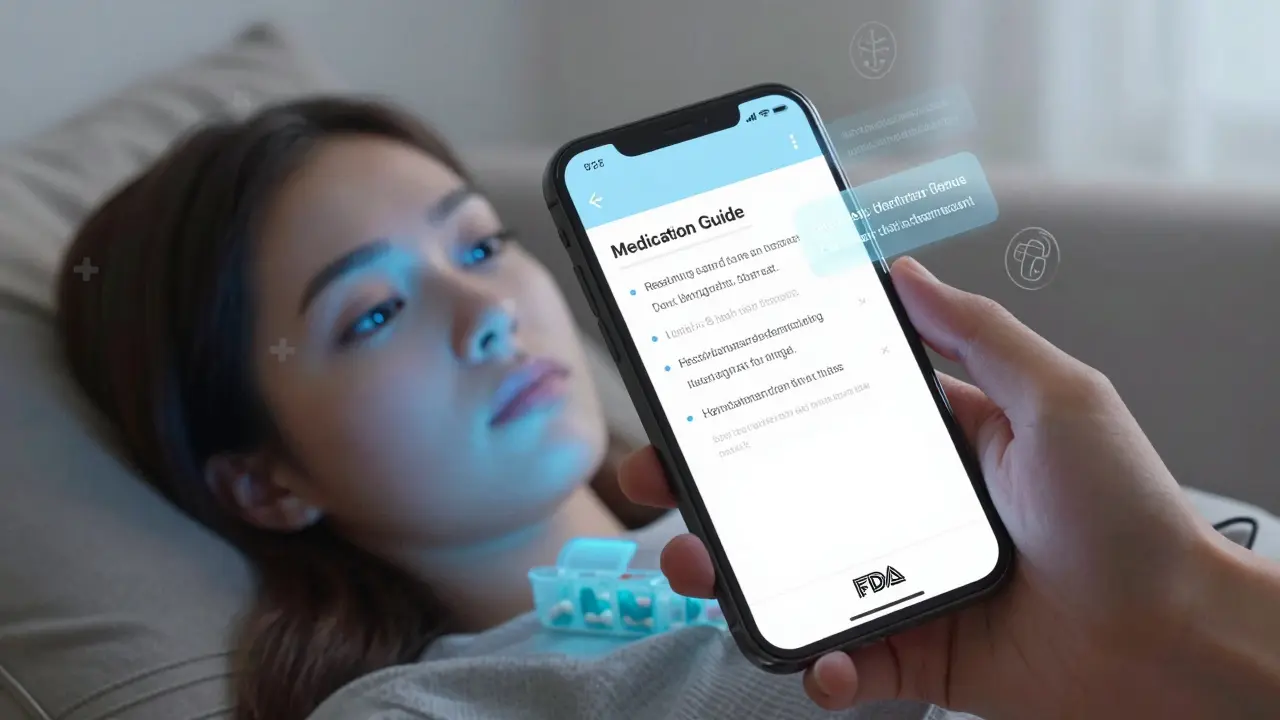
You don’t have to take a paper copy if you don’t want one. In May 2023, the FDA officially clarified that patients can choose to receive Medication Guides electronically. That means you can get it via email, text, or through your pharmacy’s app. Pharmacists can’t force you to take paper. They also can’t refuse to fill your prescription just because you prefer digital.
Some people like digital because they can save it, share it with family, or read it later on their phone. Others prefer paper because it’s easier to keep in a pill organizer or show to a doctor during an appointment. Either way, your choice matters. If your pharmacist says, "We only give paper copies," they’re wrong. The law changed. You have the right to pick.
Why Do So Many People Never Get Their Guides?
It’s not because pharmacists are ignoring the rules on purpose. It’s because the system is messy.
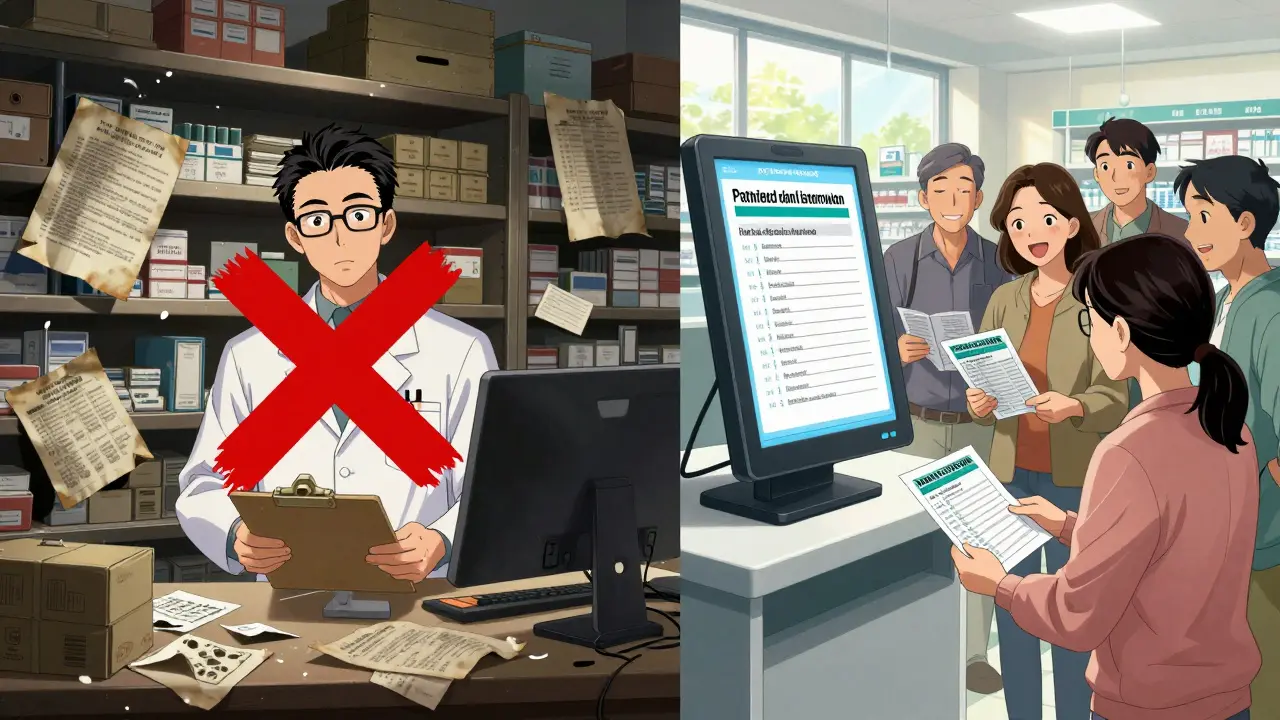
Pharmacies get Medication Guides in different ways: some from drug manufacturers, others through wholesalers, and many now via digital printing systems. But not all pharmacies track which prescriptions need which guides. A 2022 audit by the Department of Health and Human Services found that 31% of pharmacy sites had no reliable way to track guide distribution. Independent pharmacies, especially, struggle with outdated systems or limited supplies.
Time is another issue. Giving a patient a guide takes 15 to 20 seconds-time many pharmacists say they don’t have during lunch rush or weekend crowds. One pharmacist on Reddit said, "I’ve given out 200 guides this week. I know I missed 30 because I was swamped and forgot to check the list." That’s not negligence-it’s a broken workflow.
And even when patients get the guide, many don’t read it. A 2022 Pharmacy Times survey found 28% of people thought the guides were "not helpful at all," mostly because the font was too small, the language was too technical, or it repeated info they already saw on the label. The FDA itself admits this: a 2019 government report said inconsistent formatting makes guides hard to use.
What’s Changing Soon: The Move to Patient Medication Information (PMI)
The FDA isn’t just sticking with the old system. Starting in 2027, Medication Guides will be replaced by something new: Patient Medication Information (PMI).
PMI is a single-page, standardized format that will look the same no matter what drug you’re taking. It will use clear headings, bullet points, and plain language. No more confusing layouts. No more varying fonts. The goal? To make it easier to read and understand. FDA testing showed patients understood PMI 37% better than current guides.
This change is huge. It means pharmacies will need new software, new printers, and new training. The cost? Up to $600 million industry-wide. But for patients, it’s a win. You’ll get the same simple format every time-no more hunting through a 10-page booklet for the one warning that matters.
What to Do If You Don’t Get Your Guide
If you’re supposed to get a Medication Guide and you don’t, here’s what to do:
- Ask for it at the counter. Say: "This prescription requires a Medication Guide. Can I get a printed copy or an email link?"
- If they say they don’t have it, ask if they can print it. Most can.
- If they still refuse, ask for the pharmacy manager. Politely remind them it’s a federal requirement.
- If nothing changes, file a complaint with the FDA. You can do it online at fda.gov/medwatch. Include the drug name, pharmacy name, date, and what happened.
You don’t need to be aggressive. But you do need to be clear. Your safety matters.
Are Medication Guides Actually Helpful?
Some people think they’re just paper waste. But real stories prove otherwise.
Patients for Safer Drugs collected 347 testimonials. Of those, 78 people said the guide helped them avoid a bad reaction. One woman read her guide and realized she was taking a painkiller that could cause liver damage with her daily vitamin supplement. She called her doctor and switched. Another man noticed a warning about dizziness and stopped driving until he knew how the drug affected him.
These aren’t rare cases. They’re proof that when patients actually read the guide, it saves lives. The problem isn’t the guide-it’s that too many never get one, or they get one they can’t read.
Final Tips for Getting the Most Out of Your Medication Guide
- Always ask for it when you pick up a new prescription-don’t wait for it to be handed to you.
- If you get a paper copy, keep it with your pill organizer or in a folder with your medical records.
- If you get it digitally, save it to your phone or print a copy for your wallet.
- Read it before you take your first dose. Don’t wait until you feel sick.
- If something doesn’t make sense, call your pharmacist or doctor. Don’t guess.
The system isn’t perfect. But your right to this information is. Use it. Ask for it. Demand it. Because when it comes to your health, you’re not just a patient-you’re the most important person in the room.
Lisa Davies
December 15, 2025 AT 17:31RONALD Randolph
December 16, 2025 AT 08:11Christina Bischof
December 17, 2025 AT 20:13Jake Sinatra
December 19, 2025 AT 08:40Raj Kumar
December 20, 2025 AT 22:00Sai Nguyen
December 21, 2025 AT 22:46Melissa Taylor
December 23, 2025 AT 07:57John Brown
December 24, 2025 AT 00:05Jocelyn Lachapelle
December 25, 2025 AT 14:39Mike Nordby
December 26, 2025 AT 12:22John Samuel
December 27, 2025 AT 13:15