
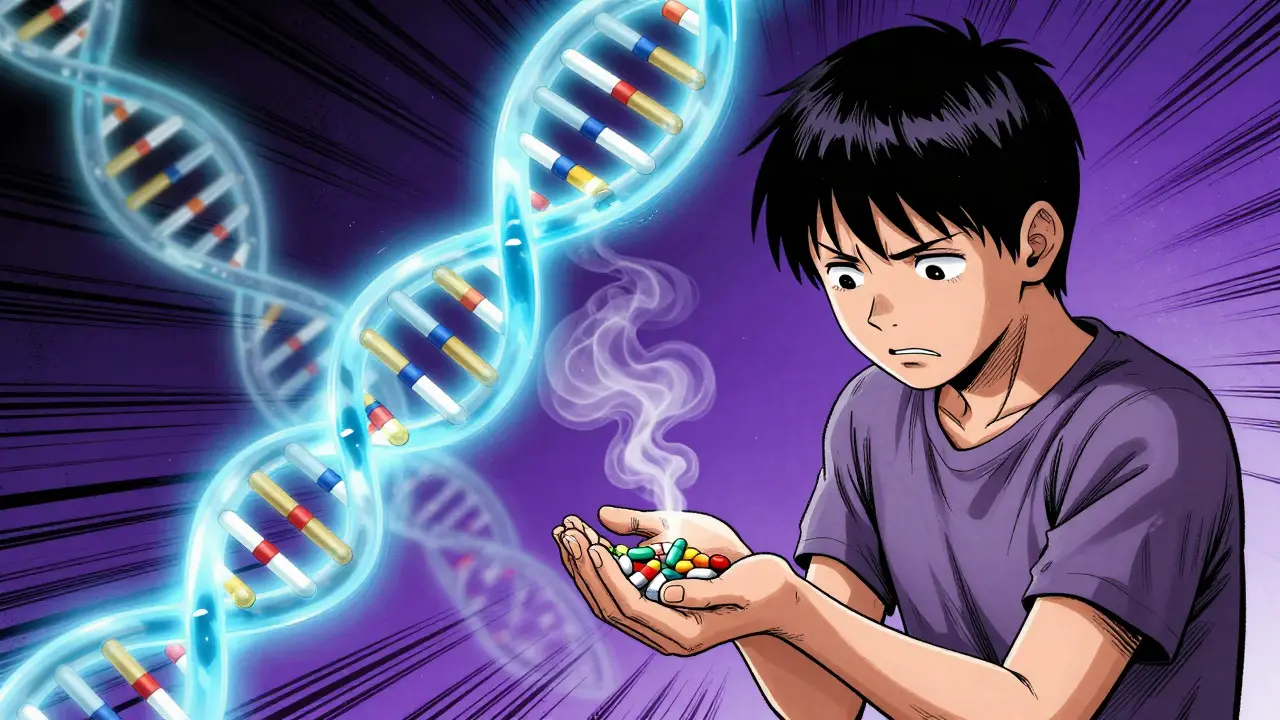
Pharmacogenomics Drug Response Simulator
Explore how your genetic makeup affects drug response. Select a metabolizer status and gene-drug pair to see personalized predictions based on clinical guidelines.
Step 1: Select Your Metabolizer Status
Your metabolizer status is determined by genetic variations in enzyme-producing genes. This affects how quickly your body processes medications.
Step 2: Select a Gene-Drug Pair
Choose a clinically significant gene-drug interaction to explore. These pairs have established CPIC guidelines for dosing recommendations.
Clopidogrel (Plavix)
Used after heart stents. Prodrug requiring activation by CYP2C19 enzyme.
Thiopurines (Azathioprine)
Chemotherapy and autoimmune treatment. TPMT deficiency causes severe toxicity.
SSRIs (Fluoxetine, Sertraline)
Common antidepressants. CYP2D6 variants significantly affect efficacy and side effects.
Simvastatin (Zocor)
Cholesterol medication. SLCO1B1 variants increase muscle damage risk.
5-Fluorouracil
Widely used chemotherapy agent. DPYD deficiency causes potentially fatal toxicity.
Warfarin (Coumadin)
Blood thinner. Genetic testing reduces time to therapeutic dose and bleeding events.
Have you ever taken a medication that felt like it did absolutely nothing? Or maybe you had such severe side effects from a standard dose that you couldn't finish the course? You are not alone. For decades, doctors have prescribed medications using a "one-size-fits-all" approach. But your body is not one size. It is unique. The reason that standard dose worked for your neighbor but failed for you likely comes down to your DNA.
This is where pharmacogenomics, or PGx, steps in. It is the study of how your specific genetic makeup changes the way your body processes drugs. By looking at your genes, healthcare providers can predict which medications will work best for you and which ones might cause harm. It moves medicine away from trial-and-error and toward precision.
How Your Genes Control Drug Metabolism
To understand pharmacogenomics, you first need to understand what happens when you swallow a pill. Your body doesn't just use the drug; it has to process it. This process is called drug metabolism. It involves four main steps: absorption, distribution, metabolism, and elimination. Most of the heavy lifting happens during the metabolism phase, where enzymes break the drug down so your body can use it or get rid of it.
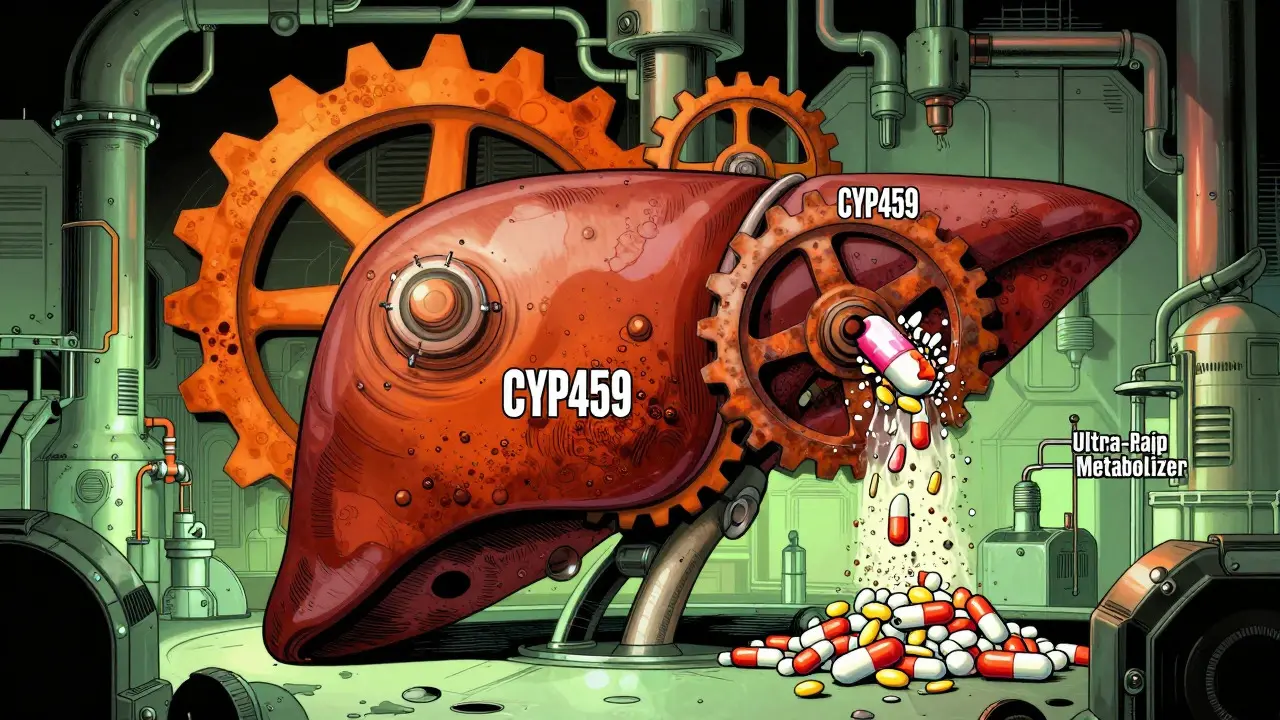
The key players here are enzymes. Specifically, a family of proteins known as cytochrome P450 enzymes, or CYP450. These enzymes are responsible for breaking down 70% to 80% of all commonly used medications. Think of them as the recycling plants of your body. If the plant works too fast, the drug gets destroyed before it can help you. If it works too slow, the drug builds up in your system, leading to toxicity.
Your genes provide the instructions for building these enzymes. But those instructions aren't identical for everyone. Small differences in your DNA, called genetic variations or polymorphisms, change how well your enzymes function. These variations determine your "metabolizer status." You generally fall into one of four categories:
- Poor Metabolizers: Your enzymes don't work well. Drugs stay in your system longer, increasing the risk of side effects.
- Intermediate Metabolizers: Your enzymes work slower than average. You may need a lower dose.
- Extensive (Normal) Metabolizers: Your enzymes work as expected. Standard doses usually work fine.
- Ultra-Rapid Metabolizers: Your enzymes work incredibly fast. The drug breaks down before it can do its job, making it ineffective.
For example, the enzyme CYP2D6 metabolizes about 25% of common drugs, including many antidepressants and painkillers. If you are an ultra-rapid metabolizer due to a gene duplication, a standard dose of codeine might turn into morphine so quickly in your liver that you could suffer respiratory depression. On the flip side, if you are a poor metabolizer, that same codeine might never convert to morphine, leaving you in pain with no relief.
Why Traditional Prescribing Falls Short
The traditional model of prescribing relies heavily on clinical trials. These trials test drugs on large groups of people to find an "average" effective dose. But averages don't account for individual biology. When a doctor prescribes a new medication, they often start with a standard dose and adjust based on how you react. This is the trial-and-error method.
This approach has significant downsides. First, it takes time. Switching medications because the first one didn't work or caused nausea can take weeks or months. During that time, your condition remains untreated. Second, it carries risk. Approximately 70% of adverse drug reactions (ADRs) in the United States are preventable. According to data from the Centers for Disease Control and Prevention, these preventable reactions lead to 1.3 million emergency department visits and 350,000 hospital admissions every year.
Consider warfarin, a blood thinner. Finding the right dose for warfarin is notoriously difficult. Without genetic testing, doctors often guess the starting dose. A study published in JAMA showed that incorporating genetic information for CYP2C9 and VKORC1 genes reduced the time to reach a safe therapeutic level by 2.3 days. More importantly, it decreased major bleeding events by 31% during the first month of treatment. That is a massive safety improvement that simply isn't possible with guessing.
Key Gene-Drug Pairs in Clinical Practice
While there are thousands of genes, only a few have clear, actionable guidelines for clinical use. The Clinical Pharmacogenetics Implementation Consortium (CPIC) publishes guidelines for specific gene-drug pairs. As of late 2023, they covered 24 pairs. Here are some of the most critical ones you should know about.
| Gene | Drug Class / Example | Impact of Variation |
|---|---|---|
| CYP2C19 | Clopidogrel (Plavix) | Poor metabolizers may not activate the drug, increasing heart attack risk. |
| TPMT | Thiopurines (Azathioprine) | Deficiency leads to life-threatening bone marrow suppression. |
| DPYD | 5-Fluorouracil (Chemotherapy) | Deficiency causes severe, potentially fatal toxicity. |
| SLCO1B1 | Simvastatin (Zocor) | Variants increase risk of muscle damage (myopathy). |
| CYP2D6 | SSRIs (Antidepressants) | Affects efficacy and side effect profile significantly. |
Take clopidogrel, a common antiplatelet drug used after heart stents. It is a prodrug, meaning it needs to be activated by the CYP2C19 enzyme to work. About 30% of people with a specific variant in this gene are poor metabolizers. For them, clopidogrel is essentially useless. The American College of Medical Genetics recommends testing for this gene before prescribing. Poor metabolizers who take clopidogrel have a much higher rate of major cardiac events compared to normal metabolizers.
Another critical example is TPMT (thiopurine S-methyltransferase). This enzyme helps break down thiopurine drugs used in chemotherapy and autoimmune diseases. If you lack this enzyme, the drug accumulates to toxic levels, destroying your bone marrow. Testing for TPMT deficiency is now standard practice before starting these therapies, preventing life-threatening complications in the small percentage of patients affected.
The Reality of Implementation Challenges
If pharmacogenomics is so beneficial, why isn't everyone doing it? The transition from research to routine care is complex. One major hurdle is cost and insurance coverage. Comprehensive PGx testing can cost between $250 and $500. While Medicare Advantage plans cover at least one PGx test in 87% of cases as of 2023, commercial insurers are lagging behind. Many patients face prior authorization delays or outright denials, creating frustration for both patients and providers.
There is also a knowledge gap among clinicians. Interpreting genetic results requires specialized training. Physicians need to understand not just the genetics, but how to apply that information to dosing decisions. Studies suggest doctors need 15-20 hours of specialized training to feel confident using PGx data. Furthermore, integrating this data into Electronic Health Records (EHRs) is technically difficult. Healthcare systems spend months and tens of thousands of dollars just to make sure the genetic alerts pop up correctly in the doctor's workflow.
Perhaps the most concerning issue is equity. Over 90% of pharmacogenomic research has been conducted in populations of European ancestry. This means the guidelines we have today may not apply accurately to people of African, Asian, or Hispanic descent. Genetic variants that affect drug metabolism differ across populations. Until more diverse data is collected, there is a risk that PGx will widen health disparities rather than close them.

What to Expect From a PGx Test
If your doctor suggests pharmacogenomic testing, the process is straightforward. It usually involves a simple cheek swab or a blood draw. There is no fasting required, and it is non-invasive. The sample is sent to a laboratory that uses next-generation sequencing to analyze dozens or even hundreds of pharmacogenes.
Turnaround times vary. Some labs offer rapid results within 24 to 48 hours, which is useful for acute situations like hospitalization. Others may take up to two weeks. Once the results are back, you will receive a report that categorizes your metabolizer status for various drug classes. Your pharmacist or doctor will then interpret this report to guide your prescription choices.
It is important to note that PGx testing is not a crystal ball. It does not tell you everything about how you will respond to a drug. Other factors, such as age, kidney function, liver health, and interactions with other medications, still play huge roles. PGx is one piece of the puzzle, not the whole picture. However, for high-risk medications like those listed in the CPIC guidelines, it is a powerful tool that can save time, reduce suffering, and prevent dangerous side effects.
The Future of Personalized Medicine
We are moving toward a future where pharmacogenomics is part of routine care. The concept of "pre-emptive testing" is gaining traction. Instead of waiting until you need a specific drug, you get tested once, perhaps at age 18 or during a routine checkup. Your results are stored in your medical record. Whenever a doctor prescribes a medication later in life, the system automatically checks your genetic profile against the drug and alerts them to potential issues.
Programs like Vanderbilt University's PREDICT project have already screened over 100,000 patients this way. They reported a 30% reduction in adverse drug reactions and significant cost savings. As technology improves and costs drop, this model could become the standard. The goal is to eliminate the guesswork entirely, ensuring that every pill you take is optimized for your unique biology.