
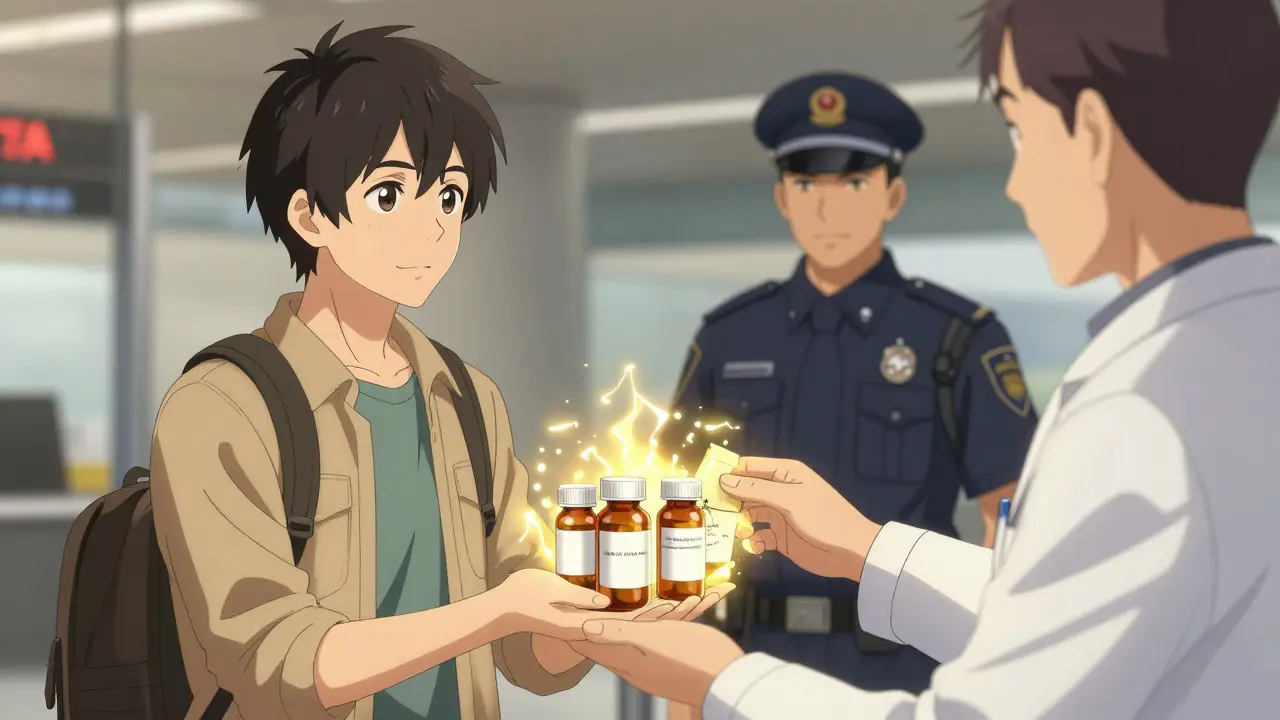
Traveling with medication isn’t just about throwing pills in a bag. One wrong move - like repacking insulin into a pill organizer or forgetting your prescription label - can mean a delayed flight, a confiscated dose, or even a medical emergency mid-trip. Millions of people fly with essential medications every year, and the rules have gotten clearer, but also more specific. If you’re flying with anything beyond basic painkillers, you need to know the exact protocols. This isn’t guesswork. It’s science, regulation, and real-world experience all rolled into one.
Original Containers Are Non-Negotiable
The TSA doesn’t just recommend keeping medications in their original pharmacy bottles - it requires it. Every pill, liquid, or injection must still have the full prescription label: patient name, drug name, dosage, prescriber, and pharmacy info. Why? Because repackaging can destroy the medication. Dr. Marcia Wyman, a pharmacist at Cleveland Clinic, found that transferring drugs into travel containers can cut potency by up to 30% in just three days due to moisture, light, or contamination. That’s not a small risk - it’s a health hazard.
One traveler on Reddit shared how their Humira auto-injector was turned away at LAX because they’d moved doses into a pill organizer. The TSA agent didn’t question their condition - they questioned the packaging. Original containers are your proof of legitimacy and your protection against degradation. Don’t risk it. Even if you’re carrying a 30-day supply, leave the blister packs and bottles as they came from the pharmacy.
Liquids Over 3.4 Ounces? You Can Bring Them - If You Declare
The 3.4-ounce (100 mL) liquid limit doesn’t apply to medically necessary medications. That includes insulin, liquid ADHD meds, seizure medications, or even oral steroids. You can bring a 120 mL bottle, a 200 mL vial, or even a full liter - if you tell security. But here’s the catch: you must declare it at the checkpoint. Don’t wait until they find it in your bag. Walk up, say, “I have liquid medication,” and have your prescription label ready.
The TSA has no upper limit on the amount, but the FAA caps carry-on liquid medications at 2,000 mL (67.6 ounces) without special approval. That’s more than enough for most travelers. A 2023 survey showed 63% of delays happened because people didn’t declare their meds or tried to hide them. Be upfront. Bring your prescription label. You’ll clear security faster than someone trying to sneak through.
Temperature-Sensitive Meds Need a Cold Chain
Insulin, biologics like Humira or Enbrel, some antibiotics, and even certain migraine treatments must stay between 2°C and 8°C (36°F-46°F). If they get too hot, they lose potency. If they get too cold - say, in a cargo hold at -40°C - they can crystallize and become useless.
Dr. David Cutler from Providence Saint John’s Health Center warns that freezing insulin doesn’t just make it less effective - it can permanently damage the protein structure. That means no more injections. No more control. Just a trip to a foreign pharmacy with no prescription.
Use a TSA-approved insulated cooler with frozen gel packs. The ice packs must be fully frozen when you go through security. If they’re slushy, they’ll be confiscated. Pre-freeze them 24 hours ahead. Pack them in a clear, zip-top bag. Declare them. TSA agents are trained to handle these. In 2023, 78% of medication-related screening interventions involved temperature-controlled items - and 90% were resolved when travelers had the right gear.
Injectables and Sharps: Know the Rules
If you use syringes, pens, or infusion pumps, you can bring them. But you must carry them with the medication they’re meant for. No loose needles. No extra syringes without a clear purpose.
The CDC requires sharps to be in a puncture-resistant container - like a dedicated sharps box or a sturdy plastic bottle with a screw-top. You can’t just toss them in your purse. At security, show the container. You may be asked to open it, but you won’t be denied. United Airlines reported a 42% rise in medication-related requests during summer months - many were from travelers who didn’t pack their sharps correctly.
Pro tip: Bring an extra needle or two in your carry-on. If your pen breaks mid-flight, you’ll be glad you did.

Documentation Is Your Backup Plan
Three documents make all the difference:
- Your current prescription label - on the original container.
- A doctor’s letter on letterhead - explaining why you need the meds, how much, and for what condition. No template. No email. Printed, signed, on official paper.
- Translated documentation - if you’re going overseas. Some countries, like Japan and the UAE, require it for even common drugs like pseudoephedrine. Give yourself 14 days to get it translated through a certified service like ATA Document Translation Network.
A traveler on TripAdvisor shared that her child’s liquid ADHD medication was cleared after she showed the prescription and a letter from her pediatrician. The TSA agent measured the bottle - 120 mL - and waved her through. No drama. Just paperwork.
International Rules Vary - Check Before You Go
What’s legal in the U.S. might be banned in Japan, restricted in Singapore, or require a permit in Germany. The European Medicines Agency allows 90-day supplies with proper docs. Many Asian countries cap it at 30 days. Japan limits pseudoephedrine to a 72-hour supply. The U.S. State Department updates its travel advisories quarterly - check their site before booking.
Since January 2023, 187 countries have mutual recognition agreements for medical documentation through ICAO. That means if your doctor’s letter meets U.S. standards, it’s more likely to be accepted abroad. But don’t assume. Always verify. A 2024 update showed 68 countries changed their rules since 2022 to better handle biologic medications. You can’t rely on old info.
Digital Passports Are Here - And They Work
Since June 2023, the TSA has partnered with MyMediTravel to offer a digital medication passport. It’s a blockchain-verified profile that stores your meds, prescriptions, and doctor’s notes. Over 127,000 travelers have used it. The clearance rate? 99.2%. You can scan a QR code at security. No paper. No delays.
It’s not mandatory - but if you fly often, it’s worth it. You can set it up in minutes on their app. Link your pharmacy, upload your doctor’s letter, and you’re done. It’s especially helpful for international trips where language and paperwork are barriers.

Time Zones and Medication Schedules
Jumping five or more time zones? Don’t just take your pills at the same clock time. Your body’s rhythm shifts. Taking a blood pressure med at 8 a.m. your time but 11 p.m. local time could cause dizziness or worse.
The American Academy of Sleep Medicine recommends adjusting your schedule gradually. Shift your dose by 15-30 minutes each day for 3-5 days before you leave. For example, if you take a pill at 7 a.m. and are flying to Tokyo (15-hour difference), start taking it at 7:30 a.m., then 8 a.m., then 8:30 a.m. over a few days. That way, when you land, your body is already synced.
What to Do Before You Leave
Here’s your checklist - do this 72 hours before your flight:
- Verify all meds are in original containers with labels.
- Pre-freeze gel packs for 24 hours if carrying temperature-sensitive meds.
- Print your doctor’s letter on official letterhead.
- Get translations if traveling overseas - start 14 days ahead.
- Test your cooler: put ice packs inside, seal it, leave it for 6 hours. If it’s still cold, you’re good.
- Bring an extra dose of each med in your carry-on.
- Arrive 2 hours early for domestic, 3 hours for international.
What Airlines Are Doing Now
United Airlines installed in-flight refrigeration units on all 787 Dreamliners as of January 2024. These maintain 2-8°C for up to 18 hours. If you’re flying one of these planes, you can ask the crew to store your meds in the onboard cooler - no need to carry it yourself.
The FAA is proposing a rule by 2026 that will require all U.S. airlines to provide temperature-controlled storage for medically necessary medications. It’s not law yet - but it’s coming. And it’s a sign that the system is finally catching up to real medical needs.
Final Word: It’s Not Just About Rules - It’s About Safety
Packing meds for air travel isn’t about bureaucracy. It’s about keeping you alive. A broken insulin vial. A lost ADHD dose. A crystallized biologic. These aren’t hypotheticals. They happen. Every day. And they’re preventable.
You’ve done the hard part - managing your health. Now do the easy part: pack smart. Original containers. Declared liquids. Frozen packs. Doctor’s letter. Digital passport if you can. Arrive early. Ask questions. You’re not a hassle. You’re a traveler with a medical need - and the system is built to support you.
Can I pack my medications in checked luggage?
It’s not recommended. Cargo holds can reach -40°C (-40°F), which can ruin insulin and other protein-based drugs. Temperature fluctuations can also degrade pills, liquids, and inhalers. Always carry essential medications in your carry-on. If you must check a supply, only do so for non-critical, non-temperature-sensitive items like vitamins or over-the-counter pain relievers.
Do I need a doctor’s letter for every medication?
No - but you should have one for any controlled substance, biologic, injectable, or liquid medication over 3.4 ounces. A letter from your doctor on official letterhead, explaining your condition and need for the medication, prevents delays. TSA agents are trained to accept these. It’s not required for aspirin or antihistamines, but for anything prescription-based, it’s your best insurance.
Can I bring my pet’s medication on a flight?
Yes - but it’s treated differently. Pet meds must be in original containers with the pet’s name and your name on the label. You must declare them at security. The same rules apply: liquids over 3.4 oz are allowed if medically necessary, and temperature-sensitive meds need proper cooling. Bring a vet’s note if possible. Some airlines require advance notice - check with them before you fly.
What if my medication isn’t available abroad?
Always bring more than you need - at least a 10% extra supply. Some countries ban certain drugs, even if they’re legal at home. For example, pseudoephedrine is restricted in Japan and the UAE. If you’re traveling long-term, contact a local pharmacy ahead of time. Many U.S. pharmacies can ship prescriptions overseas if you have a valid prescription and documentation. Never assume you can refill abroad without planning.
Do I need to inform the airline about my medications?
You don’t need to tell them before you arrive - but you should. If you use oxygen, insulin pumps, or other medical devices, notify the airline at check-in. They can help with seating, storage, or emergency protocols. United Airlines, for example, has trained staff on Dreamliners who can assist with refrigerated storage. It’s not required, but it makes your trip smoother.
Namrata Goyal
March 25, 2026 AT 07:12Kevin Y.
March 26, 2026 AT 08:14Korn Deno
March 27, 2026 AT 22:15Aaron Sims
March 29, 2026 AT 19:21Natasha Rodríguez Lara
March 30, 2026 AT 15:48Linda Foster
March 31, 2026 AT 03:45Rama Rish
April 1, 2026 AT 14:09Kevin Siewe
April 2, 2026 AT 02:13Chris Farley
April 4, 2026 AT 02:09Darlene Gomez
April 4, 2026 AT 23:31Katie Putbrese
April 5, 2026 AT 04:50Amber Gray
April 6, 2026 AT 14:12Danielle Arnold
April 8, 2026 AT 13:46Donna Fogelsong
April 8, 2026 AT 16:25Sean Bechtelheimer
April 9, 2026 AT 10:27