

Antibiotic-Antacid Spacing Calculator
Calculate Safe Spacing
Ensure your antibiotics work properly by spacing your antacid use correctly. The right timing can make the difference between effective treatment and relapse.
Recommended Timing
The safest time to take your antacid based on your medication
When you’re dealing with heartburn and an infection at the same time, it’s easy to grab an antacid while taking your antibiotic. But doing that without timing it right can make your antibiotic useless. You might not feel any worse. Your stomach might even feel better. But the infection? It’s still there-and now it’s getting stronger.
Why Antacids Fight Your Antibiotics
OTC antacids like Tums, Maalox, and Mylanta work by neutralizing stomach acid. That’s great for quick relief. But they contain metal ions-aluminum, magnesium, calcium-that bind tightly to certain antibiotics. This binding turns the antibiotic into a solid lump your body can’t absorb. Instead of entering your bloodstream, it just passes through your gut and ends up in the toilet. This isn’t theory. It’s been proven in labs and clinics since the 1970s. Studies show tetracycline absorption drops by 70-90% when taken with aluminum-based antacids. Ciprofloxacin? It loses up to 75% of its effectiveness. Even doxycycline and levofloxacin see big drops. The result? Antibiotic levels in your blood fall below what’s needed to kill bacteria.Which Antibiotics Are Most Affected?
Not all antibiotics are equally vulnerable. Some are hit hard. Others barely notice antacids. Here’s what the data says:- Tetracycline: Absorption drops by 70-90% with aluminum or magnesium antacids. This one is the most sensitive.
- Ciprofloxacin: Bioavailability falls from 70% to just 15-25% when taken with antacids. A single Tums can ruin your treatment.
- Doxycycline: Still affected, but less than tetracycline. Absorption drops 30-50%.
- Levofloxacin: 25-40% reduction. You’re still at risk.
- Amoxicillin: Mixed results. Some studies show a small 18-22% drop with aluminum-magnesium antacids. Others show no real effect, especially with amoxicillin-clavulanate.
- Penicillins, cephalosporins: Generally safe. No major interaction reported.
That’s why your doctor doesn’t just say “take your antibiotic.” They need to know exactly which one you’re on. If it’s ciprofloxacin or tetracycline, antacids are a hard no unless timed perfectly.
What About Other Acid Reducers?
You might think, “Why not just switch to omeprazole or famotidine?” That’s smarter than using antacids. PPIs and H2 blockers don’t contain metal ions, so they don’t bind to antibiotics. They work differently-slowing acid production instead of neutralizing it on the spot. But here’s the catch: they take longer to work. Antacids relieve heartburn in under five minutes. PPIs take hours. If you’re in pain right now, waiting isn’t an option. That’s why people keep reaching for Tums. But if you’re on antibiotics, that convenience comes at a cost.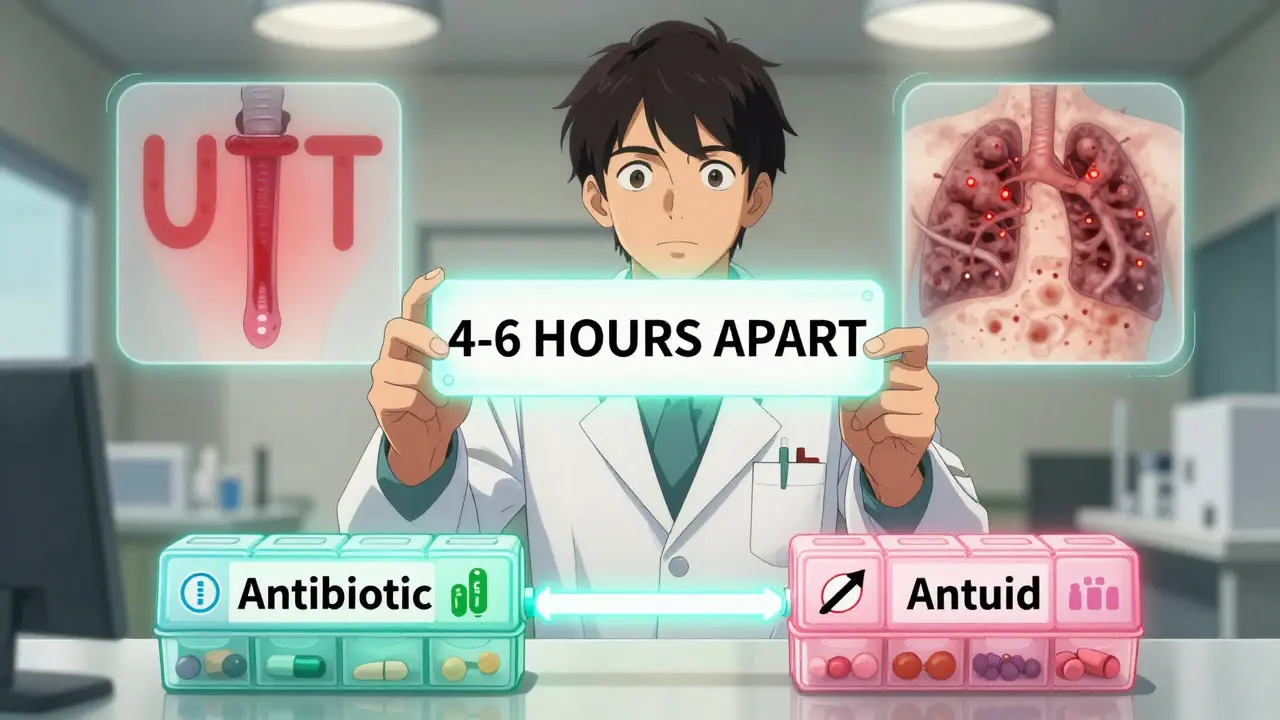
The Real-World Cost of Mixing Them
It’s not just about feeling worse. It’s about treatment failure. A 2023 meta-analysis found that when antibiotics and antacids were taken together without proper spacing, infection treatment failed 37% more often. That means:- Urinary tract infections that don’t clear up
- Pneumonia that comes back
- Skin infections that spread
One case from University Hospitals involved a patient with recurring UTIs. Three courses of ciprofloxacin failed. Each time, the bacteria came back. Only after the patient admitted to taking Tums daily for acid reflux did the doctor realize the problem. Once they spaced out the antacid by six hours, the infection cleared on the fourth try.
Reddit’s r/pharmacy has over 47 patient stories of similar failures. Most didn’t know antacids could interfere. They thought, “I’m just taking a little something for my stomach.”
How to Take Them Right
Timing isn’t optional. It’s the difference between healing and relapse. Here’s what works:- For tetracycline: Take the antibiotic at least 2 hours before or 4 hours after the antacid.
- For ciprofloxacin, levofloxacin: Separate by 4-6 hours. Don’t cut corners.
- For doxycycline: Aim for 2-3 hours apart.
- For amoxicillin: If you must use antacids, 2 hours apart is safe-but it’s still better to avoid them.
Don’t rely on memory. Set an alarm. Write it down. Use a pill organizer with labeled times. If you take your antibiotic at 8 a.m., don’t reach for Tums until after 2 p.m. (or even later for fluoroquinolones).
Who’s at Highest Risk?
This isn’t just a “be careful” issue. Some people are far more likely to get caught in this trap:- Elderly patients: Often on multiple meds, forget timing, and use antacids daily.
- People with GERD: Take antacids multiple times a day-hard to avoid overlap.
- Those on long-term antibiotics: Like for acne or chronic infections.
- Patients who buy OTC meds without asking: 68% of antacid users don’t know about the interaction, according to a 2022 survey.
Pharmacists see this every day. In fact, the American Pharmacists Association ranked antacid-antibiotic interactions as the #3 most common OTC-prescription drug conflict in 2023. That’s more than grapefruit juice, more than calcium supplements with thyroid meds.

What Can You Do Instead?
You don’t have to suffer with heartburn while on antibiotics. Here are safer options:- Switch to famotidine (Pepcid): It’s available OTC. No metal ions. Safe with antibiotics. Takes 30-60 minutes to work, but lasts longer.
- Try lifestyle changes: Avoid spicy food, caffeine, large meals before bed. Elevate your head while sleeping.
- Use antacids only when absolutely necessary: Don’t make them part of your daily routine while on antibiotics.
- Ask your doctor: Can you delay antacid use until after your antibiotic course? Sometimes, a few days of discomfort is worth avoiding treatment failure.
Why This Matters Beyond Your Stomach
Every time an antibiotic fails because of poor timing, it’s not just your body that suffers. Bacteria survive. They adapt. They become resistant. The CDC says antibiotic resistance causes over 35,000 deaths in the U.S. every year. Many of those deaths come from infections that should’ve been easy to treat. You’re not just risking your own health. You’re part of a bigger problem. A single missed timing window could mean the difference between a quick recovery and a long, expensive hospital stay.Bottom Line
Antacids aren’t harmless. When you’re on antibiotics like tetracycline or ciprofloxacin, they’re a silent saboteur. You’re not being careless-you’re just unaware. But now you know.Don’t take antacids at the same time as your antibiotic. Space them out by at least 2-6 hours, depending on the drug. Talk to your pharmacist. Ask your doctor if you can switch to a safer acid reducer. Your body will thank you. And so will the people around you-because every successful treatment helps slow the spread of superbugs.
Can I take Tums with amoxicillin?
Amoxicillin is less affected than tetracycline or ciprofloxacin, but studies show a small drop in absorption (18-22%) when taken with aluminum-magnesium antacids. It’s safer than other antibiotics, but still best to separate them by 2 hours. If possible, use famotidine instead.
How long should I wait after taking an antacid before taking my antibiotic?
For tetracyclines, wait at least 2 hours. For fluoroquinolones like ciprofloxacin, wait 4-6 hours. If you take your antibiotic in the morning, don’t take antacids until late afternoon or evening. Always check the specific drug’s guidelines.
Do all antacids interfere with antibiotics?
No. Antacids with aluminum, magnesium, or calcium are the main culprits. Sodium bicarbonate (like Alka-Seltzer) can also interfere, though less consistently. Antacids without these metals (rare) won’t cause this issue. Always check the active ingredients on the label.
What if I accidentally took them together?
If it was a one-time mistake, don’t panic. Skip your next antacid dose and resume spacing them out properly. Don’t double up on antibiotics. If you’re on a short course (like 5-7 days), you may still be okay. But if you’re on a long course or have a serious infection, contact your doctor. You might need a test to check if the antibiotic is working.
Can I use antacids after finishing my antibiotics?
Yes. Once your antibiotic course is complete, you can resume antacids as needed. The interaction only happens when both are in your system at the same time. After the antibiotic is fully cleared (usually within 24-48 hours after your last dose), antacids are safe again.
Arlene Mathison
January 20, 2026 AT 16:53Ugh, I just realized I’ve been taking Tums with my doxycycline for months. No wonder my acne never cleared up. I’m switching to Pepcid tomorrow-no more guessing games. Thanks for the wake-up call.
Also, setting alarms for meds? Genius. I’m printing out a schedule right now.
pragya mishra
January 20, 2026 AT 23:02You people are so naive. Big Pharma doesn’t want you to know this because antacids are more profitable than antibiotics. They bury the data, manipulate studies, and let people get sicker so they keep buying more pills. This isn’t science-it’s corporate control.
Why do you think they don’t put warning labels on Tums? Because they’re making billions off your ignorance.
Manoj Kumar Billigunta
January 21, 2026 AT 21:38Let me break this down simply for those who are overwhelmed. If you’re on antibiotics and have heartburn, don’t panic. Just separate the meds by a few hours. That’s it.
Antacids = fast relief. PPIs = slow but safe. Pick one. Don’t mix. Your body will thank you. And yes, this is basic pharmacy 101. We’ve known this since the 80s.
Also, if you’re elderly or on multiple meds, talk to your pharmacist. They’re paid to help you, not just hand out pills.
Andy Thompson
January 22, 2026 AT 17:59THIS IS A GOVERNMENT COVER-UP. Why do you think the FDA lets antacids be sold without big red warnings? Because they’re in bed with Big Pharma AND the calcium supplement industry. Tums is just a Trojan horse for mind control.
And don’t get me started on how they use this to justify more antibiotics → more resistance → more lockdowns. You think this is about stomach acid? Nah. It’s about population control.
Also, fluoride in water? Same playbook. Wake up.
🙏💊
sagar sanadi
January 24, 2026 AT 14:18Oh wow, so taking Tums with antibiotics is bad? Shocking. Next you’ll tell me water is wet and the sun rises in the east.
Meanwhile, my grandma takes Tums with every meal and her antibiotics like it’s a buffet. She’s 89 and still riding her bike. Maybe the real problem is overmedicating?
Also, who even uses ciprofloxacin anymore? That’s a 90s drug. Are we still living in the Bush era?
clifford hoang
January 25, 2026 AT 08:12This isn’t just about pharmacokinetics-it’s a metaphysical metaphor. The antacid represents the modern human’s desperate attempt to neutralize discomfort without confronting its root cause.
We numb the stomach. We numb the soul. We numb the planet. And then we wonder why everything collapses.
The antibiotic? That’s your spirit trying to fight back. But if you keep suppressing the fire with milk of magnesia, you’re not healing-you’re postponing the inevitable.
Also, the FDA is a puppet of the Illuminati. 🌌💊👁️
Paul Barnes
January 25, 2026 AT 10:59The article contains several grammatical errors and inconsistent punctuation. For example, the closing tag for the first paragraph is malformed:
appears twice. Also, "bioavailability falls from 70% to just 15-25%" lacks a citation for the source of that figure.Additionally, "Reddit’s r/pharmacy has over 47 patient stories" is not a valid data source. Anecdotes ≠ meta-analysis. This undermines the credibility of the entire piece.
thomas wall
January 25, 2026 AT 19:45It is profoundly disconcerting that such a fundamental pharmacological interaction remains so poorly understood by the general public. The casual disregard for timing protocols reflects a broader cultural decay in medical literacy.
One cannot expect to treat infections with precision while simultaneously indulging in the convenience of over-the-counter remedies without consequence. This is not merely a medical issue-it is a moral failure of personal responsibility.
Perhaps we should require a certification to purchase antacids, akin to purchasing pseudoephedrine. The stakes are too high to leave this to chance.
Art Gar
January 26, 2026 AT 11:17While the empirical data presented is statistically significant, the article’s conclusion assumes a binary relationship between antacid use and treatment failure, which oversimplifies the complex interplay of host factors, microbial load, and pharmacogenomic variability.
Moreover, the recommendation to "avoid antacids entirely" is not evidence-based for all patient populations, particularly those with severe GERD and concomitant antibiotic therapy. A risk-stratified approach is warranted.
Edith Brederode
January 27, 2026 AT 21:25Thank you for this! I’ve been on doxycycline for my acne and my stomach has been killing me. I was about to start taking Tums again… now I’m switching to Pepcid and sleeping with two pillows. 🙏❤️
Also, I printed the timing chart and taped it to my medicine cabinet. This is the kind of info everyone needs to see.
Greg Robertson
January 27, 2026 AT 21:49Hey, I just wanted to say I’ve been taking cipro and Tums together for weeks and felt fine. Maybe it’s not as bad as they say?
Just saying… I didn’t get sicker. Maybe some people are just less sensitive? I’m not trying to argue, just sharing my experience.
Renee Stringer
January 28, 2026 AT 15:11People who take antacids daily are just lazy. If you can’t handle a little heartburn, maybe you shouldn’t be eating junk food at midnight. This isn’t a medical emergency-it’s a lifestyle problem.
And now we’re giving out pamphlets about spacing pills? What’s next, a reminder to breathe?
Crystal August
January 28, 2026 AT 20:37Why are we even talking about this? Antacids are fine. Antibiotics are overprescribed anyway. The real problem is doctors who hand out prescriptions like candy.
Also, I’ve never heard of this interaction. Probably just fear-mongering to sell more PPIs.