
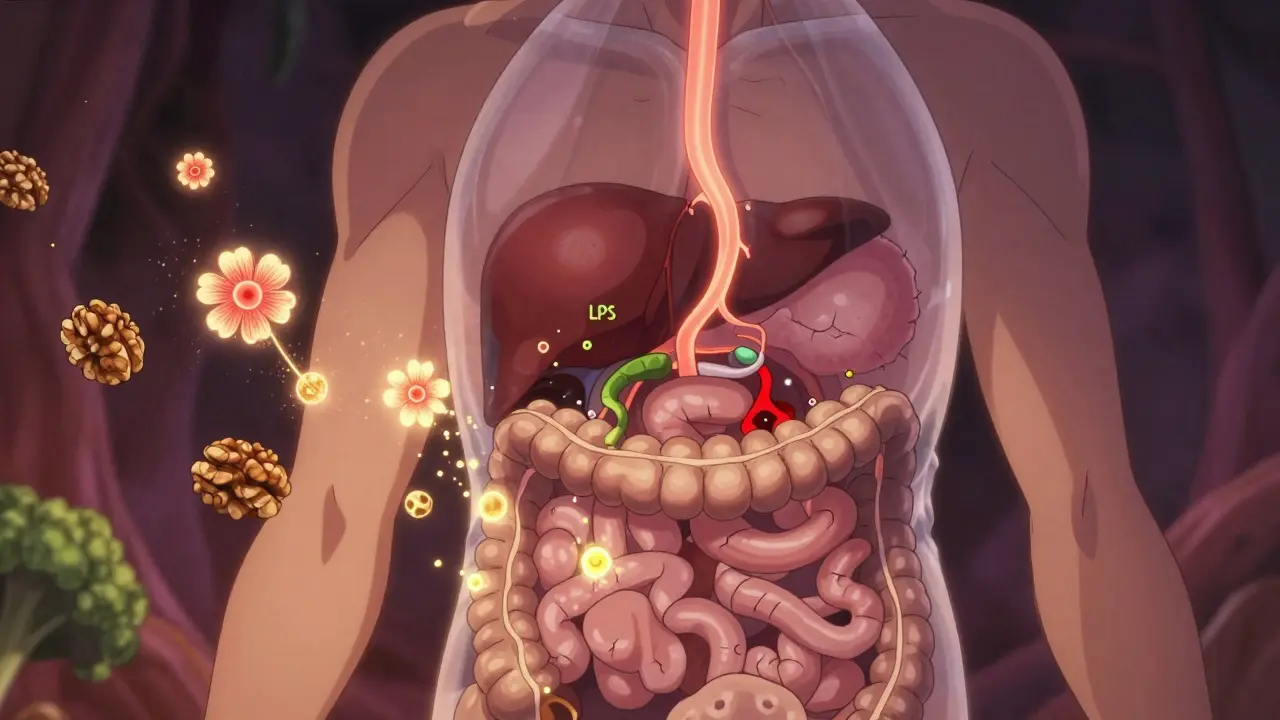
Nonalcoholic fatty liver disease (NAFLD) isn't just about fat in the liver-it's a signal that something deeper is wrong. Around one in three adults globally have it, and most don’t even know. The liver isn’t just storing fat; it’s reacting to what’s happening in your gut. When the gut lining gets damaged, toxins leak into the bloodstream and head straight to the liver, triggering inflammation, scarring, and eventually, serious liver damage. The good news? You can reverse it-not with a drug, but with food and weight loss.
How Your Gut and Liver Are Connected
Your gut and liver are linked by a direct highway: the portal vein. Every time you eat, nutrients-and sometimes harmful substances-travel from your intestines straight to your liver. Normally, your gut lining acts like a gatekeeper, letting good stuff through and blocking bad stuff. But in NAFLD, that gate breaks down. Studies show 90% of NAFLD patients have a leaky gut, letting bacterial toxins like LPS into the liver. That’s not a coincidence-it’s the engine behind the disease. LPS levels in NAFLD patients are over twice as high as in healthy people, and that constant trickle of toxin turns a fatty liver into an inflamed, scarred one.The bacteria in your gut play a huge role too. People with NAFLD don’t just have different gut bacteria-they have fewer kinds. Healthy guts have high diversity, but NAFLD patients show a drop in microbial richness. Some bad actors rise: Lachnospiraceae and Barnesiella are often overrepresented. Meanwhile, helpful bacteria like Bacteroides vulgatus decline. This imbalance doesn’t just change digestion-it changes how your body handles fat and sugar. Your gut microbes make short-chain fatty acids (SCFAs) like butyrate, which keep your gut lining strong and help your liver burn fat. But NAFLD patients have 58% less butyrate than healthy people. That’s like losing your liver’s natural defense system.
Why Weight Loss Works-And How Much You Really Need
Losing weight isn’t just about looking better. It’s the most powerful treatment we have for NAFLD. You don’t need to lose 50 pounds. 5-7% of your body weight is enough to cut liver fat by over 80% in most people. Go further-lose 10%-and you have a 45% chance of reversing NASH, the more serious form of the disease. That’s not theory. That’s from a 2023 meta-analysis of 17 studies involving thousands of patients.How do you get there? Calorie restriction is key. A daily deficit of 500-750 calories leads to a steady loss of 0.5-1 kg per week. That’s slow, but it’s sustainable. Crash diets don’t work-they often make liver inflammation worse. Combine it with exercise, and you double the benefit. One study found that people who dieted and walked 150 minutes a week cut their liver enzyme (ALT) levels by 28 units. Those who only dieted? Only 15 units. Movement helps your liver use fat for energy instead of storing it.
Real-world data from the Mayo Clinic shows people who followed a structured program with coaching lost more weight and kept it off. After two years, 68% of those with support still had improved liver health. Only 29% of those who tried alone did. Support matters. So does consistency. You don’t need to be perfect-just persistent.
The Best Diet for Your Gut and Liver
Not all diets are created equal when it comes to NAFLD. The Mediterranean diet stands out-not because it’s trendy, but because it works. In a 6-month trial with 70 NAFLD patients, those who ate a Mediterranean diet with 30g of walnuts daily cut liver fat by 32%. Why? Because it’s packed with fiber, healthy fats, and polyphenols that feed good gut bacteria.Here’s what the diet looks like:
- Fiber: 25-30g per day-from vegetables, legumes, oats, and whole grains. Fiber feeds your good bacteria and helps them make butyrate.
- Healthy fats: 25-35% of calories-from olive oil, avocados, nuts, and fatty fish. These reduce inflammation and help your liver process fat.
- Fructose under 25g per day-avoid sugary drinks, fruit juices, and processed snacks. Fructose is processed almost entirely by the liver and turns directly into fat.
- Limit refined carbs-white bread, pasta, and pastries spike blood sugar and push fat into the liver.
One surprising twist? Walnuts. They’re not just a snack. They contain fiber, omega-3s, and polyphenols that act like fertilizer for good gut bacteria. In one study, people who ate walnuts daily saw their butyrate levels rise and liver stiffness drop. It’s not magic-it’s microbiome nutrition.

Probiotics and Prebiotics: Helpful, But Not a Cure
You’ve probably heard about probiotics for NAFLD. And yes, they help-but not like a pill that fixes everything. A double-blind trial with 100 NAFLD patients showed that a specific mix of probiotics-Lactobacillus rhamnosus GG, Bifidobacterium longum, and Streptococcus thermophilus-reduced liver fat by 23% and lowered ALT by 31% over 24 weeks. That’s significant. But it only worked because they took it daily, for months.Prebiotics-food for good bacteria-are even more promising. Inulin and fructooligosaccharides (FOS) are fibers that your gut bacteria love. In a 12-week study, people who took 10g of inulin daily saw their butyrate levels jump by 47% and liver stiffness drop by 15%. That’s the same effect as losing 5% of body weight.
But here’s the catch: not all probiotics are equal. The strains matter. A mix of Lactobacillus and Bifidobacterium works best. Single-strain supplements? Mostly useless. And they’re not cheap-$40 to $60 a month. Insurance rarely covers them. So, focus first on food: yogurt with live cultures, kefir, sauerkraut, kimchi, and fiber-rich plants. Supplements can help, but they’re a bonus, not a replacement.
What Doesn’t Work (And Why)
There’s a lot of noise out there. Fasting? Intermittent fasting (like 5:2) is popular on Reddit, and many people report feeling better. But there’s no solid proof it reverses liver fat better than steady calorie reduction. Some people do well with it-others feel dizzy or end up binging. It’s not a magic bullet.Detox teas? Liver cleanses? They’re scams. Your liver cleans itself. These products just make you lose water weight, and the fat comes right back.
Fecal transplants (FMT)? They’re being studied. One small trial showed slight improvements in liver enzymes, but no change in liver structure. Too early. Too risky. Don’t try it.
And don’t fall for the “Bacteroidetes:Firmicutes ratio” hype. Some studies say NAFLD patients have more Bacteroidetes. Others say the opposite. The truth? Gut bacteria vary by geography, diet, and genetics. There’s no universal “bad” mix. Focus on diversity and fiber, not chasing a specific ratio.

Real-Life Barriers-and How to Beat Them
Let’s be honest. Changing your diet and losing weight is hard. People on Reddit’s NAFLD forum say the biggest struggles are social eating and cravings. Birthday parties. Work lunches. Late-night snacks. One woman in Auckland said she’d stick to her diet all week, then break down at her sister’s Sunday roast. She started bringing her own olive oil-dressed salad, and it made all the difference.Cost is another barrier. Eating fresh vegetables, fish, nuts, and whole grains costs more than processed food. In the U.S., it can be $150-200 more a week. But you don’t need organic. You don’t need fancy supplements. You need:
- Beans instead of meat a few times a week
- Plain oats instead of sugary cereal
- Apples and carrots instead of chips
- Tap water instead of soda
Small changes, done consistently, add up. And if you’re struggling, find one person to support you-a partner, a friend, a community group. The Mayo Clinic data is clear: people with support keep the weight off.
The Future: What’s Coming Next
The name NAFLD is changing to MASLD (metabolic dysfunction-associated steatotic liver disease) as of January 2024. It’s not just semantics-it’s a shift in thinking. We now know this isn’t about alcohol. It’s about metabolism, diet, and gut health. And the science is accelerating.Companies are developing targeted bacterial therapies. One, called VE-117, is a precise mix of 11 bacterial strains designed to activate liver-protecting receptors. Early results show a 38% drop in liver fat in 24 weeks. That’s bigger than weight loss alone. But these therapies are years away from being widely available.
For now, the best tools are still simple: eat real food, move your body, lose weight slowly, and feed your gut. You’re not just treating your liver-you’re healing the whole system.
Can you reverse fatty liver without losing weight?
No. Weight loss is the only proven way to reverse liver fat and inflammation. Even the most effective probiotics or supplements only work when paired with weight loss. Losing 5-7% of your body weight reduces liver fat by over 80%. Without weight loss, other interventions have little to no lasting effect.
How long does it take to see improvements in NAFLD?
You can see changes in liver enzymes within 4-8 weeks of starting a healthy diet and exercise routine. Liver fat reduction shows up on scans after 3-6 months. For full reversal of NASH, it usually takes 6-12 months of consistent effort. Patience is key-this isn’t a quick fix.
Are probiotics worth taking for NAFLD?
Yes, but only if they contain specific strains and you take them long-term. Look for products with Lactobacillus rhamnosus GG, Bifidobacterium longum, and Streptococcus thermophilus. Take at least 10^9 CFU daily for 12 weeks. But remember: probiotics are a support tool, not a cure. They work best with diet and weight loss.
Is intermittent fasting good for NAFLD?
Some people benefit, but it’s not better than steady calorie reduction. The key is total calorie intake over time, not when you eat. If fasting leads to binge eating or nutrient deficiency, it can make things worse. Stick to a sustainable eating pattern you can follow long-term.
What foods should I avoid with NAFLD?
Avoid added sugars (especially fructose in soda, juice, and sweets), refined carbs (white bread, pasta, pastries), trans fats (fried foods, margarine), and excessive alcohol-even small amounts can worsen liver damage. Also limit processed meats and high-sodium snacks, which promote inflammation.
Maddi Barnes
February 18, 2026 AT 15:44Okay but let’s be real-this whole post reads like a NIH grant proposal disguised as a Reddit thread 😅
Who the hell is going to eat 30g of walnuts daily while also doing 150 minutes of walking? I’m over here eating ramen with a side of existential dread and a 3am snack of cheez-its.
Also-‘fiber feeds good bacteria’? Bro, my gut bacteria are out here throwing raves with no bouncer. I’m not a microbiologist, I’m a 34-year-old who just wants to stop feeling like a bloated water balloon after oatmeal.
And don’t even get me started on probiotics costing $60/month. My insurance would rather fund a Mars rover than cover ‘Bifidobacterium longum.’
But hey-if you can afford kale, avocado toast, and a Peloton, more power to you. For the rest of us? Just stop drinking soda. That one change did more for my liver than all the walnuts in California.
Benjamin Fox
February 19, 2026 AT 02:01Jonathan Rutter
February 21, 2026 AT 00:16You know what’s really sad? People reading this and thinking ‘oh I’ll just take a probiotic’ like it’s a vitamin. Your liver isn’t a broken toaster you can fix with duct tape and a prayer.
It’s a chemical factory under siege from your 20-year habit of eating pizza at 2am, drinking juice like it’s water, and pretending ‘I’ll start tomorrow’ means anything.
I’ve seen it in clinics-patients who cry because they ‘tried everything’-and I say: no, you tried the easy stuff. You didn’t change your life. You changed your supplement list.
And now you’re mad because your liver still looks like a greasy skillet.
Stop blaming your microbiome. Start blaming your choices.
Jana Eiffel
February 22, 2026 AT 16:50The conceptual reframing of NAFLD as MASLD represents a paradigmatic shift in hepatological discourse, aligning clinical nomenclature with the broader metabolic dysregulation framework.
It is noteworthy that the portal venous axis functions not merely as a conduit, but as a dynamic bidirectional interface between intestinal homeostasis and hepatic metabolism.
The empirical evidence supporting butyrate’s anti-inflammatory modulation of Kupffer cells is compelling, particularly in light of the 58% deficit observed in affected cohorts.
Furthermore, the differential expression of Lachnospiraceae and Barnesiella, while statistically significant, must be contextualized within the individualized microbiome landscape shaped by geography, epigenetics, and dietary history.
Thus, while dietary interventions remain the cornerstone of therapeutic efficacy, we must resist reductionist narratives that conflate correlation with causation in microbial ecology.
John Cena
February 23, 2026 AT 11:31Just wanted to say I’ve been following this for 8 months now. Lost 9% of my weight, switched to Mediterranean-style eating, started walking after dinner.
My ALT dropped from 82 to 38. Not because I did anything ‘perfect’-I still have ice cream once a week.
But I stopped lying to myself. And I found a friend who does the same. We text ‘kale or chips?’ every night.
It’s not about being a hero. It’s about showing up.
Also-walnuts. They’re weirdly satisfying. Try them. Not because they’re ‘science,’ but because they taste good and don’t make you feel guilty.
aine power
February 24, 2026 AT 15:59Tommy Chapman
February 24, 2026 AT 23:07So let me get this straight-you’re telling me the reason my liver is full of fat is because I ate a slice of pizza? Nah.
It’s because America’s been fed lies by Big Food and Big Pharma.
They want you buying $40 probiotics so you don’t notice that your food is laced with high-fructose corn syrup and trans fats.
Real solution? Stop trusting ‘experts.’ Eat meat. Eat butter. Eat real food. Cut out the sugar. Don’t count calories-just don’t eat garbage.
And stop following some ‘Mediterranean diet’ like it’s a religion. My grandpa ate bacon and eggs every day and lived to 92.
This is all marketing. You’re being played.
Freddy King
February 25, 2026 AT 19:30Let’s do a quick meta-analysis of the meta-analysis.
First, the 5-7% weight loss metric-yes, it’s statistically significant (p<0.001), but effect sizes vary wildly across BMI strata. In class II obesity, the same 5% loss yields less than 40% hepatic fat reduction.
Also, the ‘butyrate deficit’ claim is confounded by fecal vs. mucosal sampling bias-most studies measure stool, not mucosal epithelial concentration.
And don’t even get me started on the probiotic trials-only 3 out of 12 used blinded, placebo-controlled, dose-escalated designs. The rest? Open-label, 12-week, n=20.
Meanwhile, the Mayo Clinic support data? 68% retention sounds great until you realize 42% of those were in paid coaching programs. That’s not ‘support’-that’s a subscription service.
TL;DR: The science is promising, but the hype is overfitting.
Laura B
February 26, 2026 AT 11:19I’ve been doing this for a year now and honestly? The hardest part wasn’t the food-it was the loneliness.
I used to eat dinner with my partner watching TV, and we’d both snack on chips. I started eating my salad first, then joining them with a small portion. No lectures. No guilt.
Slowly, they started asking for my kale. Now my partner makes veggie stir-fries on Sundays.
It’s not about being perfect. It’s about being consistent-and kind to yourself.
And if you’re struggling? Find one person. One person who doesn’t judge, just asks ‘how’d your week go?’
That’s what changed everything for me.
Robin bremer
February 27, 2026 AT 01:14Jayanta Boruah
February 27, 2026 AT 04:04The empirical validity of the proposed dietary interventions is contingent upon socioeconomic determinants that remain conspicuously unaddressed.
In the Indian context, for instance, the accessibility of walnuts, extra-virgin olive oil, and fatty fish is structurally constrained by market inequities and import tariffs.
Furthermore, the assertion that ‘5-7% weight loss is sufficient’ presumes baseline metabolic health, which is not representative of populations with high prevalence of insulin resistance and polypharmacy.
Thus, while the Western-centric model is methodologically sound, its generalizability is questionable without contextual calibration.
Hariom Sharma
February 28, 2026 AT 20:11Guys, I’m from rural India, and I didn’t know what NAFLD was until my cousin got diagnosed.
Now I eat roti with dal, onions, and a spoon of ghee. No sugar. No fries. Just real food.
My mom says ‘eat like your ancestors did’-and honestly? She’s right.
I lost 7kg in 5 months. No fancy diet. No supplements.
Just less rice, more veggies, walk after dinner.
You don’t need to be perfect. Just better than yesterday.
And if you’re tired? Rest. Then try again tomorrow. You got this 💪
Nina Catherine
February 28, 2026 AT 22:32so i started eating more fiber and i think my butt is different now??
like… not in a bad way? just… more… regular??
and i swear my skin is less breakouty??
idk if its the walnuts or the oats or just not drinking soda anymore
but i feel less… bloated??
also i cried when i realized i could eat avocado without guilt
is that weird??
Taylor Mead
March 2, 2026 AT 20:13One thing I learned the hard way: you can’t out-exercise a bad diet.
I was working out 5x a week, eating ‘clean,’ and still gaining weight.
Then I cut out the sugary protein shakes and the ‘healthy’ granola bars.
That’s when the weight started dropping.
It’s not about being perfect. It’s about being honest.
And yeah-I still have pizza on Fridays.
But now I know it’s a treat, not a habit.
And that’s enough.