
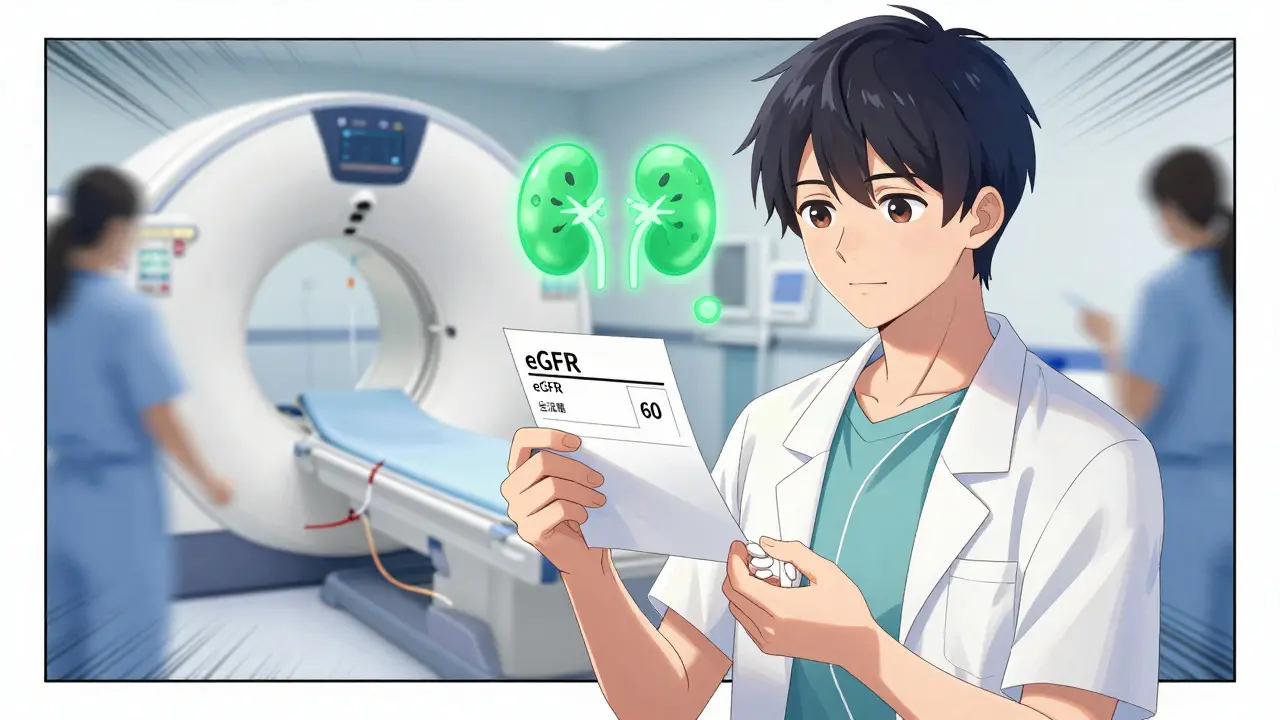
Metformin and Contrast Dye Safety Calculator
Personalized Guidance Tool
This tool helps determine if you need to stop metformin before a procedure requiring contrast dye based on your kidney function and other health factors.
Your Safety Recommendation
For millions of people with type 2 diabetes, metformin is the first and often only medication they ever need. It’s cheap, effective, and has been used safely for decades. But when you’re scheduled for a CT scan or angiogram that requires contrast dye, a warning pops up: metformin might be dangerous. Is this real? Or is it an old myth that’s still hanging around?
Why the Fear Exists
The concern isn’t about metformin itself. It’s about what happens when your kidneys can’t clear it fast enough - and contrast dye can temporarily slow down kidney function. When metformin builds up, it can interfere with how your cells use oxygen. Instead of burning sugar for energy using oxygen (aerobic metabolism), your cells switch to a less efficient, oxygen-free method. That process produces lactic acid. Too much of it, and your blood becomes dangerously acidic - a condition called lactic acidosis. This isn’t common. Studies show fewer than 10 cases of metformin-associated lactic acidosis (MALA) happen per 100,000 people each year. But when it does happen, it’s serious. Up to 40% of cases are fatal. That’s why doctors used to take no chances.What Changed in 2016
Before 2016, the rule was simple: stop metformin before any scan with contrast dye, and don’t restart it for 48 hours. It didn’t matter if you had perfect kidneys or if the dye was given through a vein in your arm. Everyone got the same warning. That changed after years of data showed the risk was wildly overestimated. The FDA updated its label in 2016, and so did major medical groups like the American College of Radiology and the National Kidney Foundation. Here’s what they now say:- If your kidney function is normal (eGFR above 60 mL/min/1.73 m²), you can keep taking metformin. No need to stop.
- If your eGFR is between 30 and 60, stop metformin at the time of the scan. Restart it only after 48 hours, once your kidney function is checked again and stable.
- If your eGFR is below 30, metformin is already not recommended - so this isn’t a new rule.
- If the contrast dye is injected into an artery (like during a heart catheterization), stop metformin regardless of kidney function. Arterial dye carries higher risk.
This shift didn’t come from guesswork. It came from watching thousands of patients. One study tracked over 100,000 diabetic patients who got contrast dye. Only three developed lactic acidosis - and none of them had normal kidney function. The rest were already at high risk for other reasons: heart failure, infection, liver disease, or severe dehydration.
Who’s Actually at Risk?
You don’t need to panic just because you’re on metformin and need a scan. The real danger comes from a mix of factors:- eGFR below 60 - especially below 45
- Heart failure or recent heart attack
- Severe infection or sepsis
- Liver disease
- Alcohol use disorder
- Age over 65
- Dehydration
If you have one or two of these, your doctor will likely pause metformin. But if you’re otherwise healthy and your kidneys are working fine, the dye won’t hurt you. The old fear was based on theory, not real-world outcomes.
What Happens During the Scan?
Contrast dye is usually iodine-based and given through a vein. It’s temporary. Your kidneys filter it out within hours. In healthy people, kidney function returns to normal within 24 to 48 hours. That’s why the 48-hour waiting period exists - it gives your kidneys time to recover before you restart metformin. If your kidneys are already weak, they might not clear the dye quickly. That’s when metformin starts to build up. But even then, lactic acidosis doesn’t happen unless other problems are present - like low blood pressure, infection, or poor oxygen delivery to tissues.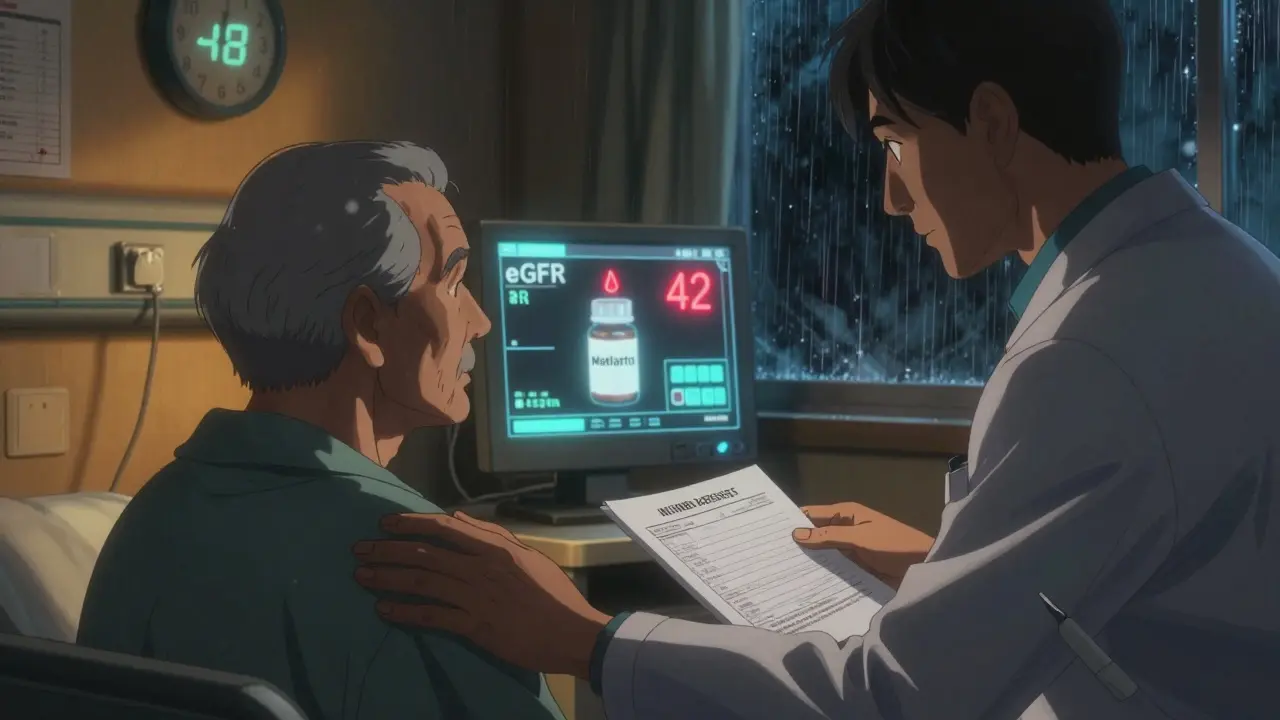
What About the Dye Itself?
Some people think the dye causes kidney damage. That’s called contrast-induced acute kidney injury (CI-AKI). But even that’s less common than people think. In patients with normal kidneys, the risk is less than 1%. Even in those with mild kidney disease, it’s often temporary and doesn’t lead to long-term harm. The real issue isn’t the dye. It’s the combination of the dye slowing kidney function + metformin still being taken + another stressor like infection or heart failure. All three need to be present for serious trouble to happen.What Should You Do?
Don’t stop metformin on your own. Talk to your doctor. But here’s what you can expect:- Your doctor will check your eGFR (a blood test that estimates kidney function). This is standard before any major scan.
- If your eGFR is above 60 and you have no other risk factors, you’ll be told to keep taking metformin as usual.
- If your eGFR is 30-60, you’ll be asked to skip your metformin dose on the day of the scan and for 48 hours after.
- You’ll get a blood test 48 hours after the scan to make sure your kidneys are back to normal before restarting.
- If you’re having an arterial procedure (like a heart cath), your doctor will stop metformin no matter what your kidney numbers say.
Some hospitals still use the old rules - especially if staff aren’t updated. If you’re told to stop metformin and you’re healthy, ask: "Is my eGFR below 60? Do I have heart failure or an infection?" If the answer is no, you might be getting outdated advice.
What If You Already Took Metformin?
If you accidentally took your dose right before the scan, don’t panic. One dose won’t cause lactic acidosis. The risk comes from accumulation over days - especially if your kidneys are already struggling. Just let the medical team know. They’ll monitor you. If you’re feeling fine - no nausea, no confusion, no rapid breathing - you’re likely okay. They’ll check your kidney function after the scan and decide whether to restart the medication.
What Happens if Lactic Acidosis Occurs?
It’s rare, but if it does, symptoms show up slowly: fatigue, muscle pain, trouble breathing, stomach pain, dizziness, or feeling cold. These aren’t specific - they can look like the flu or dehydration. That’s why it’s often missed until it’s advanced. Diagnosis requires blood tests: high lactate levels, low blood pH, and a high anion gap. Treatment is urgent: stopping metformin, IV fluids, oxygen, and sometimes dialysis. Hemodialysis is very effective - it removes both the metformin and the excess acid from your blood. Survival rates jump to over 80% if treated early.Why This Matters Beyond the Scan
This isn’t just about CT scans. It’s about how medicine changes. For years, doctors feared metformin because of a theoretical risk. But when real data came in, they changed their minds. That’s evidence-based medicine at work. Stopping metformin unnecessarily can be harmful too. Without it, blood sugar spikes. That can lead to hospital visits, dehydration, infections - and ironically, increase your risk of lactic acidosis. The goal isn’t to avoid risk at all costs. It’s to manage real risks, not imagined ones.The Bottom Line
Metformin and contrast dye can be safe together - if you know your numbers. If your kidneys are healthy, keep taking your metformin. If they’re not, pause it briefly. The risk of lactic acidosis is extremely low. The risk of uncontrolled diabetes? Much higher. Talk to your doctor. Get your eGFR checked. Ask questions. Don’t let outdated warnings keep you from getting the care you need - or from taking a medication that keeps you healthy every day.Can I take metformin the day before a CT scan with contrast dye?
Yes, if your eGFR is above 60 mL/min/1.73 m² and you have no other risk factors like heart failure, infection, or liver disease. If your kidney function is between 30 and 60, your doctor will likely ask you to skip your dose on the day of the scan. Always check with your provider - don’t assume.
Does contrast dye damage the kidneys?
In healthy people, contrast dye doesn’t cause lasting kidney damage. Even in people with mild kidney disease, any drop in function is usually temporary and recovers within 48 hours. The real concern is when kidney function is already poor (eGFR below 30) and combined with other health problems - that’s when complications are more likely.
How long should I wait to restart metformin after a CT scan?
Wait 48 hours after the scan - but only if your eGFR was between 30 and 60 before the procedure. You must get a follow-up blood test to confirm your kidney function has returned to normal. If your eGFR was above 60, you don’t need to stop at all. If it was below 30, you shouldn’t be on metformin anyway.
Is lactic acidosis from metformin common?
No. It’s extremely rare - fewer than 10 cases per 100,000 people per year. Most cases happen in people with multiple risk factors: severe kidney disease, heart failure, infection, or overdose. In healthy people with normal kidneys, the risk from contrast dye alone is virtually nonexistent.
Should I stop metformin for an X-ray or ultrasound?
No. Only procedures using iodinated contrast dye require special attention. Standard X-rays and ultrasounds don’t use contrast dye, so there’s no need to change your metformin routine. Always confirm with your provider what kind of imaging you’re having.
Can I drink alcohol while taking metformin before a scan?
Avoid alcohol for at least 48 hours before and after a contrast scan if you’re on metformin. Alcohol increases the risk of lactic acidosis by affecting liver function and dehydration. This is especially important if your kidney function is borderline. Even one drink can tip the balance in high-risk patients.
What if I’m having a heart catheterization?
For heart catheterization or any arterial contrast procedure, you should stop metformin regardless of your kidney function. Arterial dye is more concentrated and stays in the bloodstream longer, increasing the risk of metformin buildup. Restart it only after 48 hours, once your kidney function is confirmed normal.
Do I need a blood test before every scan?
If you’re on metformin and your last eGFR was more than 3 months ago, yes. Your doctor should check your kidney function before any procedure using contrast dye. If your last test was recent and normal, they may skip it - but always confirm. Don’t assume your last result still applies.
Kunal Majumder
January 11, 2026 AT 16:20Man, I was terrified to get my CT scan last year because of this metformin thing. Turned out my doc just checked my eGFR and said I was good to go. No stopping meds, no drama. So glad they updated the guidelines - old-school docs still scare people for no reason.
Aurora Memo
January 13, 2026 AT 07:29I appreciate how this breaks it down without fearmongering. So many patients get told to stop metformin out of habit, not science. It’s nice to see evidence finally catching up to practice.
chandra tan
January 13, 2026 AT 13:07In India, half the hospitals still make you stop metformin for *any* scan - even if your kidneys are perfect. My uncle got denied a CT because his eGFR was 62 and they said ‘better safe than sorry.’ But ‘sorry’ is when your sugar spikes for days because you’re off your med. Time to update the clinics.
Dwayne Dickson
January 14, 2026 AT 00:55It is, of course, an incontrovertible empirical reality that the paradigmatic shift in clinical guidelines regarding metformin and iodinated contrast media - predicated upon robust longitudinal cohort analyses - has rendered obsolete the prior precautionary orthodoxy. One might reasonably infer, then, that institutional inertia persists not due to medical necessity, but rather cognitive dissonance among practitioners unacquainted with contemporary literature.
Ted Conerly
January 14, 2026 AT 21:46If you're healthy and your kidneys are fine, don't let outdated hospital policies scare you. Ask for your eGFR number. If it's above 60 and you're not sick, keep taking metformin. Period. Your doctor should know this - if they don't, educate them gently. You're not being difficult, you're being informed.
Faith Edwards
January 15, 2026 AT 13:26How quaint. The uneducated masses are still clinging to the notion that ‘a little sugar spike’ is somehow preferable to the ‘theoretical’ risk of lactic acidosis - as if metabolic homeostasis were a mere suggestion rather than a physiological imperative. One wonders whether the authors of this post have ever actually read a nephrology textbook, or merely skimmed an FDA press release while sipping artisanal cold brew.
Jay Amparo
January 16, 2026 AT 07:13Just had my first contrast scan since being on metformin for 8 years. Doc said ‘you’re good to go’ - no stopping, no waiting. Felt like a superhero. I mean, imagine if we treated every small risk like it was a death sentence? We’d never leave the house. Thank you for this clear, calm breakdown. It’s what real care looks like.
Lisa Cozad
January 17, 2026 AT 03:21My mom’s eGFR was 48 last year and they made her stop metformin for her CT. She ended up with high blood sugar for a week, got dehydrated, and had to go to urgent care. They restarted metformin after her follow-up bloodwork. This whole thing is so much simpler than people make it - check the number, don’t panic.
Saumya Roy Chaudhuri
January 18, 2026 AT 04:35Anyone who thinks contrast dye is harmless clearly hasn’t studied renal physiology. And if you’re still taking metformin with an eGFR under 60, you’re playing Russian roulette with your liver and kidneys. This isn’t ‘evidence-based’ - it’s negligence dressed up as convenience. I’ve seen the labs. I know what happens.