
When you walk into a pharmacy and see ten different versions of the same pill on the shelf, you might assume prices are rock bottom. That’s the theory, anyway. But in real life, having lots of generic drug makers doesn’t always mean lower prices. In fact, sometimes it doesn’t change much at all.
More Competitors, But Not Always Lower Prices
The idea is simple: more companies making the same drug should drive prices down. And sometimes, they do. The FDA found that when six or more generic makers enter the market, prices for the drug can drop by up to 95% compared to the brand-name version. That’s huge. But that’s not the full story.
In many cases, even when five or six generics are approved, only one or two actually get sold. Why? Because getting approval isn’t the same as getting into the market. The first generic to enter often gets a 180-day exclusivity period in the U.S., meaning they’re the only one allowed to sell during that time. They take 80% of the market. The others? They wait. And sometimes, they never enter at all.
That’s what happened in China. A 2023 study looked at 27 brand-name drugs after generics entered. Only 12 of them had three or more generic competitors. Fifteen of the original drugs still held over 70% of the market eight quarters later. That’s not competition. That’s a stalemate.
The Paradox of Generic Competition
Here’s the twist: sometimes, the brand-name company raises its price after generics arrive.
It sounds backwards. But it happens. In the same Chinese study, 3 out of 27 brand-name drugs actually increased in price after generics entered the market. Why? Because some patients and doctors still trust the original brand. They think it’s more reliable, even if it’s the same chemical. So the brand company doesn’t cut prices to compete-they raise them, betting that loyal customers will pay more.
This isn’t rare. In Portugal, regulators set price caps on drugs to keep costs low. But instead of driving prices down, the caps created a kind of unspoken agreement among generic makers: no one lowers prices below the cap. Why? Because if you undercut, everyone else will too-and profits vanish for everyone. So they all stay at the ceiling. The system meant to save money ended up locking prices in place.
Complex Drugs Don’t Play Fair
Not all drugs are created equal. A simple pill like metformin? Easy to copy. A complex injection with special delivery tech? Not so much.
DrugPatentWatch found that making a generic version of a complex drug requires proving it’s identical in every way-down to how it dissolves in the body, how it’s absorbed, even how it’s packaged. That’s called proving Q1, Q2, Q3 equivalence. It’s expensive. It takes years. And only big companies with deep pockets can afford it.
So even if ten companies get approval, only two or three actually make the drug. The rest get scared off by the cost and risk. That’s why you’ll see a dozen generic approvals for a complex cancer drug, but only one or two are actually on shelves. The market looks competitive on paper. In reality, it’s still a duopoly.
Who Really Controls the Market?
It’s not the pharmacy. It’s not even the doctor. It’s the Pharmacy Benefit Managers-PBMs.
StoneTurn’s 2021 analysis showed that PBMs controlled 90% of all drug purchases in the U.S. in 2017. These middlemen negotiate discounts with drugmakers. They decide which generics get placed on formularies. And they often favor the cheapest option-but only if it’s profitable for them.
That means a generic drug might be approved, but if the PBM doesn’t want it, it won’t be covered. The manufacturer can’t sell it. So even with 10 generics, only the ones with the best rebate deals get sold. Competition becomes a game of who can offer the biggest kickback, not who makes the best product.
Authorized Generics: The Hidden Twist
Here’s another layer: authorized generics.
These are the exact same drug as the brand, but sold under a different label. The brand company makes them and sells them through a partner. The FTC found that when the brand company owns the authorized generic, it lowers its own wholesale price by 8-12%. That’s good for buyers.
But when a third party makes the authorized generic? The brand company raises its price by 22%. Why? Because they see the third-party generic as a threat. So they raise their own price to protect their profits. It’s not competition. It’s manipulation.
Patents and Pay-for-Delay
Brand companies don’t just rely on quality. They rely on legal tricks.
DrugPatentWatch documented cases where a single drug has over 50 patents-some on the pill’s shape, some on the coating, some on how it’s made. Generic makers have to fight each one in court. It’s expensive. It takes years.
And sometimes, the brand company pays the generic maker to stay away. These “pay-for-delay” deals are legal in the U.S. They delay competition for months or even years. The FTC has tried to stop them, but they still happen. So even if a generic is approved, it might not hit the market for a long time.
What Happens When Prices Drop Too Much?
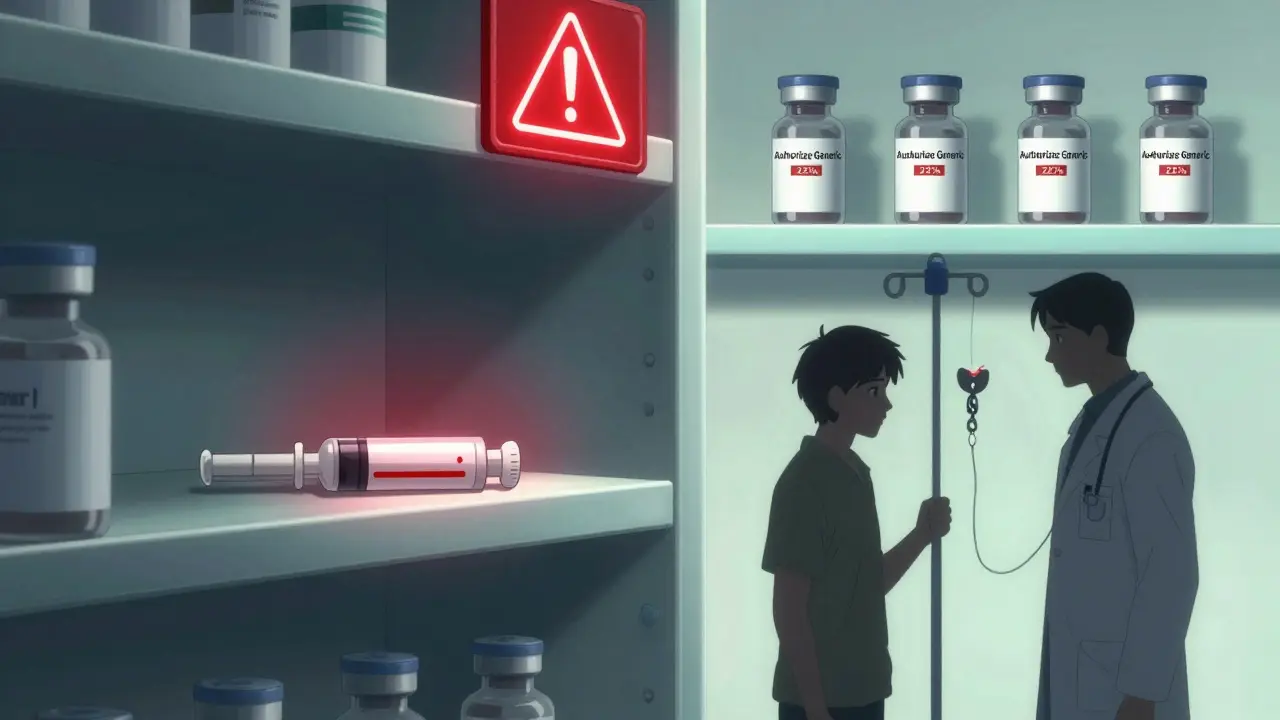
There’s a dark side to low prices: shortages.
When a drug becomes too cheap, manufacturers stop making it. Why? Because the profit margin disappears. In the U.S., drugs with only one manufacturer are 67% more likely to have shortages between 2018 and 2022 than those with three or more makers.
That’s why having multiple competitors isn’t just about price-it’s about supply. If you want a drug to be reliably available, you need more than one maker. But if prices drop too fast, even the second and third makers quit. The result? A drug that’s cheap, but impossible to find.
The New Threat: Medicare Price Caps
Starting in 2026, the Inflation Reduction Act will let Medicare negotiate prices for 10 high-cost drugs each year. The government will set a “Maximum Fair Price.”
That sounds good. But here’s the catch: if the government sets the price too low, generic makers won’t enter. Why? Because they can’t make money. The whole model of generic competition relies on enough profit to justify the cost of making the drug. If that’s gone, manufacturers won’t bother.
Lumanity’s 2023 analysis warns this could create therapeutic classes where no generics are made at all. That’s the opposite of what the law intended.
What Does This Mean for You?
If you’re on a generic drug, you might be getting a great deal-or you might be paying more than you should. It depends on how many makers are actually competing, who controls the supply chain, and whether the drug is simple or complex.
There’s no single answer. But here’s what you can do:
- Ask your pharmacist: How many companies make this generic? If it’s just one, ask if another version is available.
- Check if your insurance covers multiple brands. Sometimes switching to a different generic saves money.
- For complex drugs (like injectables or long-acting pills), don’t assume all generics are equal. Some are better made.
- If your drug suddenly disappears from the shelf, it’s not a coincidence. It’s a sign the market is broken.
Generic drugs saved the U.S. healthcare system over $3 trillion since 1984. That’s real progress. But the system is fragile. More competitors don’t always mean lower prices. Sometimes, they mean more confusion, fewer choices, and risky shortages.
The goal isn’t just to have more generics on paper. It’s to have more generics actually being made, sold, and used. That’s where real competition happens.
Nat Young
January 14, 2026 AT 21:09Let’s be real - this whole generic drug market is a rigged casino. Ten approvals? Great. One actually sold? Classic. The real competition isn’t between manufacturers - it’s between PBMs playing shell games with rebates. If your drug’s on the shelf, it’s because someone got paid to put it there, not because it’s better.
And don’t even get me started on authorized generics. Brand companies making their own knockoffs? That’s not competition. That’s corporate identity theft with a pharmacy label.
Iona Jane
January 15, 2026 AT 22:36They’re lying to us about prices and patents and everything
the FDA is in bed with Big Pharma
the same people who made the opioids are now writing the rules for generics
you think this is about health
it’s about control
Jaspreet Kaur Chana
January 16, 2026 AT 03:07Bro I grew up in a small town in Punjab where generics were the only option and we didn’t even know what brand names were - and guess what? We got better outcomes than most U.S. suburbs because the system didn’t overcomplicate it
Here in the U.S. you need a PhD just to figure out why your insulin costs $300 when the same pill in India is $3 - and it’s not because of manufacturing, it’s because of greed wrapped in bureaucracy
PBMs? They’re not middlemen - they’re middlemen with a monopoly on your health
And now Medicare’s going to cap prices? Cool - but if no one can make a profit, who’s gonna make the drug? The answer isn’t price caps - it’s cutting out the middlemen and letting pharmacists negotiate directly
India doesn’t have PBMs. We have local pharmacies. We have trust. We have access. And yes - we have generics that work
Stop treating healthcare like a stock market and start treating it like a human right
Haley Graves
January 16, 2026 AT 10:43Stop blaming the system and start asking your pharmacist for alternatives. If your drug has only one maker, ask if another generic exists under a different label. Insurance often covers multiple versions - and switching can save you hundreds.
For injectables or complex drugs, don’t assume all generics are equal. Ask about bioequivalence data. Some manufacturers have better quality control.
This isn’t rocket science. It’s basic advocacy. You have more power than you think.
Nilesh Khedekar
January 16, 2026 AT 12:48Oh wow, so the system is broken? Shocking. Who could’ve predicted that? A drug company making money off a drug? A PBM taking kickbacks? A patent system that’s been weaponized into a 50-layer legal maze? Who knew?
And now we’re supposed to be surprised that when you turn healthcare into a profit-driven auction, people start playing dirty?
Meanwhile, my cousin in Bangladesh gets his hepatitis C meds for $20 a month - same chemical, same manufacturer, same quality - and here we’re fighting over $150 co-pays because someone’s ‘authorized generic’ has a slightly different packaging color.
Capitalism isn’t broken - it’s working exactly as designed. And we’re all just the suckers in the back row.
Niki Van den Bossche
January 18, 2026 AT 07:47What’s truly tragic here isn’t the price manipulation - it’s the epistemological collapse of the American patient. We’ve been conditioned to believe that ‘more choices’ equals ‘more freedom,’ when in reality, we’re drowning in curated illusions of agency.
The PBM isn’t a market actor - it’s a gatekeeper of symbolic capital. The drug isn’t a therapeutic agent - it’s a signifier of trust, brand loyalty, and institutional validation.
And the authorized generic? A Hegelian negation of the original - a simulacrum that both undermines and reinforces the brand’s dominance.
We don’t need more generics. We need to dismantle the entire semiotic architecture of pharmaceutical value.
Jan Hess
January 18, 2026 AT 09:31Really glad someone laid this out so clearly. I’ve been on a generic blood pressure med for years and never thought twice about why there were three versions on the shelf but only one ever stocked.
Now I get it - it’s not about who makes it best, it’s about who paid the PBM the most.
My pharmacist actually told me last week that a new generic was approved but won’t be carried because the rebate deal wasn’t good enough. I was floored.
Wish more people knew this stuff. We’re all just trying to survive and we’re being played like pawns.
Gloria Montero Puertas
January 18, 2026 AT 17:21Oh please. You think this is about drugs? This is about the death of American responsibility. You want cheap medicine? Fine. But then stop expecting miracles. If you’re not willing to pay for quality, you get shortages. If you’re not willing to fund R&D, you get stagnation. If you’re not willing to accept that healthcare isn’t a grocery store, you get this mess.
And now you want Medicare to cap prices? Brilliant. Let’s just kill the goose that lays the golden egg - and then wonder why there are no more eggs.
People don’t want solutions. They want someone else to fix it while they keep scrolling.
Frank Geurts
January 19, 2026 AT 09:16It is imperative to acknowledge that the structural inefficiencies inherent in the current pharmaceutical distribution paradigm are not merely operational anomalies but systemic manifestations of regulatory capture and market distortion.
The aggregation of purchasing power by Pharmacy Benefit Managers, coupled with the absence of transparent pricing mechanisms, has engendered a perverse incentive structure wherein product availability is contingent upon rebate optimization rather than therapeutic efficacy.
Moreover, the proliferation of patent thickets constitutes a form of legal rent-seeking that fundamentally undermines the statutory intent of the Hatch-Waxman Act.
It is therefore incumbent upon policymakers to institute mandatory disclosure protocols for all rebate arrangements and to establish independent, non-industry-aligned oversight of generic market entry.
Without such interventions, the promise of accessible pharmaceuticals will remain an unfulfilled covenant.
Annie Choi
January 20, 2026 AT 04:37So if Medicare caps prices, will we see a surge in biosimilar development or just another wave of manufacturing exits? The data from Canada and the EU shows that when price floors drop below marginal cost, supply chains fracture. We’re not just talking about profit - we’re talking about clinical continuity.
And let’s not ignore the elephant in the room: the U.S. is the only major economy where patients pay list price upfront. That’s not a market - it’s a tax on the sick.
Real reform needs to tie reimbursement to actual availability, not just rebate percentages. Otherwise we’re just rearranging deck chairs on the Titanic.