
Imagine you have spent years developing a drug. You got the green light from regulators, and now it is on shelves saving lives. But what happens when you need to swap out a mixing tank or move production to a new building? If you get this wrong, you risk everything. A single misclassified change can lead to warning letters, product recalls, or even a ban on distribution.
In the world of pharmaceuticals, manufacturing changes are alterations made to an approved drug product's composition, process, equipment, or facilities after regulatory approval. These aren't just administrative hurdles. They are critical safety checks. The goal is simple but strict: ensure that any change does not negatively impact the identity, strength, quality, purity, or potency of the drug. As we navigate through 2026, understanding these notification and approval requirements is no longer optional-it is the backbone of staying in business.
The Core Framework: Risk-Based Classification
Regulators do not treat all changes equally. A minor tweak to a label differs vastly from changing the chemical pathway of an active ingredient. That is why agencies like the U.S. Food and Drug Administration (FDA) use a tiered system based on risk. This approach was solidified by the Federal Food, Drug, and Cosmetic Act (FD&C Act), specifically Section 506A, and detailed in regulations like 21 CFR 314.70 for drugs.
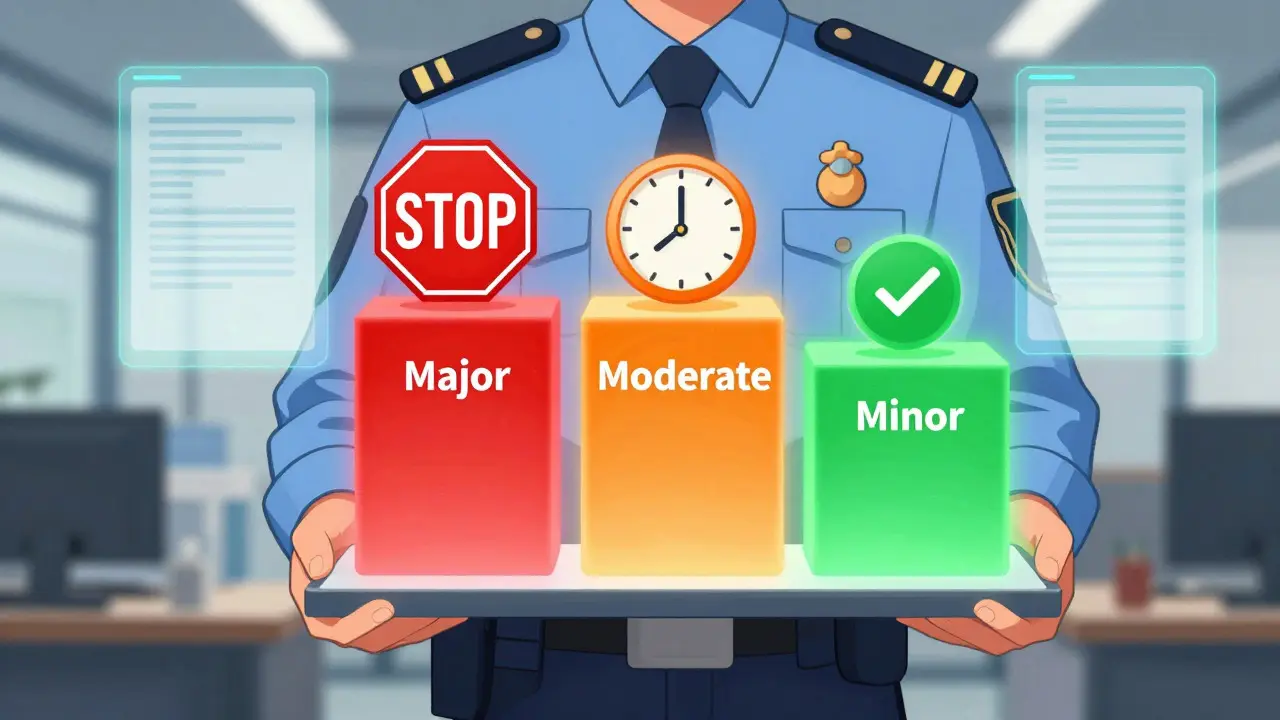
The FDA divides changes into three main buckets. First, you have major changes. These carry a high potential to affect product quality. Think about introducing a new manufacturing site for a critical step or altering equipment that changes how the drug behaves. For these, you need a Prior Approval Supplement (PAS). You cannot sell the product until the FDA says yes. Second, there are moderate changes. Examples include replacing equipment with an equivalent model. Here, you file a Changes Being Effected in 30 days (CBE-30) supplement. You wait 30 days, and if the FDA doesn't object, you proceed. Finally, minor changes-like moving a non-critical step within the same facility-are reported in your annual report. No prior approval needed, but you must document it.
| Change Category | Risk Level | Reporting Mechanism | Approval Timing |
|---|---|---|---|
| Major | High | Prior Approval Supplement (PAS) | Before distribution |
| Moderate | Moderate | CBE-30 or CBE-0 | 30 days before (or immediate for CBE-0) |
| Minor | Low | Annual Report | Within 60 days of anniversary date |
Global Differences: EMA and Health Canada
If you operate globally, the rules shift slightly depending on where you sell. The European Medicines Agency (EMA) uses a different classification under EC No. 1234/2008. They categorize changes as Type IA, IB, or II. Type IA covers minor changes that you notify within 12 months. Type IB involves moderate changes requiring approval before implementation. Type II is for significant changes needing full evaluation. Notice the difference? The EMA allows some "do-and-tell" scenarios for very minor changes, whereas the FDA is stricter about pre-notification for anything beyond annual reports.
Health Canada also uses a three-tier system: Level I (major, prior approval), Level II (moderate, notify and wait), and Level III (minor, annual notification). While Level I and III align closely with FDA’s PAS and Annual Reports, the timing and documentation nuances can trip up companies used to one jurisdiction. For instance, WHO Prequalification requires a Comparability Protocol with explicit justification and stability data, adding another layer of complexity for international players.
Why Misclassification Happens (And Why It Hurts)
You might think classifying a change is straightforward. It often isn’t. In 2023, the FDA issued four warning letters specifically for misclassified equipment changes. One notable case involved Lupin Pharmaceuticals, which replaced a lyophilizer without getting the required PAS approval. The result? A public reprimand and potential market disruption.
Why do experts mess this up? Ambiguity. Take tablet press replacement. Is it an "equivalent" machine (CBE-30) or "new" equipment (PAS)? The FDA clarifies that "equivalent" means the same principle of operation, same critical dimensions, and same material of construction. If any of those differ, you likely need a PAS. Dr. Jane Axelrad, former FDA Deputy Center Director for Policy, noted that the reporting category depends entirely on the risk to product quality. If you underestimate that risk, you pay the price.
The cost isn't just regulatory. According to a 2021 PDA benchmarking study, moderate changes require about 120 hours of cross-functional effort. Misclassifying them wastes time, money, and trust. A senior regulatory specialist at a generic manufacturer shared that deciding between CBE-30 and PAS for a tablet press consumed 37 hours of team time due to vague specifications. That is time better spent on innovation.
Best Practices for Compliance in 2026
To stay ahead, you need a robust internal process. Large companies like Pfizer use sophisticated risk scoring tools. Their internal guidance includes a 15-point assessment for equipment changes, looking at Critical Quality Attributes (CQAs) and historical performance data. You don't need to be Pfizer to adopt similar rigor.
Start with early consultation. The FDA’s 2021 final guidance for biologics encourages talking to the agency if you are unsure about classification. It is better to ask than to guess. Use Failure Modes and Effects Analysis (FMEA) to assess risks systematically. The Parenteral Drug Association recommends FMEA for equipment changes because it highlights potential failure points before they happen.
Documentation is your shield. Ensure your files include facility diagrams, process validation reports, and comparative batch data for at least three consecutive batches. Real-time quality monitoring data is becoming increasingly valuable. McKinsey predicts that by 2025, 40% of submissions will use this data to reduce regulatory burden. Adopting these technologies now positions you well for the future.

The Role of ICH Q12 and Harmonization
Good news is on the horizon. The International Council for Harmonisation (ICH) released guideline Q12 in November 2020. Titled "Technical and Regulatory Considerations for Pharmaceutical Product Lifecycle Management," it aims to standardize post-approval change management across regions. This means less fragmentation and more predictability.
Under ICH Q12, manufacturers can define a "well-understood" range for their processes. Changes within this range may require less scrutiny. This is a game-changer for efficiency. However, adoption varies. Large pharma companies have a 98% adoption rate for sophisticated change control systems, while smaller firms lag at 63%. Closing this gap requires investment in training and technology.
Continuous manufacturing is another trend reshaping requirements. Because processes are interconnected, equipment changes in continuous systems often trigger PAS submissions. The FDA’s 2022 guidance on Continuous Manufacturing acknowledges this complexity. If you are moving toward continuous manufacturing, expect stricter oversight on every modification.
FAQ: Common Questions on Manufacturing Changes
What is the difference between a PAS and a CBE-30?
A Prior Approval Supplement (PAS) is for major changes with high risk to product quality. You must get FDA approval before distributing the changed product. A Changes Being Effected in 30 days (CBE-30) is for moderate changes. You submit the supplement and wait 30 days; if the FDA does not object, you can distribute the product. PAS requires explicit permission; CBE-30 relies on a waiting period.
How do I classify a manufacturing change correctly?
Classification depends on the risk to product quality attributes like identity, strength, and purity. Use risk assessment tools like FMEA. Consult FDA guidelines such as 21 CFR 314.70. If uncertain, engage in early consultation with the FDA. Major changes affecting Critical Process Parameters (CPPs) usually require PAS, while minor adjustments go into annual reports.
What happens if I misclassify a change?
Misclassification can lead to severe consequences. The FDA may issue warning letters, order product recalls, or halt distribution. For example, Lupin Pharmaceuticals received a warning letter in 2023 for implementing a major lyophilizer change without PAS approval. Beyond penalties, it damages credibility and delays market access.
Does ICH Q12 apply to all pharmaceutical products?
ICH Q12 applies broadly but focuses on products with well-established manufacturing processes. It allows manufacturers to define controlled ranges for parameters. Changes within these ranges may face reduced regulatory burden. However, advanced therapies and complex biologics may still require stringent reviews under existing frameworks like BLA supplements.
How has the EMA variation system changed recently?
Effective January 1, 2023, the EMA introduced "Type IB accelerated" pathways for certain equipment modifications. This reduces review timelines from 60 to 30 days for specific changes. It aims to streamline approvals for low-to-moderate risk variations, making the EU market more agile for manufacturers making routine updates.