
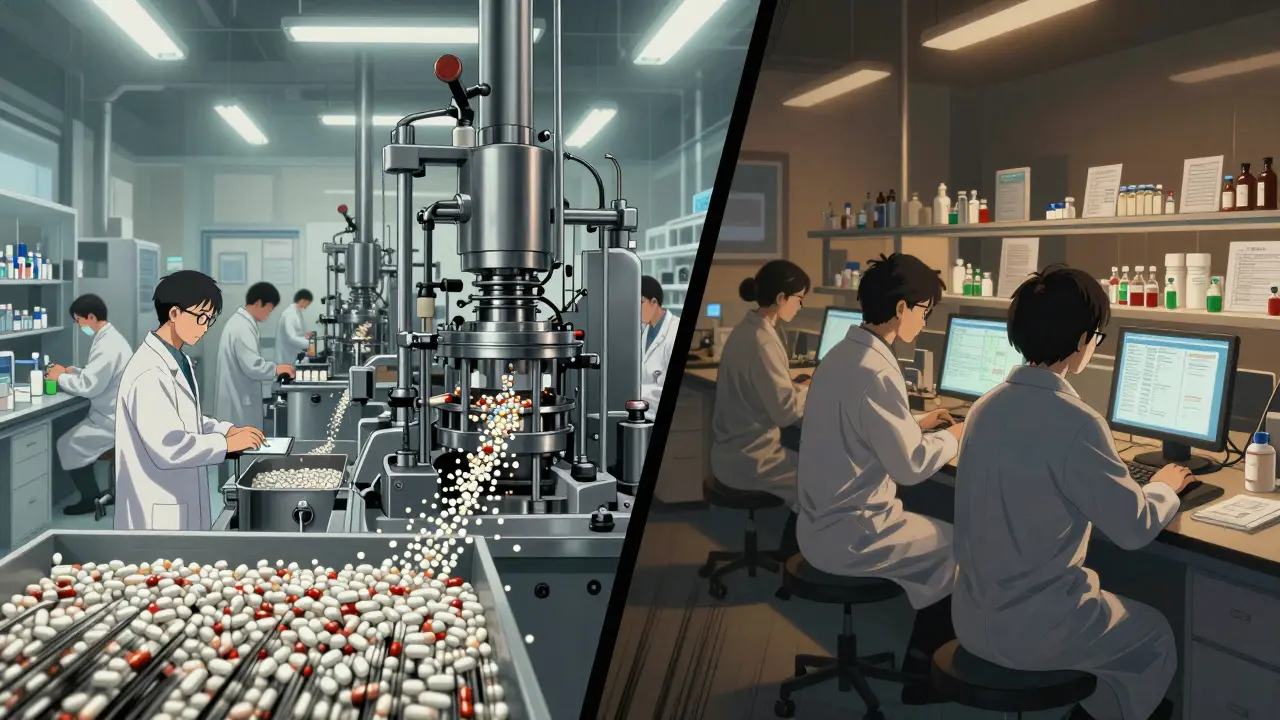
When you pick up a prescription, you might not think about who made the pill or how much it cost to produce. But behind every generic pill and every brand-name drug is a complex system of labor, regulation, and economics. And the differences in labor costs between generic and brand-name drugs are huge - not because one is made better, but because they’re made for completely different reasons.
Why Generic Drugs Cost Less - It’s Not Just the Ingredients
Many people assume generic drugs are cheaper because they use cheaper chemicals. That’s partly true - the active ingredient is the same. But the real savings come from what happens after the ingredient is made. Labor is a big part of that. For generic drug makers, labor makes up only about 15% to 25% of total production costs. For brand-name drugs, especially when they’re first launched, labor can eat up 30% to 40% of the cost.
Why? Brand-name drugs require a lot of hands-on work during development. Teams of scientists, clinical trial coordinators, regulatory specialists, and quality control experts spend years building the drug from scratch. Every step - from testing stability to documenting every batch - requires skilled labor. That’s expensive. Generic manufacturers don’t have to do any of that. They don’t need to prove the drug works. They just need to prove it’s the same as the brand.
The Hidden Labor Behind Quality Control
Don’t think that means generic drug production is simple. In fact, quality control is one of the most labor-heavy parts of making generics. Every batch of pills must be tested for purity, strength, and consistency. Raw materials, in-process samples, and final products all get checked. Paperwork for traceability is just as strict as for brand-name drugs. In some cases, it’s even more detailed because regulators watch generic makers more closely to make sure they’re not cutting corners.
According to DrugPatentWatch, quality control alone can account for over 20% of total generic drug production costs. For a medium-sized company, that means spending around $184,000 a year just to keep compliance systems running. Add in $1.9 million for program participation and another $320,000 per new drug application, and you’re looking at a massive labor-driven overhead. But here’s the catch: generic companies spread that cost across millions of pills. Brand-name companies spread it across maybe a few hundred thousand.
Scale Changes Everything
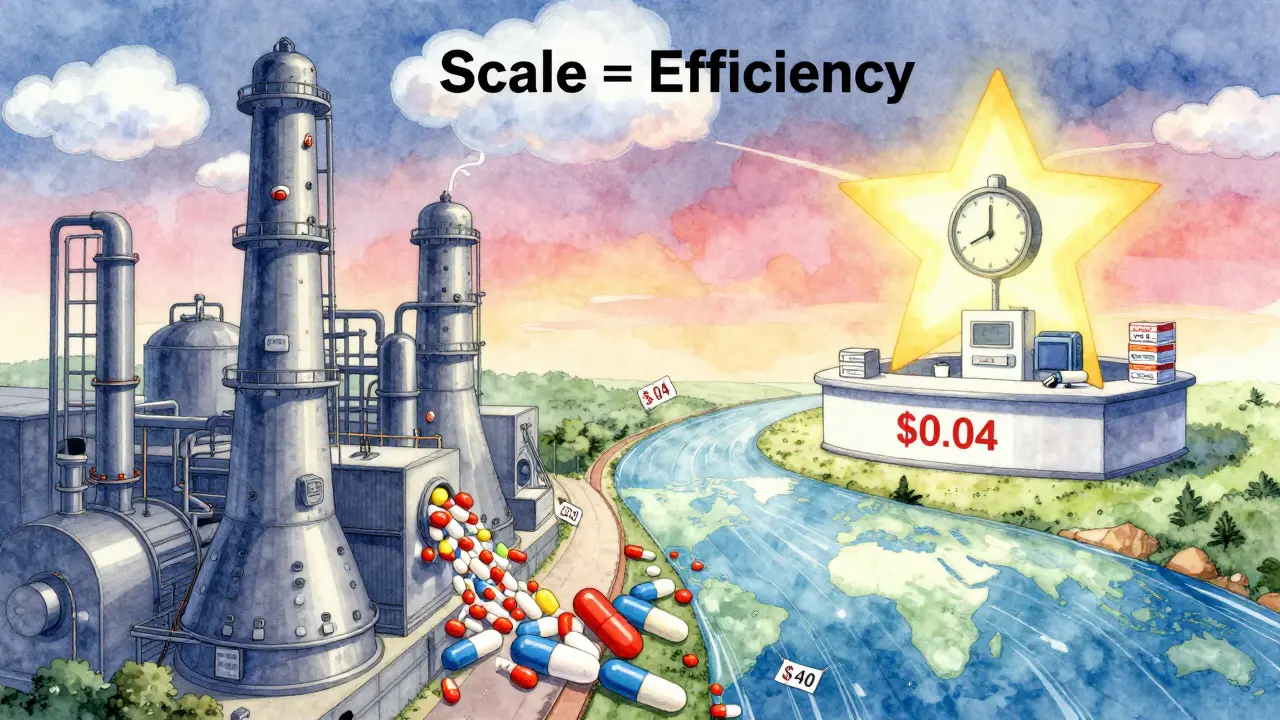
One generic drug maker can produce 100 million tablets of a blood pressure medication in a single year. A brand-name company might only make 5 million of the original version before generics enter the market. That difference in volume changes everything.
BCG’s 2019 study found that every time a generic manufacturer doubles its production volume, unit costs drop by 27%. For brand-name drugmakers, the same increase only cuts costs by 17%. Why? Because labor becomes more efficient at scale. Workers get faster. Machines run longer without downtime. Training becomes standardized. One worker can oversee more lines. The same quality control team can test ten times as many batches without adding staff.
This is why a single generic drug factory in India or China can supply the entire U.S. market. Labor is cheaper there - about 42% less than in the U.S. But even more than wages, it’s the volume that drives down the cost per pill. Nine out of ten prescriptions filled in the U.S. are for generics. That kind of demand means factories run 24/7, and labor costs per unit become almost negligible.

Brand Drugs Pay for R&D - Not Just Labor
Brand-name drugs aren’t expensive because they’re made with more skilled workers. They’re expensive because the company had to spend $2.6 billion on average to bring one drug to market. That’s 10 to 15 years of research, trials, failures, and regulatory filings. That cost doesn’t show up as a line item on the pill bottle. It shows up as the price tag.
When a brand-name drug’s patent expires, the company doesn’t stop making it - but they don’t need to. They’ve already recovered their investment. The real cost of making the pill now? Maybe $1 or $2 per unit. But the generic version sells for 80% to 85% less. That’s not because the generic is made cheaper. It’s because the brand was priced to cover its R&D, not its labor.
UH Hospitals found that brand-name drugs make up 75% of total prescription spending in the U.S., even though they’re only used in 10% of prescriptions. That’s the power of patent protection. It lets companies charge what they need to recoup their investment - and then some.
Where Labor Is Outsourced - And Why
Most generic drug makers don’t even own their own factories anymore. About 42% of biosimilar production costs go to contract manufacturers. That’s a strategic shift. Instead of paying full-time salaries for engineers, chemists, and QA staff, they pay per batch. It turns fixed labor costs into variable ones.
This lets companies scale up or down based on demand. If a new generic hits the market and sales spike, they can order more from a CMO without hiring new staff. If demand drops, they cut back. That flexibility is impossible for brand-name companies, which need to keep their R&D teams, regulatory departments, and clinical trial staff on payroll - even if sales fall.
The HHS Office of Planning and Evaluation points out that this global supply chain isn’t about efficiency. It’s about cost arbitrage. Labor laws, environmental rules, and subsidies in countries like India and China make production cheaper - but not necessarily better. That’s why some experts worry: when the pressure to cut costs gets too high, companies may skimp on staffing, training, or testing. That’s when shortages and quality issues start to appear.
The Trade-Off: Lower Prices, Higher Risk
The FDA has warned that the intense pressure to keep generic drug prices low could lead to dangerous compromises. If a company cuts labor too deeply - reduces QA staff, skips training, or delays maintenance - the risk of contamination or ineffective batches goes up. The FDA’s 2023 report says this is now a major concern.
But here’s the irony: the same companies that cut labor to save money are often the ones that end up spending more in the long run. A manufacturer that invests in training, prevention, and consistent quality control ends up with fewer batch failures, less rework, and faster release times. That means more product on the shelf, fewer recalls, and higher reliability. It’s not about hiring fewer people. It’s about hiring the right people and keeping them.
What This Means for You
When you choose a generic drug, you’re not just saving money. You’re benefiting from a system built on scale, efficiency, and global competition. But that system is fragile. It depends on stable labor practices, strong regulation, and enough profit for manufacturers to invest in quality - not just cut costs.
Brand-name drugs are expensive because they’re risky. Generic drugs are cheap because they’re predictable. But predictability only works when someone’s watching. When you see a generic drug priced at $4 instead of $40, remember: someone’s doing the math - and they’re trying to do it right.
Gray Dedoiko
December 24, 2025 AT 19:42Really put into perspective how much goes into those little pills. I never thought about how scale changes everything-makes sense why generics are so cheap when they’re pumping out 100 million tablets a year. Still, it’s wild to think one factory in India supplies half the country.
Aurora Daisy
December 25, 2025 AT 12:02Oh wow, so we’re outsourcing our medicine to countries where labor laws are basically suggestions? Brilliant strategy. Next we’ll be importing our heart surgery from a TikTok influencer with a scalpel and a dream.
Paula Villete
December 27, 2025 AT 01:06generic drugs aren’t cheap because they’re bad-they’re cheap because we’ve turned medicine into a volume game. and honestly? that’s kinda beautiful. someone’s doing the math so you don’t have to pay $40 for aspirin. also, typo: ‘batches’ not ‘batces’ but you get it.
Georgia Brach
December 27, 2025 AT 10:38The premise is fundamentally flawed. The FDA’s own data shows that 80% of generic drug manufacturing violations occur in facilities that prioritize cost-cutting over compliance. This isn’t about scale-it’s about regulatory capture. The entire system incentivizes under-staffing, and the public pays in delayed recalls and contaminated lots.
Katie Taylor
December 27, 2025 AT 23:36People act like generics are some kind of scam, but they’re the reason my diabetic kid can actually afford insulin. Stop talking about ‘risk’ and start talking about access. This system saves lives. If you want to fix it, fund better oversight-not scare people away from the cheapest option.
Isaac Bonillo Alcaina
December 28, 2025 AT 01:14You’re romanticizing the supply chain. The ‘efficiency’ you praise is built on the backs of underpaid workers in countries with zero worker protections. The fact that this is profitable doesn’t make it ethical. And no, ‘scale’ doesn’t absolve systemic exploitation. This isn’t economics-it’s colonialism with pill bottles.
Chris Buchanan
December 29, 2025 AT 08:27Bro, you just described why I take generics. I’m not some pharma exec with a yacht-I’m just trying not to go broke on my blood pressure med. And yeah, I know the factory’s in India. But if it works, and it’s safe, and it costs $4? I’m all in. Let’s fix the system, not hate the solution.
Andy Grace
December 30, 2025 AT 02:01Interesting how you mention quality control costs but don’t address the human factor-training, retention, morale. The real cost isn’t the salary, it’s the turnover. If you treat workers like disposable parts, the pills might pass inspection… but the system won’t last.
John Pearce CP
December 31, 2025 AT 05:43It is a misapprehension to equate cost efficiency with systemic reliability. The concentration of generic manufacturing in jurisdictions with weak regulatory enforcement constitutes a latent public health hazard. The FDA’s 2023 report is not an anomaly-it is a predictable consequence of market-driven deregulation. The current paradigm is unsustainable and demands structural intervention, not anecdotal gratitude.