
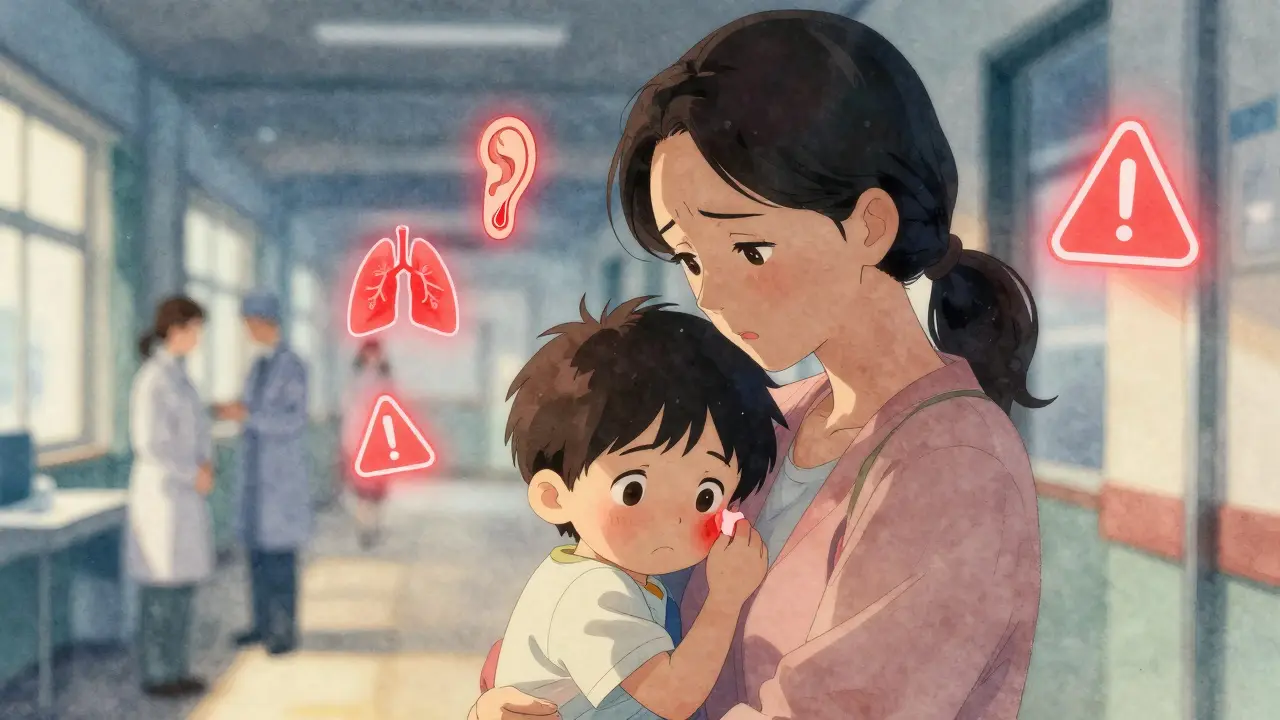
When your child keeps getting sick-ear infections, pneumonia, sinus infections-it’s easy to blame it on daycare, cold weather, or bad luck. But what if it’s not luck? What if it’s your immune system failing to fight off even the most common bugs? Recurrent infections aren’t always normal, especially when they’re frequent, severe, or don’t respond to standard treatment. In fact, they might be the earliest and most obvious sign of an underlying immunodeficiency.
How Many Infections Are Too Many?
Most healthy kids get 6 to 12 respiratory infections a year. That’s normal. But if your child has four or more ear infections in 12 months, or two or more pneumonias in a year, that’s a red flag. The same goes for deep skin abscesses, persistent thrush after age one, or infections that require IV antibiotics to clear. These aren’t just annoying-they’re signals your immune system isn’t doing its job. The American Academy of Allergy, Asthma & Immunology and the European Society for Immunodeficiencies agree: there are clear thresholds. Eight ear infections in a year? That’s not coincidence. Two sinus infections that don’t improve with two months of antibiotics? That’s not just bad timing. These patterns don’t match up with typical childhood illness. They match up with immune failure.What Makes an Infection a Red Flag?
Not all infections are created equal. Some infections should never happen in a healthy person. If your child gets infections caused by organisms like Candida (fungal thrush) that stick around after age one, or Pneumocystis jirovecii (a fungus that only attacks people with severely weakened immunity), that’s a major alarm. These are called opportunistic infections. They’re the immune system’s last cry for help. Other red flags include:- Recurrent deep abscesses in organs like the liver or lungs
- Failure to gain weight or grow normally (failure to thrive)
- Family history of early deaths from infection or known immunodeficiency
- Chronic diarrhea that doesn’t improve
- Absent or very small tonsils and lymph nodes on physical exam
When to Suspect Antibody Deficiency
The most common type of immunodeficiency involves antibodies-specifically, low levels of IgG, IgA, or IgM. These proteins are your body’s missiles against bacteria and viruses. When they’re missing, you get hit again and again. Common Variable Immunodeficiency (CVID) is the most frequent antibody deficiency in adults. But it can show up in kids too. The diagnostic criteria are strict: IgG levels below 400 mg/dL, plus low IgA or IgM, and a poor response to vaccines. But here’s the catch-many doctors miss it because they look at the wrong numbers. A pediatrician in Ohio recently shared a case: an 8-year-old with repeated pneumonia. His IgG was 420 mg/dL. That’s above the general cutoff of 400. But for an 8-year-old? That’s abnormally low. Age-adjusted norms show the average is closer to 700 mg/dL. He was misdiagnosed as having chronic bronchitis for over a year.
The Workup: What Tests Actually Matter?
You can’t diagnose immunodeficiency by guesswork. You need specific tests, done in the right order. Step 1: Complete Blood Count (CBC) with DifferentialThis checks your white blood cells. In kids over one year, a lymphocyte count under 1,500 cells/μL is suspicious. In infants under one, under 3,000 is a warning sign. Low lymphocytes mean your T cells-your infection fighters-are running low. Step 2: Immunoglobulin Levels (IgG, IgA, IgM)
These must be interpreted by age. A 3-month-old’s normal IgG is 243 mg/dL. By age 5, it should be 700-1,600 mg/dL. If your child’s IgG is 450 mg/dL at age 6? That’s not normal. It’s low. Step 3: Lymphocyte Subset Analysis (Flow Cytometry)
This counts your T cells (CD3, CD4, CD8), B cells (CD19), and natural killer cells (CD56). A CD3 count under 1,000 cells/μL in a child over two years is abnormal. This test tells you which part of the immune system is broken. Step 4: Vaccine Response Testing
This is the gold standard. You give a vaccine-like tetanus or pneumococcal-and then check antibody levels 4 to 8 weeks later. If your child doesn’t make a strong response, they can’t fight off real infections. The CDC says protective tetanus antibody levels must be above 0.1 IU/mL. For pneumococcus, it’s 1.3 μg/mL. If they’re below that, you’ve got a real problem.
Don’t Jump to Immunoglobulin Therapy
Too many patients get IV immunoglobulin (IVIG) without proper testing. A 2020 study in the Annals of Internal Medicine found that 22% of patients started on IVIG didn’t actually have a functional antibody deficiency. They had low IgG, but their bodies could still respond to vaccines. Giving IVIG to these patients doesn’t help-and it’s expensive, invasive, and carries risks. Before you start lifelong infusions, you must prove the immune system can’t make its own antibodies. That’s why vaccine challenge testing is non-negotiable.What Else Could It Be?
Not every recurrent infection is immunodeficiency. In fact, up to 43% of cases have other causes.- Cystic fibrosis: Causes thick mucus that traps bacteria in the lungs. Often mistaken for recurrent pneumonia.
- Structural nasal or sinus problems: Deviated septum, enlarged adenoids-these block drainage and cause chronic sinusitis.
- Inhaled foreign bodies: A child might swallow a peanut, and it gets stuck in the airway. It causes repeated lung infections that look like pneumonia.
- Autoimmune diseases: Lupus or rheumatoid arthritis can lower antibody levels.
- Medications: Steroids, chemotherapy, or even long-term antibiotics can suppress immunity.

What Happens If You Wait?
Delaying diagnosis has real consequences. A 2017 study in the Journal of Allergy and Clinical Immunology showed that children with SCID diagnosed before 3.5 months had a 94% survival rate. Those diagnosed later? Only 69% survived. The longer you wait, the more damage accumulates. Repeated pneumonia can scar the lungs. Chronic sinus infections can destroy sinuses. Untreated CVID can lead to lung disease, liver disease, or even cancer. Early diagnosis doesn’t just prevent death-it prevents lifelong disability.What’s Changing Right Now?
In 2023, the FDA approved a new genetic test called StrataID Immune. It checks 484 immune-related genes in one test. It finds the cause in 35% of suspected cases-almost double the old methods. More states now screen newborns for SCID. In 2018, only 26 states did it. Now, 38 do. That’s saving lives before symptoms even appear. The future is faster diagnosis. Experts predict that within five years, whole exome sequencing will be the first test for suspected immunodeficiency-not the last. AI tools are being trained to predict immune disorders from routine blood tests with 92% accuracy. But here’s the hard truth: 78% of low- and middle-income countries still can’t test for basic immunoglobulin levels. That’s why awareness matters. If you’re a parent, a teacher, or a doctor, knowing the red flags can mean the difference between a child who grows up healthy-and one who doesn’t.What Should You Do Next?
If you’re seeing these patterns:- Write down every infection: type, frequency, treatment, duration
- Check growth charts-has your child fallen below the 5th percentile?
- Look for signs like chronic thrush, abscesses, or absent tonsils
- Ask about family history: anyone die young from infection? Any cousins with immune problems?
- Ask your doctor for: CBC, immunoglobulins, lymphocyte subsets, and vaccine response testing
How do I know if my child’s infections are normal or a sign of immunodeficiency?
Normal children get 6-12 colds or ear infections a year. Red flags include four or more ear infections in 12 months, two or more pneumonias in a year, infections needing IV antibiotics, thrush after age one, deep abscesses, or failure to grow. These patterns suggest immune failure, not just bad luck.
Can a child have low IgG and still have a normal immune system?
Yes. Some kids have transient hypogammaglobulinemia of infancy, where IgG is low but improves by age 2-3. The key is whether they respond to vaccines. If their antibody levels rise after a tetanus or pneumococcal shot, their immune system is working. If not, they likely have a true deficiency.
Is IV immunoglobulin (IVIG) always the answer for recurrent infections?
No. IVIG is only recommended if there’s a proven functional antibody deficiency-meaning the body can’t make its own antibodies even after vaccination. Giving IVIG without this proof is unnecessary and risky. Studies show 22% of patients receive it incorrectly.
What tests are needed to diagnose primary immunodeficiency?
The essential tests are: a complete blood count (CBC) with differential, quantitative immunoglobulins (IgG, IgA, IgM), lymphocyte subset analysis by flow cytometry, and vaccine response testing (tetanus, diphtheria, pneumococcal). These together confirm whether the immune system is missing key pieces.
Can adults develop immunodeficiency later in life?
Yes. While many immunodeficiencies appear in childhood, some-like Common Variable Immunodeficiency (CVID)-often show up in adults in their 20s to 40s. Recurrent sinus infections, pneumonia, or chronic diarrhea in an adult should prompt immune testing, especially if there’s no clear cause like smoking or asthma.
How long does it usually take to get a diagnosis?
Historically, people waited an average of 9.2 years. But with standardized criteria and better awareness, that’s dropped to 2.1 years in centers using the 10-warning-signs approach. The key is early testing-don’t wait for symptoms to get worse.
Prakash Sharma
January 8, 2026 AT 08:26Finally someone says it straight. In India, we see this all the time-kids getting sick every other week, doctors shrugging like it’s normal. No one checks IgG levels. No one asks about family history. We treat symptoms, not causes. It’s not luck. It’s negligence. And yeah, I’m angry about it.
Donny Airlangga
January 8, 2026 AT 23:18This is so important. My niece had 7 ear infections in one year. We thought it was just daycare. Turned out her IgG was 380. We didn’t even know to test for it until a pediatric immunologist finally asked. Thank you for laying this out so clearly.
swati Thounaojam
January 10, 2026 AT 01:54my kid had thrush at 18 months and i just thought it was from antibiotics. never thought it was immune. oops.
Aubrey Mallory
January 10, 2026 AT 21:18Let me be real-most parents don’t know what an immunoglobulin is. And most doctors don’t test for it unless you scream. This post should be mandatory reading for every pediatrician in America. And if you’re a parent? Write down every infection. Don’t wait for someone else to notice.
Dave Old-Wolf
January 12, 2026 AT 06:44Wait, so if my kid’s IgG is 420 but he’s 8, that’s low? I thought 400 was the cutoff. So age matters? That’s wild. I never knew that. My cousin’s kid had pneumonia twice and they just gave him more antibiotics. No tests. No nothing.
Molly Silvernale
January 13, 2026 AT 21:27It’s not just medicine-it’s metaphysics. Our bodies are symphonies, and when one instrument goes silent-the lymphocytes, the IgG, the CD3 counts-we call it disease. But really, it’s silence. And we’ve trained ourselves to ignore the quietest notes until the whole orchestra collapses. That’s the tragedy. Not the infection. The forgetting.
Ken Porter
January 15, 2026 AT 03:11Wow. Another liberal medical guilt trip. Next you’ll tell me we need universal IVIG coverage. Meanwhile, my kid got 3 ear infections and still beat the other kids at soccer. Maybe stop pathologizing childhood?
Annette Robinson
January 15, 2026 AT 18:29If you’re reading this and your child has had recurrent infections-please don’t feel guilty. You’re not a bad parent. You’re just a parent who didn’t know. Now you do. Take the list. Go to your doctor. Say: ‘I want these tests.’ You’re not being pushy. You’re being brave.
Manish Kumar
January 17, 2026 AT 14:58Think about it-human immunity evolved in a world without antibiotics, without daycare, without processed sugar. We’re asking our bodies to fight modern pathogens with Stone Age genes. Maybe the problem isn’t the immune system failing… maybe it’s the environment overwhelming it. We treat the symptom, not the cause. We test IgG but ignore gut flora, mold exposure, vitamin D deficiency. We’re looking for a needle in a haystack… while the haystack is on fire.
Kristina Felixita
January 18, 2026 AT 15:27As an immigrant mom-I didn’t even know to ask for vaccine response tests. Here in the US, I was told ‘it’s normal.’ Back home in Indonesia, we’d have taken them to a specialist by the third infection. Culture matters. Knowledge matters. Thank you for this.
Joanna Brancewicz
January 19, 2026 AT 12:48CD3 <1000 in kids >2yrs = abnormal. Lymphocyte subset flow cytometry is non-negotiable. IgG alone is insufficient. Vaccine challenge is gold standard. Don’t skip steps.
Evan Smith
January 20, 2026 AT 06:17So… if my kid’s IgG is low but he responds to vaccines… we don’t give him IVIG? But my cousin got it and now he’s fine. Are you saying she got the wrong treatment? Like… on purpose?
Lois Li
January 21, 2026 AT 16:32This is the kind of post that makes me want to hug every parent who’s ever been told ‘it’s just a phase.’ You’re not overreacting. You’re paying attention. And that’s the most powerful thing a caregiver can do.
christy lianto
January 22, 2026 AT 06:47I spent 18 months being told my daughter’s cough was ‘just allergies.’ Then she got Pneumocystis. Now she’s on IVIG. Don’t wait. If you feel it in your bones-push. Even if they roll their eyes. Even if they say ‘it’s normal.’ It’s not. Not always.
Luke Crump
January 23, 2026 AT 19:56Or… maybe the whole ‘immunodeficiency’ framework is just a capitalist invention to sell IVIG and genetic tests. What if we’re overmedicalizing childhood? What if kids just need less sugar, more sleep, and less fear? Maybe the immune system doesn’t need fixing-it needs breathing room.