
Imagine this: you’ve been taking a brand-name drug for years. It works. You trust it. Then, your doctor switches you to a generic version. The pill looks different-maybe smaller, maybe a different color. Suddenly, you’re worried. Will it still work? Is it safe? Are they just trying to save money at your expense?
You’re not alone. Many patients feel this hesitation. In fact, studies show that nearly 70% of people believe cheaper means worse quality when it comes to medicine. But here’s the truth: generic drugs are required by law to be just as effective and safe as their brand-name counterparts. So why does doubt persist? And more importantly, how can you have an open, honest conversation with your doctor about switching-or staying-with generics?
Key Takeaways
- Generic drugs contain the same active ingredients as brand-name drugs and must meet strict FDA standards for safety and effectiveness.
- Switching to generics can save you hundreds or even thousands of dollars annually without sacrificing health outcomes.
- Patient skepticism often stems from misinformation, but evidence shows generics improve adherence rates by up to 12%.
- The 'Ask-Tell-Ask' method is a proven way to start meaningful conversations with your healthcare provider about medication choices.
- Inactive ingredients may differ between brands and generics, which can affect tolerability in rare cases-but these differences do not impact efficacy.
What Are Generic Drugs-and Why Do They Matter?
Generic drugs are medications that contain the same active pharmaceutical ingredient (API) as brand-name drugs but are sold under different names and usually at lower prices. These drugs go through rigorous testing by the U.S. Food and Drug Administration (FDA) to ensure they perform identically to the original product.
Here’s what makes them special:
- Same Active Ingredient: Generics must match the brand-name drug in dose, strength, route of administration, and intended use.
- Bioequivalence Required: To get approved, generics must prove they deliver the same amount of active ingredient into your bloodstream within a similar timeframe as the brand-name version.
- Cheaper Cost: Because manufacturers don’t repeat costly clinical trials, generics typically cost 80-85% less than branded versions.
As of 2023, generics made up 90% of all prescriptions filled in the United States, yet accounted for only 23% of total drug spending. That’s a massive savings-for both individuals and the healthcare system.
Why Do Patients Doubt Generic Medications?
If generics are so well-tested and widely used, why do so many patients hesitate? According to a 2022 analysis by Drug Patent Watch, three main reasons drive patient skepticism:
- The “Cheaper Is Inferior” Myth: Nearly 7 out of 10 surveyed patients believed that lower price meant lower quality-a common misconception rooted in consumer behavior rather than medical science.
- Distrust in Manufacturing Quality: Over half of respondents expressed concerns about where and how generics were produced, especially if manufactured overseas.
- Lack of Trust in the Healthcare System: Almost half of those surveyed felt unsure whether doctors or pharmacists had their best interests at heart when recommending generics.
These doubts aren’t unfounded-they stem from real experiences like seeing different-colored pills or hearing stories from friends who switched and didn’t feel the same results. But let’s look closer at what actually happens behind the scenes.
How Does the FDA Test Generic Drugs?
The FDA doesn’t take shortcuts when approving generic medications. Here’s how the process works:
- Bioequivalence Testing: Generics must fall within an 80-125% confidence interval compared to the reference listed drug (the brand-name version). This ensures peak concentration (Cmax) and area under the curve (AUC)-two key measures of how much drug enters your body-are comparable.
- Quality Standards: All generic manufacturers must follow Current Good Manufacturing Practices (cGMP), the same rules applied to brand-name producers.
- Stability & Dissolution Profiles: Each batch undergoes extensive lab testing to confirm consistency over time and proper release of the active ingredient.
In short, generics aren’t second-rate copies-they’re scientifically validated equivalents. Yet despite this, some patients still report feeling side effects or noticing subtle changes after switching. What gives?

Inactive Ingredients and Tolerability Issues
While the active ingredient stays the same, inactive components-like fillers, binders, dyes, and coatings-can vary between brands and generics. For most people, these differences don’t matter. But for a small percentage, they might.
A 2022 study published in the Annals of Internal Medicine found that about 4.3% of patients reported minor formulation-related issues after switching to generics. Most commonly, these involved thyroid medications like levothyroxine, where even tiny variations can cause noticeable symptoms.
That said, the American Society of Health-System Pharmacists (ASHP) notes that only 0.8% of documented patient complaints involve actual adverse reactions tied to inactive ingredients. Still, it’s worth mentioning during your visit-if something feels off after switching, tell your doctor.
Starting the Conversation With Your Doctor
Talking openly with your healthcare provider about generics isn’t just okay-it’s encouraged. In fact, research shows that explicit endorsement of generics using teach-back methods increases medication adherence by 19%. So how do you begin?
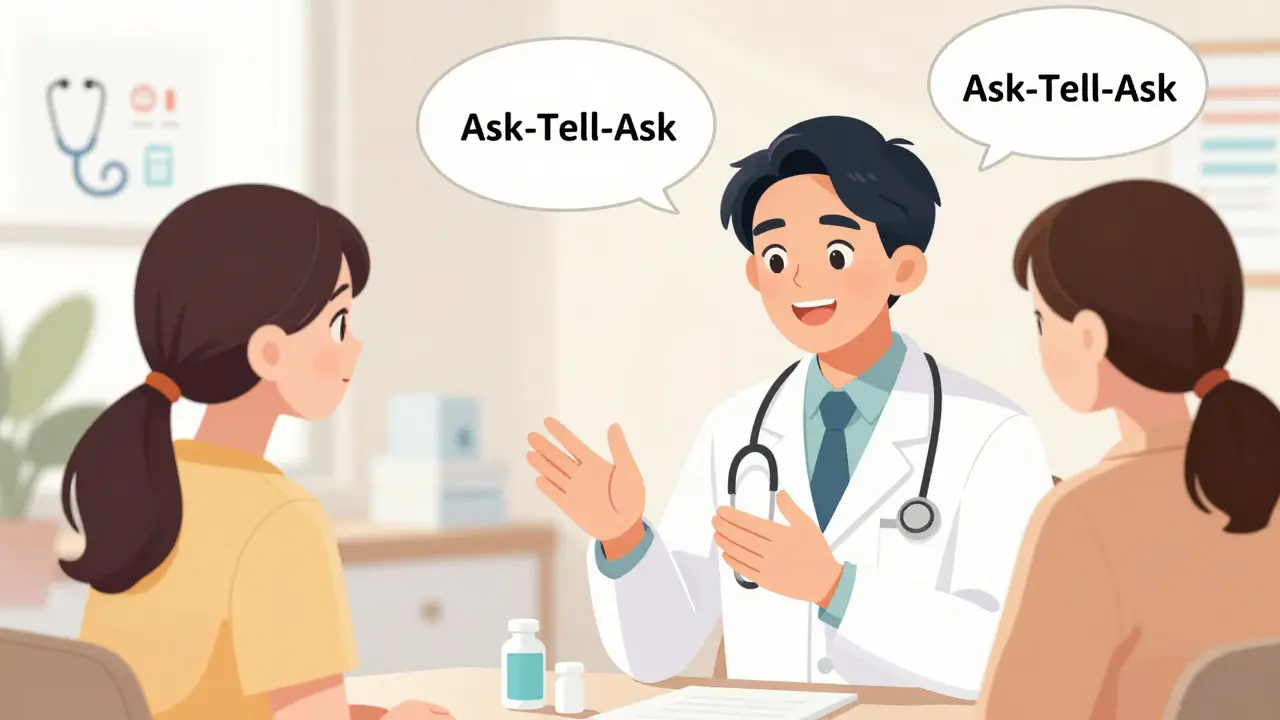
Try the Ask-Tell-Ask approach recommended by the FDA:
- Ask First: Start by asking your doctor what they know about your current medication. Example: “I’ve heard there’s a generic option available. Can we talk about it?”
- Tell Them Your Concerns: Share any worries you have-whether it’s cost, appearance, past experiences, or fear of reduced effectiveness.
- Ask Again: End with a question to verify understanding. Try: “Can you explain how this new medication will work for me?”
This simple framework takes just two to three extra minutes per consultation-but according to a 2022 study, it reduces medication errors by 37%. Plus, it builds trust between you and your provider.
Common Questions Patients Ask About Generics
| Question | Answer |
|---|---|
| Do generic drugs work as well as brand-name ones? | Yes. The FDA requires generics to be bioequivalent and therapeutically equivalent to brand-name drugs. |
| Why do generics look different? | Different colors and shapes come from inactive ingredients that don’t affect how the drug works. |
| Are generics safer than brand-name drugs? | Both types undergo identical safety checks. Generics simply skip redundant clinical trials because the API has already been proven safe. |
| Can I request a specific brand instead of a generic? | Yes, though insurance coverage may change. Always discuss alternatives with your doctor or pharmacist first. |
| Will my doctor prescribe me a generic automatically? | Most states allow automatic substitution unless the prescriber specifies otherwise. You always have the right to ask. |
Real-World Savings From Switching to Generics
Let’s put numbers to the benefit. According to IQVIA data from 2023:
- Average retail price for a generic prescription: $15.78
- Average retail price for a brand-name prescription: $674.89
- Annual savings per patient on cardiovascular meds alone: ~$2,847
- Total annual savings across U.S. healthcare system: $1.7 trillion
For Medicare Part D beneficiaries refusing generic substitution, potential yearly savings average $5,200. Multiply that by millions of users, and you see why policymakers push for wider adoption.
When Might You Stick With Brand-Name?
There are rare situations where sticking with a brand-name drug makes sense:
- Narrow Therapeutic Index (NTI) Drugs: Some medications-like warfarin or lithium-require tighter control. The FDA mandates narrower bioequivalence ranges (90-110%) for these drugs due to their sensitivity.
- Complex Delivery Systems: Inhalers, topical creams, and extended-release formulations sometimes pose challenges in matching performance exactly.
- Personal Sensitivity: If you’ve tried multiple generics and experienced consistent side effects, talk to your doctor about exploring other options-including biosimilars or alternative therapies.
Remember: your comfort matters. If a particular brand truly works better for you, advocate for yourself-but understand the trade-offs involved.
Tips for Successful Medication Management
To make the most of your treatment plan-whether on generics or brand-names-follow these practical steps:
- Keep a Medication Diary: Track dosage times, side effects, and symptom changes. This helps identify patterns quickly.
- Use Teach-Back Techniques: After each appointment, summarize back what you understood. Example: “So I’ll take one tablet every morning before breakfast.”
- Consult Your Pharmacist Regularly: Pharmacists are medication experts. Don’t hesitate to ask them questions about interactions, storage, or timing.
- Stay Updated on Policy Changes: New laws like the Inflation Reduction Act aim to reduce copays for generics starting in 2025. Know your rights and benefits.
Future of Generic Drugs and Patient Education
The landscape around generic medications continues evolving. Recent developments include:
- FDA’s ‘Take With Confidence’ Campaign (2024): Features patient testimonials and training modules designed to ease fears around generics.
- AI-Powered Tools: Pilots like the FDA’s Generic Drug Navigator chatbot offer instant answers to common patient queries.
- QR Code Integration: Future labels may link directly to video explanations showing how generics compare to brand-name versions.
- Standardized Counseling Metrics: ASHP plans to require uniform documentation practices among pharmacists to improve education quality nationwide.
With growing emphasis on transparency and accessibility, patients now have more tools than ever to stay informed and empowered.
Is it okay to switch from brand-name to generic medication?
Absolutely. Generics are required by law to be bioequivalent and therapeutically equivalent to brand-name drugs. Millions of patients safely switch every year, saving significant money while maintaining health outcomes.
Why do some doctors prefer prescribing generics?
Doctors recommend generics because they’re equally effective, significantly cheaper, and backed by strong scientific evidence. Additionally, higher adherence rates mean better long-term health results for patients.
Can I refuse a generic substitution?
Yes, you can choose to stay on a brand-name drug. However, check with your insurance provider first-coverage terms may change depending on your plan.
What should I do if I experience side effects after switching to a generic?
Contact your doctor immediately. While most side effects resolve quickly, persistent issues may warrant switching back to the brand-name version or trying another generic formulation.
Are all generic drugs covered by insurance?
Most insurers strongly encourage generic use and cover them fully or at low cost. Under the Inflation Reduction Act, Medicare Part D will eliminate cost-sharing for generics entirely by 2025.
How do I find reliable information about generic medications?
Start with official sources like the FDA website, ASHP guidelines, or your local pharmacy. Avoid relying solely on anecdotal reports online-always cross-check with credible references.
Do generic drugs expire faster than brand-name ones?
No. Both types must meet the same stability requirements set by the FDA. Expiration dates reflect shelf life based on storage conditions-not inherent differences in formulation.
Should I worry about manufacturing locations for generic drugs?
Not necessarily. Facilities worldwide must comply with FDA cGMP standards. As of FY2023, 98.7% of inspected generic plants passed evaluation-showing high global compliance levels.