
When your doctor hands you a prescription for a brand-name drug, you might assume you have no choice but to pay the full price. But here’s the truth: generic medication is often just as safe, just as effective, and costs up to 85% less. In fact, 9 out of 10 prescriptions filled in the U.S. are for generics. The question isn’t whether a generic exists-it’s whether you’re checking for it.
Why Generic Medications Are Worth Asking For
Generic drugs aren’t cheap knockoffs. They’re exact copies of brand-name drugs in every way that matters: same active ingredient, same strength, same way of being taken-whether it’s a pill, injection, or inhaler. The FDA requires them to deliver the same results in your body. That’s not marketing speak-it’s science. A generic version of Lipitor (atorvastatin) works the same as the brand. So does the generic for Zoloft (sertraline), Metformin, or even your morning blood pressure pill. The only differences? The inactive ingredients-like fillers or dyes-and the packaging. Those don’t affect how the drug works. And yes, the price difference is staggering. In 2022, the average brand-name drug cost $765. A generic? Just $15. That’s not a small saving. That’s hundreds of dollars a month.How to Find Out If a Generic Is Available
You don’t need to be a pharmacist or a researcher to find out. Here’s how to do it, step by step.1. Ask Your Pharmacist First
This is the fastest, easiest, and most reliable method. Pharmacists have real-time access to databases that tell them exactly which generics are approved and available. When you drop off your prescription, say: “Is there a therapeutically equivalent generic version of this drug?” Don’t just ask, “Do you have a generic?” That’s too vague. You want to know if it’s an AB-rated generic-the kind the FDA says is fully interchangeable. Pharmacists get this right 98.7% of the time, according to a JAMA study. Most major chains-CVS, Walgreens, Rite Aid-automatically flag generic options before you even ask. But if they don’t bring it up, ask. It’s your right.2. Use the FDA’s Drugs@FDA Database
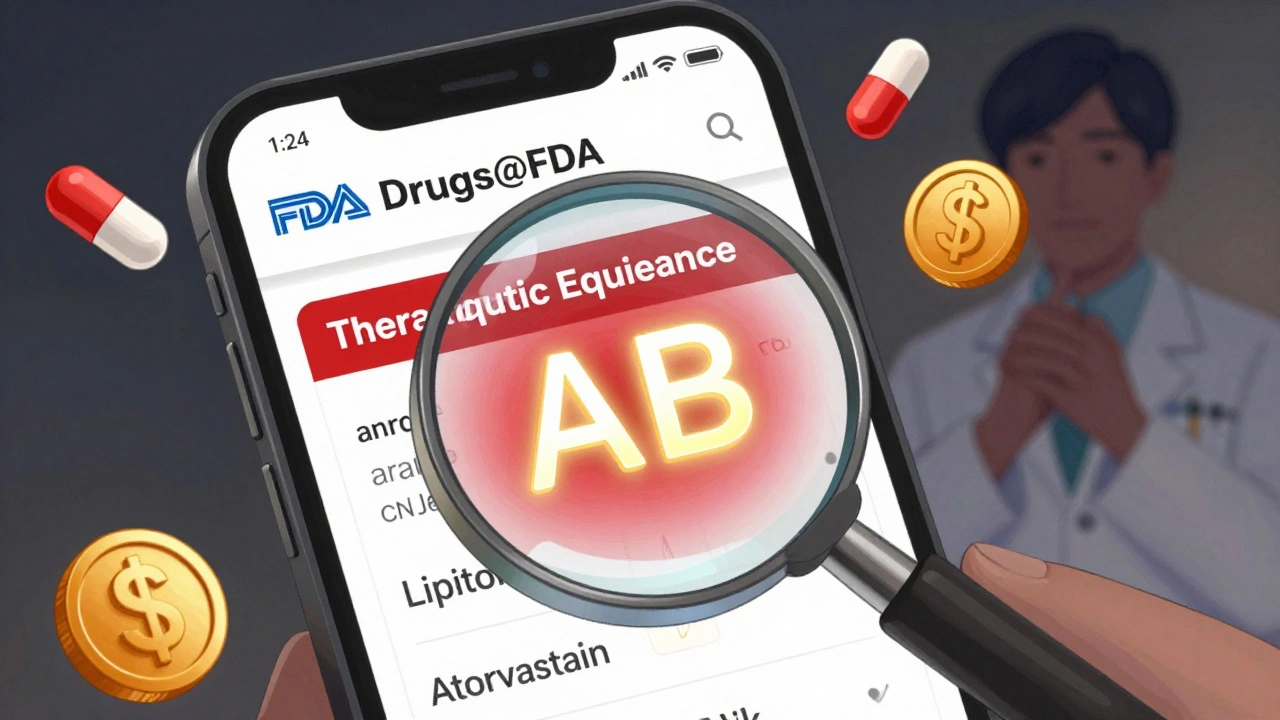
If you want to check yourself, go to Drugs@FDA. Search for your brand-name drug. Once you find it, scroll down to the “Therapeutic Equivalence” section. Look for the two-letter code next to each approved version. - AB means it’s approved as interchangeable with the brand. Safe to swap. - BX means it’s not rated as equivalent. Avoid swapping without talking to your doctor. You’ll also see the generic name listed right under the brand. If you see multiple AB-rated versions, you’ve got options. Some might be cheaper than others.3. Check the Orange Book (Officially: Approved Drug Products with Therapeutic Equivalence Evaluations)
The FDA’s Orange Book is the gold standard. It’s where all therapeutic equivalence ratings are published. You can search it directly on the FDA website. It’s more technical than Drugs@FDA, but it’s the source all pharmacies use. Look for the “Therapeutic Equivalence Code.” If it says “A” for the first letter and “B” for the second (AB), you’re good. If it says “B,” stay away unless your doctor says otherwise.4. Use GoodRx or Similar Apps
Apps like GoodRx are great for comparing prices. They’ll show you how much a generic costs at nearby pharmacies-sometimes under $5 with a coupon. But here’s the catch: GoodRx doesn’t always tell you if the generic is rated as therapeutically equivalent. It just shows you what’s available to buy. So use it for price checks, but always cross-reference with the FDA’s rating to be sure.5. Check Your Medicare or Insurance Plan
If you’re on Medicare Part D or have private insurance, your plan’s formulary determines what gets covered-and at what cost. Go to your plan’s website and use the Drug Finder tool. Type in your brand-name drug. It will tell you if a generic is preferred (and cheaper). Some plans automatically switch you to a generic unless your doctor writes “Do Not Substitute.” But beware: some plans switch you without telling you. That’s why you should always check your receipt or pharmacy confirmation. If your pill looks different, ask why.When a Generic Might Not Be the Best Choice
Most of the time, generics are perfect. But there are exceptions. Some drugs have a very narrow therapeutic index. That means even a tiny difference in how the body absorbs the drug can cause serious side effects. Examples include:- Warfarin (blood thinner)
- Levothyroxine (thyroid hormone)
- Phenytoin (seizure control)
- Lithium (bipolar disorder)
What to Do If No Generic Is Available
About 10% of medications still don’t have generics. Why? Patents. Brand-name companies hold exclusive rights for up to 17 years from the patent filing date, and sometimes longer due to legal extensions. If your drug is still under patent, there’s no generic yet. But that doesn’t mean you’re stuck paying full price. Ask your doctor if there’s another drug in the same class that’s already generic. For example, if your brand-name statin is still under patent, maybe a different statin like generic atorvastatin or rosuvastatin would work just as well. You can also check the ASHP Drug Shortages database. Sometimes, even if a generic exists, it might be out of stock. That’s rare but worth knowing.Real Stories: What People Are Saving
One Reddit user saved $1,200 a year just by switching from a brand-name antidepressant to its generic. Another found their $400 monthly insulin was available as a $25 generic alternative after asking their pharmacist. A Medicare beneficiary in Ohio discovered her $180 brand-name blood pressure pill had a $9 generic version-she’d been overpaying for three years. On TikTok, nurses like @nurse_jen are showing people how to use the FDA’s Drugs@FDA tool in under 60 seconds. The video has over 2 million views because people are tired of being overcharged.
मनोज कुमार
December 2, 2025 AT 13:53Generic = same active ingredient. FDA says so. Pharmacist confirms. Save money. Done. Why is this even a debate?
Arun kumar
December 4, 2025 AT 01:15bro i switched my zoloft to generic last year and my anxiety didnt care. same pill, same effect, just cheaper. why do people act like generics are some kind of scam? its not magic, its science. the company just stopped paying for fancy packaging and ads. i saved like 300 a month. mind blown.
Zed theMartian
December 4, 2025 AT 12:14Oh wow. A whole article about how to *check* for generics. As if the average American isn’t already drowning in pharmaceutical greed. Did you know that in Canada, you can buy the exact same pills for $5? And they’re not even ‘generics’-they’re the same damn drugs from the same factories. This isn’t innovation. This is exploitation dressed up as ‘consumer empowerment.’
And let’s not pretend the FDA is some saintly guardian. They rubber-stamp generics while letting brand-name companies extend patents via ‘evergreening’ loopholes. You think your ‘AB-rated’ pill is safe? Ask someone who got sick after switching from one generic to another because the fillers changed. The system is rigged. You’re just being told how to play the game better.
Ella van Rij
December 6, 2025 AT 02:32so like… i just found out my blood pressure med has a generic and i’ve been paying $120 a month for 4 years??
also i spelled ‘generic’ wrong in my notes. again. oops.
ATUL BHARDWAJ
December 6, 2025 AT 21:42India makes 60% of global generic drugs. US pays more because it refuses to negotiate. Simple. Ask pharmacist. Save money. No drama.
Steve World Shopping
December 8, 2025 AT 02:34Generic isn’t ‘cheaper’-it’s the baseline. Brand names are the overpriced luxury tier. You’re not saving money. You’re just paying the fair price for the first time. And if you’re still buying brand-name statins in 2024? You’re part of the problem. The FDA isn’t your babysitter. Educate yourself or keep bleeding cash.
Rebecca M.
December 9, 2025 AT 10:48Oh my god I just realized I’ve been paying $180 for my blood pressure pill when it’s $9? I feel like I’ve been scammed by the entire medical industrial complex. My therapist is going to have a field day with this. Also I cried in the pharmacy. Again.
Lynn Steiner
December 10, 2025 AT 12:47I’ve been on levothyroxine for 12 years. I switched generics once. My heart started racing. I couldn’t sleep. I felt like I was dying. I went back to the brand. Now I pay $45 a month. I’d rather pay for peace of mind than gamble with my thyroid. Don’t tell me to ‘just save money.’ My body isn’t a spreadsheet.
😭
Alicia Marks
December 12, 2025 AT 04:25Good for you for asking! You deserve to pay less for your health. Keep checking every 6 months-new generics drop all the time. You got this 💪
Paul Keller
December 13, 2025 AT 22:36While the premise of this article is technically accurate, it fails to address the systemic issues underlying pharmaceutical pricing in the United States. The fact that a patient must independently research therapeutic equivalence codes via the FDA’s Orange Book is not a feature-it is a failure of public policy. The burden of cost mitigation has been shifted entirely onto the consumer, while pharmaceutical corporations retain monopolistic pricing power through patent extensions and regulatory capture. One cannot ‘empower’ oneself out of structural inequity. This is not a guide to savings-it is a manual for survival in a broken system.
Shannara Jenkins
December 14, 2025 AT 02:32My grandma started using GoodRx after I showed her how. She’s on three meds now-all generics-and her monthly cost dropped from $312 to $47. She sends me memes now about ‘pharma scams.’ I’m so proud. You’re not alone. Ask. Always ask.
Elizabeth Grace
December 15, 2025 AT 03:30i just checked my insulin and it’s a $25 generic?? i’ve been paying $400 for 3 years. i’m not mad. i’m just… disappointed in myself. and the system. and my doctor who never mentioned it. why does no one tell you this stuff?
Steve Enck
December 16, 2025 AT 18:00Let us not confuse accessibility with efficacy. The FDA’s AB rating is a statistical construct, not a biological guarantee. Bioequivalence is measured via mean AUC and Cmax thresholds-yet inter-individual pharmacokinetic variance is rarely accounted for. For patients with polypharmacy, hepatic impairment, or genetic polymorphisms in CYP450 enzymes, even minor excipient differences can trigger clinically significant deviations. The ‘one-size-fits-all’ paradigm of generic substitution is a dangerous oversimplification. This article romanticizes commodification as liberation. It is not.
Jay Everett
December 16, 2025 AT 20:47Y’all are overthinking this. Go to Drugs@FDA. Type in your brand name. Look for AB. If it’s there, ask your pharmacist for it. If they give you a hard time, say ‘I know it’s AB-rated, I checked.’ They’ll swap it. Done. I saved $800 last year just by doing this for my cholesterol and diabetes meds. My dog even got a new bed with the savings. 🐶💰