

When your kidneys stop working, the clock starts ticking. You face a choice that will define your daily routine, your physical comfort, and your long-term health. The two main paths are hemodialysis, which uses a machine to filter your blood outside your body, and peritoneal dialysis, which uses the lining of your abdomen to clean your blood from the inside out. Neither option is perfect, but one might fit your life far better than the other. Understanding the mechanics, the lifestyle impact, and the clinical outcomes of each can help you navigate this critical decision with confidence rather than fear.
How Hemodialysis Works: The External Filter
Hemodialysis (HD) has been the standard of care since the 1940s, pioneered by Dutch physician Willem Kolff. It is an aggressive, high-efficiency process that physically pulls blood out of your body, runs it through an artificial kidney, and returns it cleaned. Think of it as using a powerful external vacuum to clear debris from a clogged pipe.
To make this work, you need reliable access to your bloodstream. Most patients get an arteriovenous (AV) fistula created surgically. This involves connecting an artery to a vein in your arm, causing the vein to enlarge and strengthen over 6-8 weeks. Once matured, needles can be inserted directly into the fistula during treatment. If a fistula isn't possible, doctors may use an AV graft or a central venous catheter, though these carry higher infection risks.
The actual treatment usually happens three times a week, lasting 3 to 5 hours per session. During this time, blood flows through the dialyzer at rates of 300-500 mL/min. The machine removes waste products like urea and excess fluid rapidly. While effective, this rapid removal can cause a "crash" effect. Many patients report feeling wiped out, dizzy, or nauseous after a session because their blood pressure drops suddenly as fluid is pulled off too quickly.
- Frequency: Typically 3 times per week.
- Duration: 3-5 hours per session.
- Location: Usually in a clinic (in-center), though home HD exists.
- Access: Requires surgical creation of AV fistula, graft, or catheter.
How Peritoneal Dialysis Works: Your Body as the Filter
Peritoneal dialysis (PD) takes a gentler, more continuous approach. Instead of a machine doing all the heavy lifting, PD uses your own peritoneum-the thin membrane lining your abdominal cavity-as a natural semipermeable filter. This method was first successfully performed in 1923 but wasn't refined for chronic use until the 1970s.
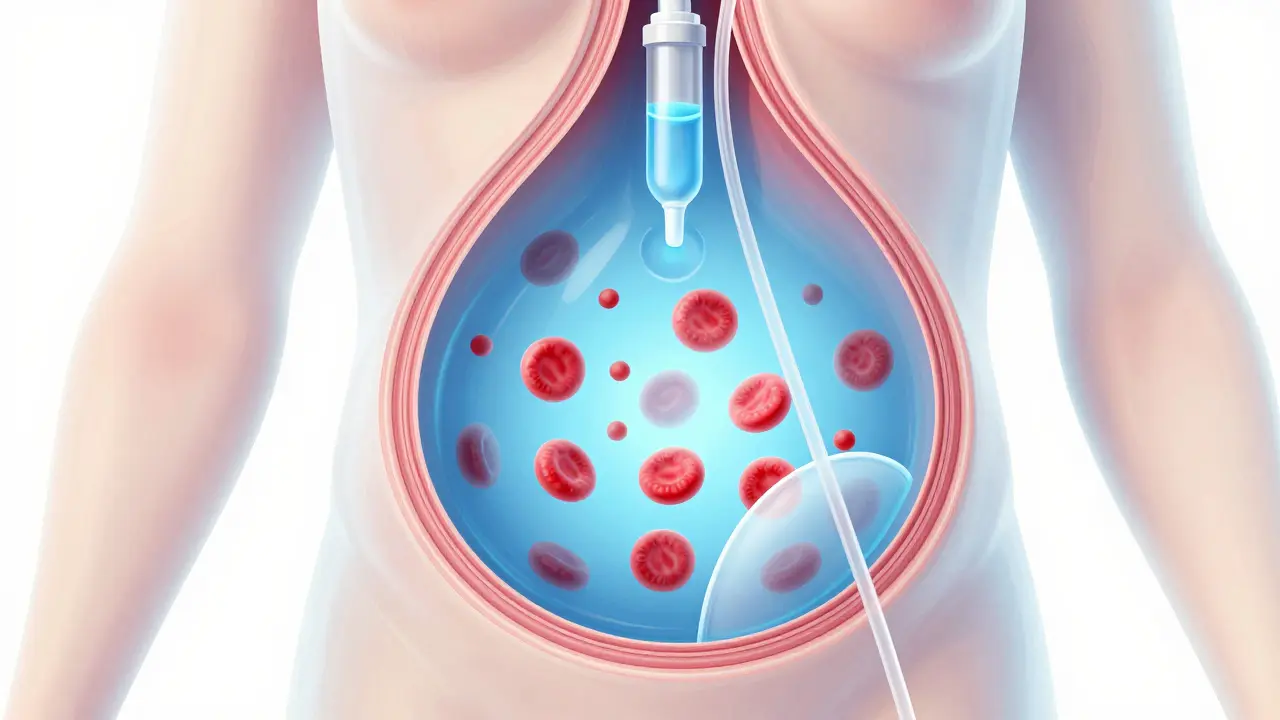
A soft plastic tube called a Tenckhoff catheter is surgically implanted into your abdomen. Through this catheter, a special cleaning fluid called dialysate is introduced into your belly. The fluid sits there for a "dwell time" of 4 to 6 hours. During this period, waste products and excess fluid pass from your blood vessels in the peritoneum into the dialysate. Afterward, you drain the used fluid out and replace it with fresh solution.
There are two main ways to do PD. Continuous Ambulatory Peritoneal Dialysis (CAPD) involves manual exchanges throughout the day-usually 3 to 5 times. Automated Peritoneal Dialysis (APD) uses a machine called a cycler that performs multiple exchanges overnight while you sleep, leaving you free during the day. Because PD works continuously, it avoids the sharp spikes and drops in toxin levels seen with hemodialysis, leading to better stability for many patients.
- Frequency: Daily exchanges (manual or automated).
- Duration: Dwell times of 4-6 hours; APD runs overnight.
- Location: Home-based.
- Access: Requires implantation of a Tenckhoff catheter.
Clinical Outcomes: Stability vs. Speed
Which therapy is medically superior? The answer depends on what you value: speed of clearance or physiological stability. A 2023 study published in the National Center for Biotechnology Information (PMC10626077) compared clinical outcomes between 74 hemodialysis patients and 77 peritoneal dialysis patients. The results showed that PD demonstrated significantly lower systolic and diastolic blood pressure levels, along with better control of intact parathyroid hormone (iPTH). Crucially, the PD group had a significantly lower total incidence of complications.
Hemodialysis achieves higher clearance rates per single session. A typical HD session targets a Kt/V (a measure of dialysis adequacy) of 1.2-1.4. PD aims for a weekly Kt/V of 1.7-2.1. While HD sounds more impressive per hour, PD provides consistent filtration 24/7. This means less buildup of potassium, sodium, and fluid between treatments. For patients with heart conditions, this steady state is often safer. HD poses greater risks for hemodynamic instability, whereas PD protects residual kidney function longer.
| Metric | Hemodialysis (HD) | Peritoneal Dialysis (PD) |
|---|---|---|
| Blood Pressure Control | Often unstable during sessions | More stable, lower complications |
| Toxin Clearance | High per session, intermittent | Lower per exchange, continuous |
| Residual Kidney Function | Declines faster | Better preserved |
| Fluid Removal | Rapid, can cause cramping/dizziness | Gentle, gradual removal |
| Infection Risk | Bloodstream infections (catheters) | Peritonitis (abdominal infection) |
Lifestyle Impact: Freedom vs. Flexibility
Your choice of dialysis will dictate how you spend your days. Hemodialysis typically ties you to a clinic schedule. Three days a week, you must travel to a center, arrive early, stay for 4-5 hours, and then recover. This rigid structure makes full-time work difficult and limits spontaneity. However, it also means healthcare professionals handle the technical aspects. You sit back, read, or nap while nurses monitor you.
Peritoneal dialysis offers significant freedom. Since it is home-based, you can travel, work, and manage household chores more easily. A 2022 patient survey by the National Kidney Foundation found that 68% of PD users reported higher satisfaction with treatment flexibility compared to only 32% of HD users. But this freedom comes with responsibility. You become your own nurse. You must learn sterile techniques to prevent peritonitis, an abdominal infection that occurs in 0.3-0.7 episodes per patient-year. You also need space to store dialysate bags and, if using APD, a cycler machine.
Reddit discussions among kidney disease patients highlight these trade-offs. In June 2023, 97% of comments about HD complained about the rigid schedule and post-treatment fatigue. Conversely, 78% of PD users expressed concern about the constant presence of the catheter and the mental load of daily management. If you have impaired manual dexterity, morbid obesity (BMI >35), or extensive abdominal scarring, PD may not be suitable for you.

Cost and Accessibility
Money matters when choosing a long-term therapy. Globally, hemodialysis dominates the market, comprising approximately 85% of dialysis revenue. In the United States, about 70% of dialysis patients use in-center HD, while only 10-15% use PD. This disparity isn't just preference; it's infrastructure. There are far more dialysis centers than home training programs.
However, studies suggest PD offers superior value for money. The Journal of Peritoneal Therapy and Clinical Practice (2023) noted that PD provides better early patient-reported quality of life outcomes at a lower cost to the healthcare system. Despite this, barriers remain. Only 34% of US nephrology fellows receive adequate PD training, leading to fewer doctors who can prescribe and manage it effectively. Geographic variations are stark: Hong Kong sees 77% PD adoption, Mexico 48%, while the US lags at 12%. Reimbursement policies, like the CMS ESRD Treatment Choices Model, are now incentivizing home therapies, aiming for 80% of new patients to consider home dialysis or transplant by 2025.
Who Should Choose What?
There is no universal winner. The best choice depends on your specific health profile and personal circumstances.
Consider Hemodialysis if:
- You have severe cardiovascular instability or cannot tolerate the fluid shifts of PD.
- You lack the physical dexterity or cognitive ability to perform sterile exchanges.
- You live alone without support and prefer professional oversight during treatment.
- You have extensive abdominal surgeries or hernias that compromise the peritoneum.
Consider Peritoneal Dialysis if:
- You want to maintain employment or travel frequently.
- You have heart disease and need gentle, continuous fluid removal.
- You wish to preserve residual kidney function for as long as possible.
- You have a safe, clean space at home for supplies and equipment.
Experts consistently identify PD as more appropriate for medically stable patients seeking independence, while HD is recommended for those with advanced comorbidities or acute kidney injury. Dr. Xu XD’s research confirms that PD imposes less strain on the vascular system, making it a kinder option for many elderly patients.
Can I switch from hemodialysis to peritoneal dialysis later?
Yes, switching modalities is possible, though it requires careful medical planning. Moving from HD to PD involves surgery to place the Tenckhoff catheter and a healing period of 10-14 days before starting. Switching from PD to HD requires creating vascular access, such as an AV fistula, which takes 6-8 weeks to mature. Discuss your long-term goals with your nephrologist early to keep both options open.
Is peritoneal dialysis painful?
The procedure itself is generally not painful. Some patients feel mild discomfort or bloating when the dialysate fills the abdomen, especially during the first few weeks. Pain during exchange usually indicates a problem, such as constipation or peritonitis, and should be reported immediately. Proper technique and positioning can minimize discomfort.
What is the biggest risk of peritoneal dialysis?
The primary risk is peritonitis, an infection of the peritoneal membrane. Symptoms include cloudy dialysate fluid, abdominal pain, and fever. Strict adherence to sterile technique during connections drastically reduces this risk. With proper hygiene, infection rates are low (0.3-0.7 episodes per patient-year), but prompt treatment with antibiotics is essential if it occurs.
Does insurance cover home dialysis supplies?
In most developed countries, including the US under Medicare, home dialysis supplies (dialysate, tubing, cyclers) are fully covered. The Centers for Medicare & Medicaid Services (CMS) actively incentivizes home therapies due to their cost-effectiveness. Private insurers typically follow similar guidelines, but you should verify coverage details for travel and emergency supplies.
Which dialysis type has better survival rates?
Recent large-scale studies show no consistent survival advantage for either modality in the general end-stage renal disease population. Survival depends more on individual factors like age, comorbidities, and adherence to treatment. However, PD tends to offer better quality of life and hemodynamic stability, which indirectly supports long-term health.