
When you pick up a generic pill from the pharmacy, you expect it to work the same as the brand-name version. You trust that it’s safe, clean, and effective. But what if that pill had been contaminated during manufacturing? Contamination in generic drugs isn’t a rare glitch-it’s a growing, documented risk that affects real people. In 2022, generic drugs made up 37% of all contamination-related drug recalls in the U.S., even though they account for 90% of prescriptions filled. This isn’t about suspicion. It’s about science, supply chains, and how little oversight exists in places where drugs are made.
How Contamination Happens in Generic Drugs
Contamination doesn’t mean dirt or dust. It means unintended chemicals, microbes, or residues from other drugs mixing into your medicine. The FDA calls this cross-contamination: when leftover material from one product sticks around and gets into the next. Think of it like using the same knife to cut cheese, then meat, without washing it. The cheese residue stays-and now the meat is contaminated.
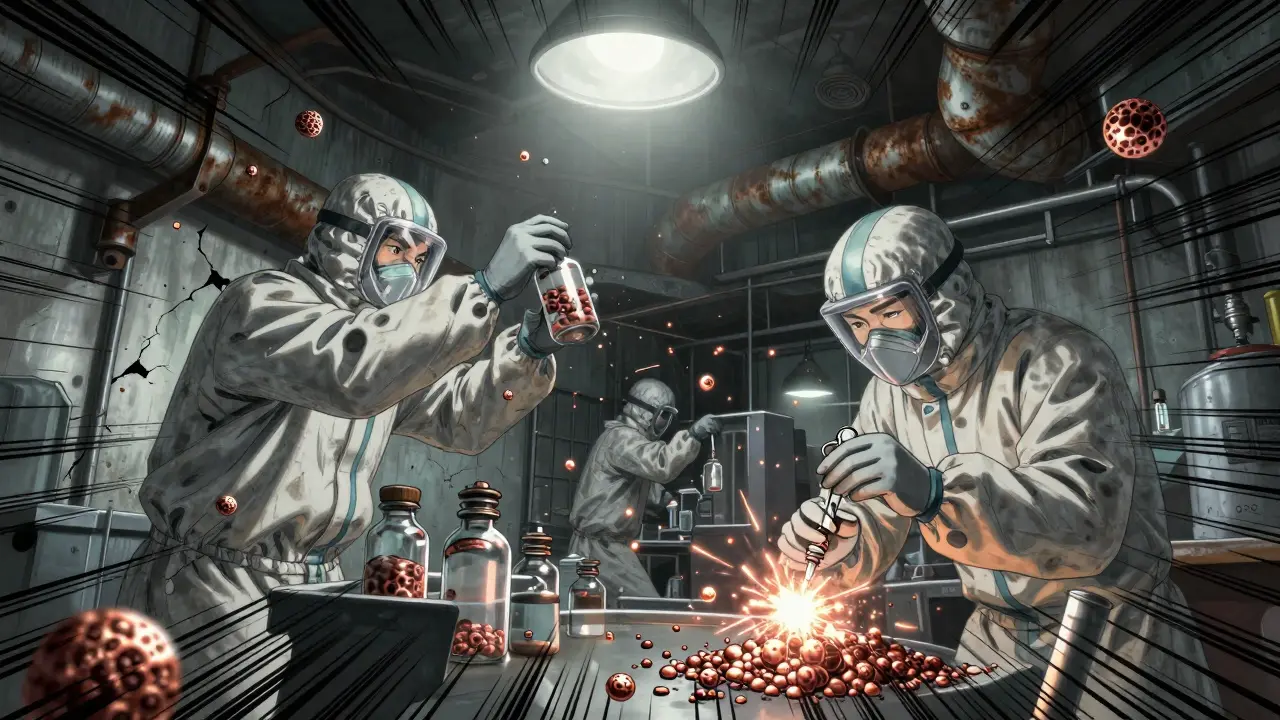
Most contamination happens during manufacturing. The biggest culprits? Human error and outdated facilities. Studies show that a single person in a cleanroom sheds about 40,000 skin cells per minute. That’s over 100,000 tiny particles floating in the air just by standing still. These particles carry bacteria, fungi, and even trace chemicals. When a worker handles vials, breaks ampules, or pierces stoppers with needles-common steps in making pills or injections-they can introduce contaminants. In fact, 62% of hazardous drug incidents are tied to needle use alone.
Then there’s the environment. Non-sterile drugs (like pills and creams) must be made in environments meeting ISO Class 8 standards. That’s like a clean warehouse, not a hospital operating room. But even that’s not enough. Some manufacturers still use facilities built before 2000, which were never designed for today’s strict standards. Older buildings have cracks, poor airflow, and outdated HVAC systems. These aren’t just flaws-they’re contamination highways.
Why Generic Drugs Are More at Risk
Generic drugs must meet the same quality rules as brand-name drugs. That’s the law. But here’s the catch: generics are made for pennies. The average profit margin on a generic pill is 20-25%. Brand-name drugs? 60-70%. That gap changes everything.
When profits are thin, companies cut corners. They delay equipment upgrades. They skip extra cleaning cycles. They use cheaper cleaning agents that don’t fully remove residues. The FDA found that 8.3% of generic manufacturing sites got flagged for contamination control issues in 2022. For brand-name companies? Only 5.1%. The difference isn’t luck-it’s investment.
And it’s not just about money. Most generic drugs rely on raw ingredients made overseas. About 80% of active pharmaceutical ingredients (APIs) come from India and China. The FDA inspects just 1% of imported drug products each year. That’s like checking one out of every 100 bags at the airport. If a batch is contaminated, it slips through. In 2022, Indian facilities had 12.7% of contamination-related FDA observations-more than double the rate of U.S.-based plants.
Real Cases: When Contamination Hits Patients
Stories aren’t hypothetical. In 2021, a patient developed severe skin rashes after using a generic hydrocortisone cream. Testing found copper particles-something that shouldn’t be in a skin ointment. The FDA logged it as Report #123456. Another case, reported by a pharmacist on Reddit, described metronidazole tablets with blue specks. Lab tests confirmed copper contamination. The patient had taken the pills for a bacterial infection. Instead of healing, they got sick.
Pharmacists are seeing this too. A 2022 survey by the American Society of Health-System Pharmacists found that 28% of hospital pharmacists had encountered suspicious generics. Of those, 14% led to patient harm. One hospital had to pull 200 bottles of a generic antibiotic after staff noticed unusual discoloration. The batch was traced back to a single manufacturing line that hadn’t been cleaned properly between runs.
These aren’t isolated. Between 2020 and 2022, the FDA received 1,247 reports of possible contamination in generic drugs. Nearly 400 of them involved actual health problems-rashes, nausea, infections, even organ damage. Patients don’t always connect the dots. They blame themselves: “Did I do something wrong?” The truth? The problem started on a factory floor halfway around the world.
How Manufacturers Prevent Contamination
Not all generic manufacturers cut corners. Some have turned contamination control into a competitive advantage.
Teva’s facility in Bologna, Italy, slashed cross-contamination incidents by 78% between 2018 and 2022. How? They installed closed manufacturing systems. These are sealed, automated lines where drugs move without human contact. No needles. No open vials. No airborne particles. It costs $500,000 to $2 million per line-but it works.
Mylan’s Morgantown plant reduced contamination by 82% using real-time particle monitors. These devices track air quality every second. If a spike happens, the system shuts down the line before a single pill is packed. They also overhauled gowning procedures. Workers now change clothes twice before entering cleanrooms. They wear full hoods, double gloves, and shoe covers. Training isn’t optional. It’s 12 hours a year-mandatory.
Even cleaning validation has gotten smarter. The old rule? Remove 10 parts per million (ppm) of previous drug residue. But that’s not enough for potent drugs. A 2022 FDA advisory said acceptance limits must be based on toxicology-not guesswork. If a drug is powerful at 0.1 mg, then even 1 ppm of residue could be dangerous. Leading companies now test for product-specific thresholds.
What You Can Do as a Patient or Pharmacist
You can’t test your pills at home. But you can stay alert.
- Check the pill’s appearance. If it looks different-color, shape, markings-ask your pharmacist. A change doesn’t always mean contamination, but it’s worth verifying.
- Report anything odd. If you feel sick after taking a new generic, tell your doctor. Ask them to file a report with the FDA’s MedWatch system. You don’t need proof. Just suspicion.
- Use reputable pharmacies. Chain pharmacies often have better supply chain tracking than small independents. But even then, most don’t test drugs themselves. Only 37% of independent pharmacists say they have the tools to check for contamination.
- Know your drug’s manufacturer. Some companies consistently have clean records. Teva, Sandoz, and Mylan have improved transparency. Others? Less so. You can search FDA inspection reports by company name.
Pharmacists: If you see a suspicious batch, don’t dispense it. Quarantine it. Contact the manufacturer. And report it. One report can trigger a recall that saves hundreds of lives.
What’s Changing in 2026
The system is slowly getting better. In January 2023, the FDA made nitrosamine testing mandatory for all sartan-class blood pressure drugs. That’s after a 2018 crisis where 2,317 recalls happened over cancer-causing impurities. Now, the agency uses a system called PREDICT to flag risky shipments before they even land in the U.S. It’s 37% better at catching contamination than the old system.
Technology is helping too. Rapid microbiological methods can now detect bacteria in 4 hours instead of 7 days. That’s a game-changer. Sixty-three percent of top generic makers have adopted these methods. By 2024, the FDA plans to roll out AI systems that analyze 15,000 data points per factory to predict contamination before it happens. Early tests show 89% accuracy.
But the biggest challenge remains: global supply chains. As long as 80% of APIs come from two countries, and inspections remain at 1%, the risk won’t disappear. Regulation can’t keep up with complexity. That’s why prevention must be built into every step-design, cleaning, training, monitoring.
Bottom Line: Safety Isn’t Automatic
Generic drugs save billions of dollars every year. They’re essential. But safety isn’t guaranteed just because a pill is cheap. Contamination risks are real, documented, and growing. The same drug, made by two different companies, can have wildly different safety records. It’s not about brand. It’s about manufacturing standards.
Patients need to know: if your medicine looks, tastes, or feels different, speak up. Pharmacists need to act: if something seems off, don’t ignore it. And regulators? They need more power, more funding, more inspections. Until then, vigilance is your best defense.
Andrew Mamone
March 19, 2026 AT 13:08Just wanted to say this post is incredibly well-researched. I work in pharma logistics, and I can tell you-cleanrooms aren’t what they used to be. Some places still use 1990s HVAC systems. One plant I visited had a fan that sounded like a dying dragon. 😅
But hey, the good news? More companies are adopting closed systems. Teva’s Bologna facility? Absolute gold standard. No human contact. No airborne particles. Just robots doing the job right.
It’s expensive, sure-but so is a lawsuit when someone gets poisoned by copper in their cream. 💡
MALYN RICABLANCA
March 20, 2026 AT 05:07OH MY GOD. I CAN’T BELIEVE THIS IS HAPPENING. 🤯
So like, I took this generic metronidazole last month-blue specks? YES. I thought I was hallucinating. Then I Googled it. And guess what? I’m not alone. I’m basically a walking case study. 🧪
My pharmacist said, ‘Oh, that’s normal.’ NORMAL?!?! I’ve been taking this for 12 years and NEVER saw blue. Now my gut feels like it’s been through a blender. I’m filing a report. I’m going viral. I’m suing someone. I’m calling the FDA. I’m crying. I’m screaming into the void. 🙃
gemeika hernandez
March 20, 2026 AT 14:53This is scary. People don’t realize how much we rely on pills. I had a friend who got sick from a generic antibiotic. She thought she had the flu. Turns out, it was contamination. She was in the hospital for a week. Just because someone didn’t clean a machine right.
And yeah, India and China make most of the stuff. But we buy it because it’s cheap. So we’re basically trading safety for savings. That’s not a deal. That’s a trap.
Nicole Blain
March 21, 2026 AT 07:16My grandma takes 7 generics a day. I just checked her pill bottles. Two looked slightly off-color. I asked her pharmacist. She said, ‘It’s fine, different batch.’
…I’m gonna start keeping a log. 📋
Kathy Underhill
March 21, 2026 AT 20:43There’s a deeper issue here: we’ve outsourced trust.
We assume that because a drug is FDA-approved, it’s safe. But approval isn’t inspection. It’s paperwork. And when the system is stretched thin-when 1% of imports are checked-it’s not a regulatory failure. It’s a philosophical one.
We’ve turned medicine into a commodity. And commodities are optimized for cost, not care.
The solution isn’t more rules. It’s a shift in values. Medicine isn’t widgets. It’s life.
Srividhya Srinivasan
March 22, 2026 AT 02:13Of course it’s happening! 🤡
China and India are just dumping trash into our medicine. The FDA is a puppet. Big Pharma owns them. The whole system is rigged. They want us sick so we keep buying drugs. And now they’re poisoning us with copper?! That’s not an accident-that’s a plan.
They’re also putting fluoride in the water. And 5G is killing us. And the vaccines have microchips. You think this is different? Think again.
Wake up, sheeple. 🚨
Prathamesh Ghodke
March 22, 2026 AT 13:30Hey, I get why this is scary-but let’s not panic. I’m from India, and I’ve worked in API manufacturing. Most plants are clean. The bad ones? They’re the exception, not the rule.
Yes, inspections are low. But the industry’s changing fast. Real-time monitoring? AI? Closed systems? We’re not stuck in 2005 anymore.
And honestly? I’d rather have a cheap, mostly-safe generic than no medicine at all. The real villain isn’t the factory-it’s the system that makes affordability a crime.
Let’s fix the system. Not the scapegoats.
Stephen Habegger
March 23, 2026 AT 14:54This is why I always check the manufacturer on my prescription. If it’s Teva or Sandoz? I’m good. If it’s some name I’ve never heard? I ask.
Small step-but it matters.
Justin Archuletta
March 25, 2026 AT 03:31My pharmacist told me to ‘trust the system.’ I said, ‘What system?’ 😅
Now I take pics of my pills every time I refill. If it looks weird? I call them out. No shame.
Also-why are we still using needles in cleanrooms? That’s like using a spoon to stir soup in a microwave. 🤦♂️
Melissa Starks
March 26, 2026 AT 10:59Okay, I’m gonna say something real here. I’m a nurse. I’ve seen patients get sick from generics. Not because they’re ‘bad people’-but because they’re scared to speak up. They think, ‘Maybe it’s me.’
But guess what? It’s NOT you.
It’s the system. It’s the cost-cutting. It’s the lack of oversight. And we’re all complicit because we choose the cheapest option.
So here’s what I do now: I tell every patient-‘If it looks different, if it tastes weird, if you feel off-speak up. Don’t be polite. Don’t be quiet. Your life matters more than being ‘easy.’
Also-I keep a little notebook. I write down batch numbers. I report everything. Even if no one listens. Someone has to.
And yes, I cry sometimes. But I keep going. Because if I don’t, who will?
Suchi G.
March 27, 2026 AT 09:38My sister took a generic blood pressure pill and ended up in the ER. They said it was ‘possible contamination.’ They didn’t even test it. Just said, ‘We’ll replace it.’
Replace it? Like it’s a defective toaster?
And now I’m terrified. Every pill I take. Every time I see a new bottle. I hold it up to the light. I check the color. I smell it. I Google the batch. I’m not paranoid. I’m just… done trusting.
They told us generics are the same. But they’re not. Not even close.
Andrew Muchmore
March 28, 2026 AT 09:38Contamination isn’t the real issue. It’s the lack of accountability.
Who gets fined when a batch poisons people? No one. Who loses their job? No one. Who pays for the hospital bills? No one.
Until there’s real financial liability for manufacturers-until someone goes to jail for cutting corners-this won’t change.
Regulations are paper. Accountability is steel.
Laura Gabel
March 30, 2026 AT 04:27Ugh. Why do we even import this junk? Just make it here. We have the tech. We have the workers. Why let China control our medicine? It’s like letting Russia run our power grid.
Buy American. Or don’t take the pill.
jerome Reverdy
March 31, 2026 AT 16:52One thing people miss: contamination isn’t always visible. You won’t see copper in a pill. You won’t smell a fungal spore. That’s why the real heroes are the pharmacists who notice the ‘off’ batch and pull it.
They don’t get medals. They don’t get headlines. But they’re the last line of defense.
So next time your pharmacist says, ‘This batch looks different,’ listen. They’re not being paranoid. They’re being professional.
And if they’re not? Find a new one.