
Ever wonder why some medications cost a fortune while their generic versions cost a fraction of the price? It isn't just about branding. The difference lies in a complex legal framework that allows companies to skip the most expensive parts of drug development, provided they can prove their version is a mirror image of the original. In the U.S., about 9 out of 10 prescriptions are filled as generics, meaning the average person interacts with this regulatory system far more often than they realize.
The Legal Foundation: The Hatch-Waxman Act
The entire system of low-cost medicine in America started with the Hatch-Waxman Act is a 1984 law formally known as the Drug Price Competition and Patent Term Restoration Act. Before this law, if a company wanted to sell a generic version of a drug, they basically had to do everything the original company did-including expensive and time-consuming clinical trials on humans. This made generics too expensive to produce, which kept prices high for everyone.
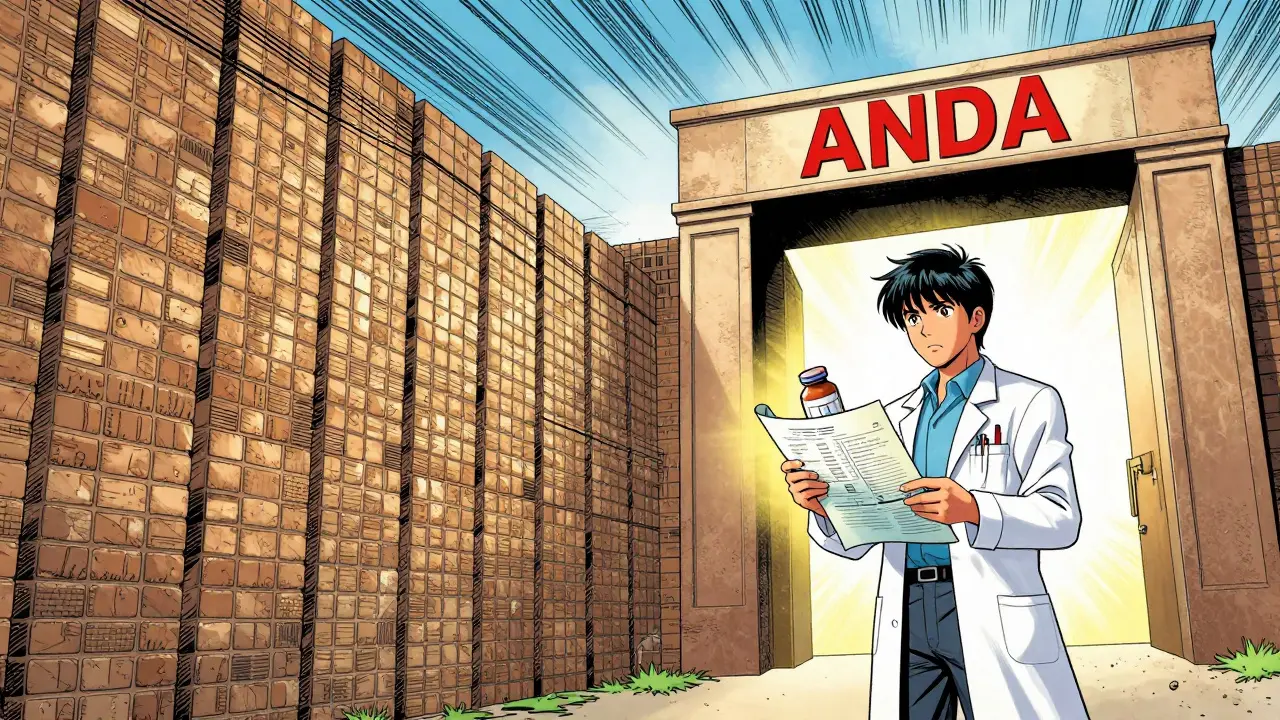
The Hatch-Waxman Act changed the game by creating the Abbreviated New Drug Application, or ANDA. Instead of starting from scratch, a generic manufacturer can essentially say to the FDA, "The original drug was already proven safe and effective. Here is the proof that my version is exactly the same." This legal shortcut is what makes the generic industry economically viable today.
How the ANDA Process Works
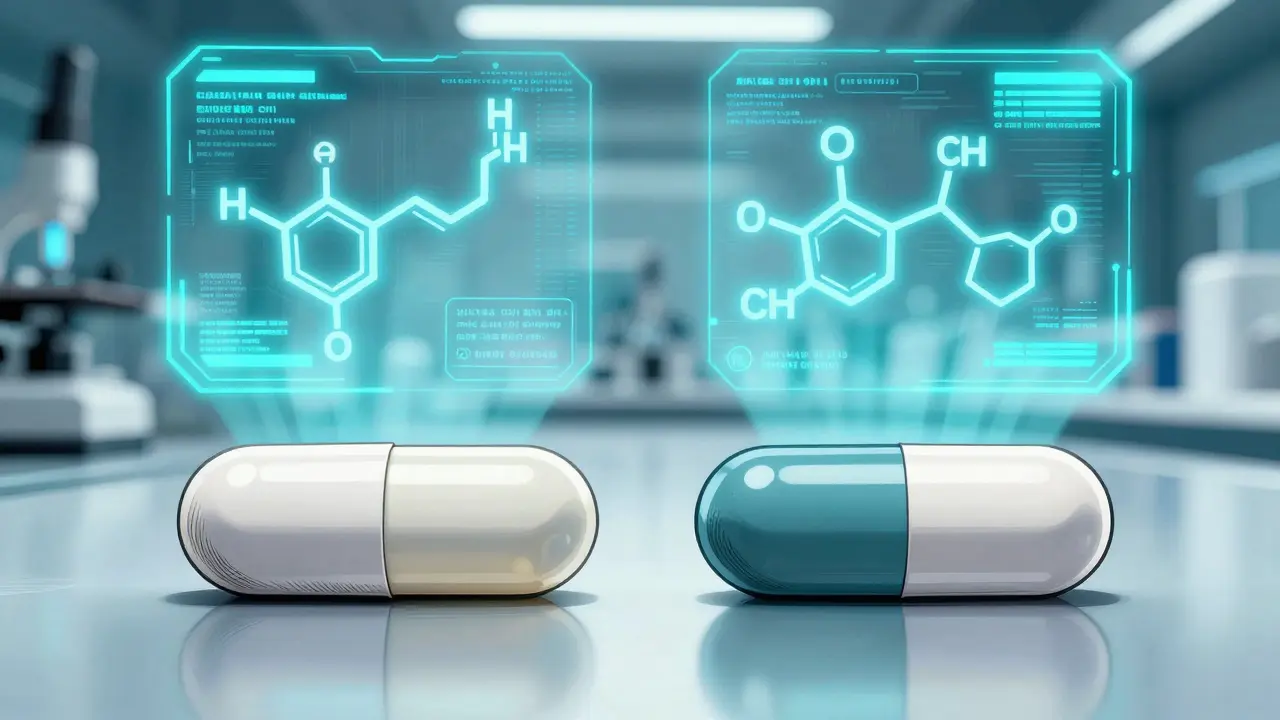
When a company wants to launch a generic, they submit an ANDA to the Office of Generic Drugs (OGD) within the FDA. The goal isn't to prove the drug works (the original developer already did that), but to prove bioequivalence.
To get the green light, the generic must meet several strict criteria:
- Active Ingredients: It must have the same active chemicals as the brand-name version.
- Strength and Dosage: The concentration and the way the drug is delivered (pill, injection, cream) must be identical.
- Route of Administration: If the original is a nasal spray, the generic must be a nasal spray.
- Performance: It must deliver the same amount of active ingredient into the patient's bloodstream in the same amount of time as the original.
To prove this, companies typically conduct pharmacokinetic studies with 24 to 36 healthy volunteers. If the blood levels of the drug match the brand-name version, the FDA considers them therapeutically equivalent.
| Feature | Brand-Name (NDA) | Generic (ANDA) |
|---|---|---|
| Clinical Trials | Required (Phases I, II, III) | Not required (rely on RLD) |
| Primary Goal | Prove safety and efficacy | Prove bioequivalence |
| Estimated Cost | Up to $2.6 billion | $1 million to $5 million |
| Development Time | Years of research/testing | Significantly shorter |
Navigating Patents and the "Orange Book"
Getting the science right is only half the battle. The bigger hurdle is often the law. The FDA maintains a publication called the Orange Book, which lists all approved drug products and their patents. Generic companies use this to figure out when a brand-name drug's patent expires.
Sometimes, a generic company will file a "Paragraph IV Certification." This is essentially a legal challenge where the generic maker claims the brand's patent is invalid or won't be infringed. If the brand company sues in response, the Hatch-Waxman Act triggers a 30-month stay. This means the FDA cannot approve the generic for 30 months while the courts decide who is right. This "patent thicket" is one of the main reasons some generics take years to hit the market even after the original patent seems to have ended.
The Approval Timeline and GDUFA
The process is streamlined by the Generic Drug User Fee Amendments, known as GDUFA. Under this system, companies pay fees that the FDA uses to hire more reviewers and speed up the process. Instead of the old 180-day window, the FDA now aims to review standard ANDAs within 10 months.
If a drug is in short supply or is the first ever generic for a specific brand, it gets "priority" status, and the FDA tries to wrap up the review in 8 months. However, not every application is a smooth ride. The FDA often issues "Refuse-to-Receive" (RTR) letters if the initial paperwork is messy or incomplete, forcing the company to start over and pay a new filing fee.
Challenges with Complex Generics
Not all drugs are created equal. For a simple tablet, bioequivalence is easy to measure. But for "complex generics"-like inhalers, long-acting injectables, or topical creams-it's much harder. You can't just measure blood levels to see if a skin cream is working the same way as the brand name.
Because of this, the FDA has launched initiatives like the Complex Generic Drug Product Development Resources to help companies find better ways to prove their products work without needing full-scale clinical trials. A recent victory in this area was the 2023 approval of the first generic naltrexone extended-release injectable, a critical step in fighting the opioid epidemic by making long-term recovery treatments more affordable.
What's Next for the Industry?
Looking ahead, the FDA is focusing more on the domestic supply chain. On October 3, 2025, the agency announced a pilot program to prioritize ANDA reviews for companies that actually test and manufacture their products within the United States. This is an attempt to reduce reliance on foreign factories and prevent drug shortages.
We are also seeing a shift toward Biosimilars. These aren't generics in the traditional sense because they are made from living cells rather than chemicals. They follow a different legal path (the BPCIA), but the goal is the same: break the monopoly of expensive brand-name biologics to make healthcare accessible for more people.
Is a generic drug exactly the same as a brand-name drug?
In terms of the active ingredient, strength, and effect on the body, yes. The FDA requires them to be bioequivalent. However, they can differ in inactive ingredients, like the dyes used for color or the fillers that hold a pill together, which is why a generic might look different from the original.
Why does the FDA allow some generics to be approved faster than others?
Priority reviews are granted to drugs that are currently in shortage or are the first-ever generic for a specific brand. This encourages competition and ensures patients have access to medication when there are no other affordable options.
What happens if a brand company sues a generic company?
If the generic company challenges a patent (Paragraph IV filing) and the brand company sues, a 30-month stay is usually triggered. During this time, the FDA will not approve the generic drug regardless of how good the science is, until the legal battle is resolved.
What is the "Orange Book" exactly?
The Orange Book is the official FDA publication that lists all approved drug products. It provides a roadmap for generic companies by listing which patents cover a drug and whether other generics have already been deemed therapeutically equivalent.
Do generic drugs have to be made in the U.S.?
No, they can be manufactured anywhere, provided the facilities meet the FDA's strict good manufacturing practice (GMP) standards. However, new FDA initiatives are now offering faster review times for companies that do keep their manufacturing and testing within the U.S.
Ryan Wilson
May 1, 2026 AT 08:05Absolute corporate circus. The "patent thicket" is just a fancy term for legal extortion by Big Pharma to squeeze every last cent out of sick people while these generic suits play a shell game with Paragraph IV filings. It's a moral wasteland where profit beats patients every single time, and the FDA is basically just a rubber stamp for the highest bidder in a suit.
Stephen Johnson
May 2, 2026 AT 12:31It's an interesting balance between incentivizing innovation and ensuring accessibility. If there were no patents, nobody would spend billions on R&D. But if patents lasted forever, we'd be paying 1990s prices for life.
Thomas Jorquez
May 2, 2026 AT 13:49The orange book sounds like a lawyer's dream and a patient's nightmare tbh.
Jean Robert
May 2, 2026 AT 18:16I really think it's wonderful that we have these pathways to make life-saving medications more affordable for everyone, because when you think about the stress of a chronic illness, the last thing anyone needs is the crushing weight of a medical bill they can't pay, and seeing the progress with those complex generics like the naltrexone injectables just gives me so much hope that we are moving toward a more empathetic healthcare system where the focus is on recovery rather than revenue, which is just such a heartening direction for all of us to be heading in as a society.
Amber McCallum
May 3, 2026 AT 00:17People just trust the system too much. The FDA is just a cog in a machine.
Timothy Brown
May 4, 2026 AT 07:27The Paragraph IV stuff is basically just a legalized gamble. Companies bet they can break the patent, the brand sues, and the patient just waits 30 months while the lawyers get rich. Typical.
prince king
May 6, 2026 AT 02:09Love seeing the push for domestic manufacturing! 🇺🇸 It's so important for security and quality control. Great way to bring jobs back and keep our meds safe! 😊✨
Jarrett Jensen
May 7, 2026 AT 05:29The simplistic portrayal of the ANDA process in this text fails to acknowledge the profound biochemical complexities inherent in bioequivalence. It is a rudimentary explanation for those who lack the intellectual fortitude to grasp the actual pharmacology involved. One would think the nuances of pharmacokinetic variability would be the focal point rather than mere legalities.
Jenna Riordan
May 9, 2026 AT 05:06Does anyone here actually take these generics or are you all just talking about the laws?
Raymond Lipanog
May 9, 2026 AT 17:08One must contemplate whether the efficiency of GDUFA truly serves the public interest or merely accelerates the commodification of health. While shorter review times are beneficial, the integrity of the review process must remain paramount above all industrial expedience.
Angela Cook
May 11, 2026 AT 07:45Finally! We need to stop relying on overseas factories for our medicine. If it's not made in the USA, we can't trust it. About time the FDA prioritized American companies!
lalit adesara
May 11, 2026 AT 22:14US systems are overrated. India produces more generics. Truth.
Trish Perry
May 13, 2026 AT 20:07It makes you wonder if the 30-month stay is actually just a negotiated truce between corporations to keep the market stable. The law says it's for the courts, but the result is always a delay in cheaper options for the poor.