

Quick Relief: Why Doctors Use Steroids
When a doctor prescribes a steroid, they are looking for speed. Most other anti-inflammatory drugs, like DMARDs (Disease-Modifying Antirheumatic Drugs), can take anywhere from 4 to 12 weeks to actually start working. You can't wait three months when you're in a crisis. Systemic corticosteroids often start working within 24 to 48 hours. For example, someone with a lupus flare might take Prednisone and find their fever breaking and joint swelling dropping by 70% in just two days. Even local treatments, like cortisone shots in a joint, usually show significant results within a week, though they can provide relief for several months.| Type | Examples | Half-Life (Duration) | Primary Use Case |
|---|---|---|---|
| Short-acting | Hydrocortisone | Under 12 hours | Quick, acute responses |
| Intermediate-acting | Prednisone, Prednisolone | 12-36 hours | Standard inflammatory flares |
| Long-acting | Dexamethasone | 36-54 hours | Severe, prolonged inflammation |
The Hidden Cost of Long-Term Use
The "fire extinguisher" analogy is apt because steroids are dangerous if left running. When you take these medications long-term, your body begins to experience cumulative toxicity. This isn't just about a few annoying side effects; we're talking about systemic changes. One of the most immediate changes is metabolic. Many patients report rapid weight gain-some averaging over 12 pounds in just eight weeks-and the development of "moon face," where the face becomes rounded due to fat redistribution. More seriously, steroids trigger blood sugar elevations. In some cases, this leads to steroid-induced diabetes, which can be permanent even after the medication stops. Your bones and eyes are also at risk. Long-term use can lead to Osteoporosis, as bone loss can occur at a rate of 3-5% per month during the first year of therapy. There is also a documented increase in the development of cataracts. These aren't just possibilities; data shows that nearly 30% of long-term users experience these permanent changes.
The Dangerous Side of "Quick Fixes"
There is a worrying trend of using steroids for things they aren't meant for. Some people get prescriptions for simple upper respiratory infections or nonspecific back pain. This is a major medical failure. Using a powerful systemic steroid for a common cold provides negligible benefit but exposes the patient to massive risks. Even short courses (under 30 days) aren't completely risk-free. Research indicates that short-term use can significantly spike the risk of sepsis and venous thromboembolism. When you suppress your immune system to stop inflammation, you're also lowering your defenses against serious infections. This is why doctors are now pushing for strict 5-day maximum courses for things like COPD exacerbations to avoid an absolute increase in pneumonia risk.Managing the Exit: The Tapering Process
You cannot simply stop taking corticosteroids if you've been on them for more than two weeks. Your Adrenal Glands (which produce natural cortisol) essentially go on vacation while the synthetic steroids do the work. If you quit cold turkey, your body may not be able to produce enough cortisol to function, leading to a life-threatening condition called adrenal insufficiency. To prevent this, doctors use a tapering schedule. This involves slowly reducing the dose over several days or weeks, allowing your adrenal glands to "wake up" and start producing hormones again. In some cases, if you've been on steroids for a long time, you might even need special "stress dosing" during major surgery to keep your blood pressure stable.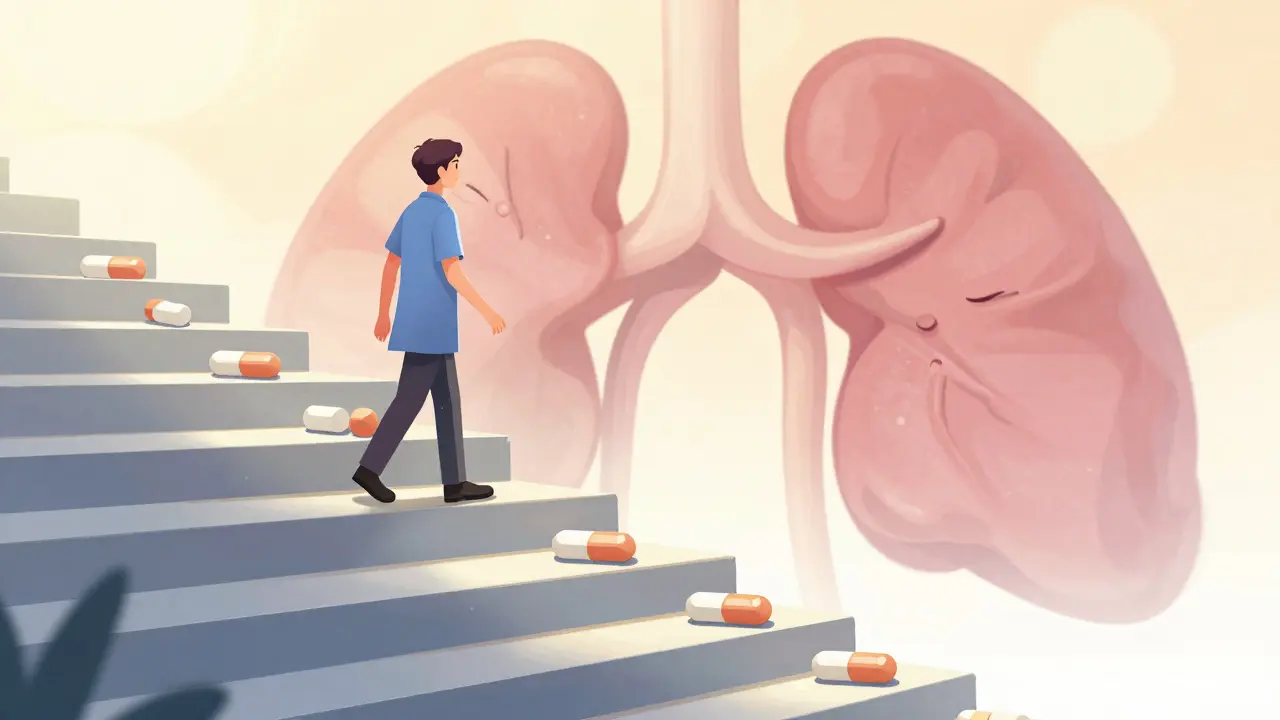
How to Protect Yourself During Treatment
If you must be on corticosteroids, you shouldn't just "hope for the best." There are specific protocols to mitigate the damage. If you're taking a dose equivalent to 7.5mg of prednisone for more than three months, you should be getting a DEXA scan to monitor your bone density. To fight bone loss, medical guidelines often suggest a combination of calcium (1200mg/day) and Vitamin D (800IU/day). In more severe cases, doctors might use zoledronic acid injections annually. Monthly blood glucose checks are also non-negotiable for anyone on long-term therapy to catch diabetes early.Looking Toward the Future
Medicine is moving away from "blunt instrument" steroids. New developments like fosdagrocorat, a selective glucocorticoid receptor modulator, aim to keep the anti-inflammatory benefits while cutting the metabolic side effects. Early trials show a 63% lower incidence of hyperglycemia compared to traditional prednisone. Furthermore, the shift toward using biologic therapies as primary maintenance tools means steroids are being relegated to their rightful place: a short-term bridge to get a patient stable until a safer, long-term medication can take over.Can I stop taking prednisone immediately if I feel better?
No. If you have been taking steroids for more than 14 days, stopping abruptly can cause adrenal insufficiency because your body has stopped producing its own cortisol. You must follow a tapering schedule provided by your doctor to safely wean off the medication.
What is "moon face" and is it permanent?
"Moon face" is a side effect where fat redistributes to the cheeks and face, making it look rounded. It is usually a result of the medication's effect on metabolism and fat storage. In most cases, this reverses once the steroid dose is lowered or discontinued, though it can take some time.
Do cortisone shots have the same risks as oral steroids?
Local injections have fewer systemic side effects than oral pills because the drug stays mostly in one area. However, repeated shots in the same joint can lead to cartilage breakdown and tissue atrophy. They are generally safer for the rest of the body but can damage the specific joint if overused.
Why do steroids cause weight gain?
Corticosteroids increase appetite and change how your body processes fats and carbohydrates. They also cause your body to retain sodium and water, which contributes to the number on the scale and the feeling of bloating.
How long is a "short-term" course of steroids?
Generally, a short-term course is considered to be under 30 days. However, for specific conditions like COPD exacerbations, the ideal course is often limited to just 5 days to minimize the risk of pneumonia and other infections.
Ryan Wilson
April 28, 2026 AT 15:13The absolute audacity of some doctors to hand these out like candy for a sniffle is a moral bankruptcy of the highest order. It's a chemical sledgehammer being used to kill a fly. We're basically gambling with our internal organs just because some patient wants a quick fix and the doc is too lazy to actually diagnose the root cause. Pure medical malpractice wrapped in a white coat.
Abhishek Charan
April 29, 2026 AT 12:40Actually... steroids are totally fine if you just ignore the 'risks'!!! 🙄 Who cares about a little moon face when you feel like a god for two weeks??? 💊✨ The medical establishment just wants us scared... 🤡😂
Aubrey Johnson
April 30, 2026 AT 22:59It is truly unfortunate that most people lack the basic discipline to manage their health without a pharmaceutical crutch. The failure here is not just the drug, but the lack of willpower in the modern patient. Simple living and strict dietary adherence would solve half of these inflammatory issues if people weren't so lazy.
lalit adesara
May 2, 2026 AT 02:39Weak minds seek pills. Strong souls seek truth. This is just a symptom of a decaying western approach to health.
Kevin Taggart
May 2, 2026 AT 21:00i wonder if the new drugs actually work as well as the old ones...’s kinda scary to think about the bone loss tho :o
Amber McCallum
May 2, 2026 AT 21:03Your body is just a mirror of your spirit. If you are inflamed, your soul is out of balance. Using a drug to hide the fire doesn't put out the flame; it just makes you forget that you are burning. We must look inward to find the cure, not in a bottle.
Justin Crice
May 4, 2026 AT 15:20The pharmacokinetic profile of selective glucocorticoid receptor modulators suggests a significant reduction in the activation of gluconeogenesis, which explains the attenuated hyperglycemic response. It would be interesting to see the long-term data regarding the hypothalamic-pituitary-adrenal axis suppression compared to traditional prednisone protocols.
Steve Grayson
May 6, 2026 AT 00:01I think the point about the tapering process is the most critical part of this whole discussion. Many people don't realize how dangerous it is to just stop. It's good that this was highlighted.
I've seen a few friends struggle with this, and the recovery from adrenal insufficiency is no joke. The information about calcium and Vitamin D is also a great practical tip for anyone currently in the middle of a treatment cycle. It's all about minimizing the collateral damage while getting the necessary relief. Hopefully, these new biological therapies become more accessible soon so we can move away from the heavy-duty steroids for maintenance.