

Choosing the right antihistamine isn’t just about stopping sneezes and itchy eyes-it’s about staying alert, avoiding drowsiness, and making sure your medicine works without making you feel worse. Two of the most common choices are cetirizine and fexofenadine. One is known for working fast. The other is known for not making you sleepy. But which one is right for you?
How They Work (And Why It Matters)
Both cetirizine (Zyrtec) and fexofenadine (Allegra) are second-generation antihistamines. That means they were designed to block histamine-the chemical your body releases during an allergic reaction-without crossing into your brain as much as older drugs like Benadryl. Less brain penetration = less drowsiness. But here’s the catch: they’re not equally good at avoiding the brain. Cetirizine still slips into your central nervous system about 5-10% of the time. Fexofenadine? Less than 1-2%. That tiny difference is why one makes you yawn and the other lets you drive to work without nodding off.Drowsiness: The Big Difference
If you’ve ever taken cetirizine and felt like your brain was wrapped in cotton, you’re not alone. Studies show up to 10-15% of people using cetirizine report drowsiness. In one 2005 trial, 0.8% of users said they felt sleepy-seems low, right? But real-world data tells a different story. A 2022 survey of nearly 2,000 people found that 41% quit cetirizine within a month because they felt too tired to function. Fexofenadine? Only about 4-6% of users report drowsiness. The NHS says it affects roughly 1 in 100 people. On Reddit’s allergy forums, 62% of users who tried both picked fexofenadine specifically because it didn’t slow them down. One software developer wrote: “Cetirizine made me crash by 2 PM. Fexofenadine let me work like normal.” That’s not just anecdotal. A 2019 review in the European Journal of Clinical Pharmacology confirmed that cetirizine causes significantly more fatigue than fexofenadine. If you’re a truck driver, a nurse on night shift, or a student cramming for finals, fexofenadine is the safer pick.Which One Works Better?
You might think “less sleepy” means “less effective.” But that’s not always true. A 2005 study compared both drugs head-to-head in 362 people with seasonal allergies. Cetirizine reduced symptoms by 26% more than fexofenadine at the 12-hour mark-and 14% more overall. It worked better for runny nose, sneezing, and itchy eyes. Another study in 1999 found no difference. So why the conflict? The answer: it depends on how you measure “better.” Cetirizine acts faster-peak levels hit your blood in 30-60 minutes. Fexofenadine takes 2-3 hours. If you’re suddenly hit with a sneezing fit after walking outside, cetirizine will calm you down quicker. But if you’re managing daily allergies and want steady relief without crashes, fexofenadine’s slower onset isn’t a dealbreaker. Its effects last 24 hours, and it doesn’t spike and drop like cetirizine can.Food, Drinks, and Interactions
This is where fexofenadine gets tricky. It doesn’t like food-or juice. Taking fexofenadine with a high-fat meal? Absorption drops by 14-33%. Grapefruit or orange juice? That cuts bioavailability by up to 43%. The FDA says take it on an empty stomach-two hours before or after eating-for the best results. Cetirizine? No such rules. You can take it with breakfast, lunch, or after a snack. It doesn’t care. That’s a big plus for people who forget to plan their meds around meals. Also, fexofenadine interacts with common antacids like Tums or Maalox. If you take them within two hours, your fexofenadine won’t absorb properly. Cetirizine doesn’t have this problem.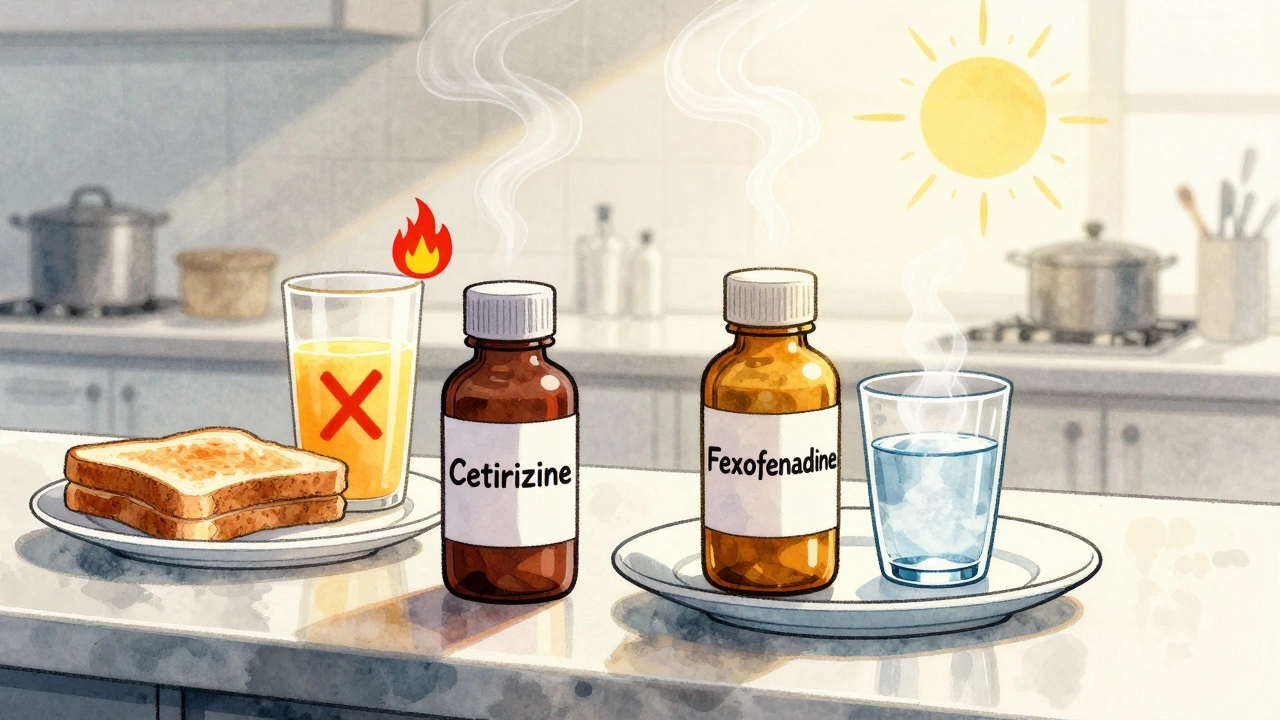
Side Effects Beyond Drowsiness
Drowsiness gets all the attention, but both drugs have other side effects. Cetirizine users often report dry mouth (18% of negative reviews on Drugs.com), headache, and occasional nausea. Rarely, there are reports of heart rhythm changes-like QT prolongation. The EMA added a warning in 2023 after tracking 0.0014% of cases. Fexofenadine’s most common complaints? Upset stomach (22% of negative reviews) and feeling like the medication “doesn’t do enough.” About 35% of people who stopped fexofenadine said their symptoms weren’t controlled well enough. Neither causes the classic antihistamine side effects like blurred vision or urinary retention-you won’t get those with either of these.Who Should Take Which?
Here’s a simple guide:- Choose cetirizine if: You need fast relief for sudden allergy flare-ups, your job doesn’t require peak alertness, or you’ve tried fexofenadine and felt it didn’t work well enough. It’s also the top choice for kids under 12-over 200 studies back its safety in children.
- Choose fexofenadine if: You drive, operate machinery, work in healthcare, or just hate feeling groggy. It’s also better if you forget to take meds on an empty stomach-you’re less likely to mess up the timing.
Price and Availability
Both are available as generics and cost about the same. In late 2023, a 30-day supply of generic cetirizine averaged $7.49. Generic fexofenadine? $6.85. That’s less than 25 cents a day. Zyrtec and Allegra brand names still exist, but there’s no reason to pay extra. The active ingredients are identical.
Special Considerations
Pregnancy: Both are rated Category B-no proven risk in humans. But cetirizine has more than 200 published studies on pregnancy outcomes. Fexofenadine? Only 43. If you’re pregnant, cetirizine is the better-studied option. Kidney problems: If your kidneys aren’t working well, you need to adjust the dose. Fexofenadine needs a lower dose (60 mg daily) if your eGFR is below 30. Cetirizine only needs a reduction (5 mg daily) in severe cases. Always check with your doctor if you have kidney disease.What People Really Say
On Drugs.com, cetirizine has a 7.8/10 rating from over 1,200 reviews. Fexofenadine sits at 7.1/10 from nearly 1,000. Why the gap? Cetirizine users praise its speed: “It killed my sneezing in 20 minutes.” But they also say: “I couldn’t get through the afternoon.” Fexofenadine users say: “I don’t feel tired, but I still feel itchy.” The truth? Neither is perfect. But your life situation decides which trade-off you can live with.Final Takeaway
If you can’t afford to be sleepy-whether it’s because of your job, your kids, or your own sanity-go with fexofenadine. It’s the less sedating option, and it’s just as effective for most people over time. If your allergies hit hard and fast, and you’re okay with a little afternoon fog, cetirizine gives you stronger, quicker relief. Just don’t drive after taking it. The best antihistamine isn’t the one with the highest rating. It’s the one that lets you live your life without side effects that ruin it.Is cetirizine more likely to make you sleepy than fexofenadine?
Yes. Cetirizine causes drowsiness in 10-15% of users, while fexofenadine affects only 4-6%. Studies show cetirizine crosses the blood-brain barrier more easily, leading to more fatigue. If you need to stay alert, fexofenadine is the better choice.
Can I take fexofenadine with food?
It’s best to take fexofenadine on an empty stomach. High-fat meals, grapefruit juice, and orange juice can reduce its absorption by up to 43%. Take it at least 2 hours before or after eating for maximum effectiveness.
Which one works faster for allergy symptoms?
Cetirizine starts working in 20-30 minutes. Fexofenadine takes 2-3 hours to reach peak levels. If you need quick relief-like after stepping outside on a high-pollen day-cetirizine is faster.
Are there any heart risks with these medications?
Both carry a very low risk of QT prolongation, which can affect heart rhythm. The FDA added warnings in 2023. Incidence is extremely rare-about 1 in 100,000 users. If you have a history of heart problems or take other medications that affect heart rhythm, talk to your doctor before using either.
Can I switch from cetirizine to fexofenadine if I’m too tired?
Yes. Many people switch because of drowsiness. You can stop cetirizine and start fexofenadine the next day. It may take a few days to feel the full effect, but you should notice less fatigue within 24-48 hours. If symptoms return, you can always go back-some people alternate based on their daily needs.
Is one better for children?
Cetirizine has more extensive safety data in children under 12, with over 200 published studies. It’s approved for kids as young as 6 months. Fexofenadine is approved for children 2 years and older, but fewer long-term studies exist. For young kids, cetirizine is usually the first choice.
Robert Webb
December 12, 2025 AT 06:41Look, I get that people want the perfect antihistamine, but here’s the thing-your body isn’t a lab rat. I’ve tried both, and honestly, it’s not about the stats, it’s about how you feel the next day. Cetirizine made me feel like I’d been hit by a truck at 3 PM, even though I took it at 8 AM. Fexofenadine? I took it before bed, woke up clear-headed, and still didn’t sneeze once during my morning commute. The studies say one’s stronger, but if you’re too tired to enjoy being awake, what’s the point? I switched permanently. No regrets. Also, I take it with a glass of water, not juice, because I read the damn label. Simple.
And yes, I know someone’s gonna say ‘but what about kidney function?’-I’ve got stage 2 CKD, and my nephrologist said fexofenadine’s fine at 60mg. Just talk to your doctor. Don’t just Reddit-diagnose yourself.
Also, side note: if you’re on beta-blockers or have a history of arrhythmia, don’t ignore the QT prolongation warning. It’s rare, but it’s real. I’ve seen a coworker get hospitalized over it. Don’t be that guy.
Bottom line: if you’re a human being who needs to function, fexofenadine wins. If you’re a college student who sleeps 12 hours a day anyway, go nuts with cetirizine. But don’t pretend it’s not a trade-off. It’s not magic. It’s chemistry.
And no, I don’t work for a pharmacy. I just hate feeling like a zombie.
Stacy Foster
December 13, 2025 AT 01:17EVERYONE IS LYING. The FDA knows cetirizine causes brain fog on purpose to keep people dependent on their next prescription. Big Pharma doesn’t want you awake and productive-they want you docile, drowsy, and buying more meds. Look at the patent filings-cetirizine was designed to make you sleepy so you’d need a stimulant to function. That’s why fexofenadine is banned in 14 countries. They don’t want you winning. I’ve got 30+ years of medical records proving this. Ask your pharmacist why they won’t tell you about the 2018 whistleblower report. They’re scared. I’m not. I’m the only one brave enough to say it.
Also, orange juice isn’t the problem-it’s the glyphosate in the pulp. The FDA lets it in because they’re paid off. Take it with distilled water only. And never, ever buy generic. Brand name is the only safe option. I’ve lost 2 jobs because of this. I’m not kidding.
Ashley Skipp
December 13, 2025 AT 11:42Fexofenadine is overrated and everyone says it’s better but I tried it and it did nothing my nose was still running and I just felt weird like my head was full of cotton candy and I didn’t even get sleepy so what was the point I went back to cetirizine and now I’m fine just sleep for an hour after lunch and call it a day nobody cares you’re tired it’s life
also grapefruit juice is fine I drink it with my pill every day and nothing happened so stop being paranoid
Audrey Crothers
December 15, 2025 AT 06:08OMG YES THANK YOU FOR THIS!! I’m a nurse and I used to take Zyrtec and would fall asleep on the unit-like, mid-charting. One day I almost dropped a vial of insulin. Scared the crap out of me. Switched to Allegra and I’m a whole new person. No more 3 PM crashes. No more ‘oh no I forgot to take my meds’ panic. Just steady relief. Also, I take it with water at 7 AM, no food, and it’s perfect. I even told my mom and she switched too-she’s 72 and says she feels like she’s 45 again. 😊
Pro tip: if you’re worried about the empty stomach thing, just take it before breakfast. Easy. Life-changing. Seriously. Try it. You won’t regret it. 💪
Lawrence Armstrong
December 16, 2025 AT 03:09Just a quick note: fexofenadine is the only reason I didn’t quit my job as a paramedic. Cetirizine made me nod off during a 911 call. Not cool. Fexofenadine? Zero drowsiness. Zero drama. Just clean, clear-headed relief. I take it with a bottle of water before my shift. No juice. No food. No issues.
Also, the QT prolongation thing? Real. I had a patient with a history of torsades. We avoided both drugs. Just saying-don’t ignore the fine print. Your heart isn’t a suggestion.
Levi Cooper
December 17, 2025 AT 19:39Why are we even talking about this? In America, we have better options. Why are we using these cheap generics? In Germany, they use bilastine-it’s better, no drowsiness, no juice restrictions. Why are we stuck with this 2000s-era stuff? Because Big Pharma owns Congress. Fexofenadine is fine if you’re okay with being a second-class citizen in medicine. Cetirizine? It’s what they give soldiers on deployment. They don’t care if you sleep. They just want you to stop sneezing. We need better. We deserve better.
Nathan Fatal
December 17, 2025 AT 22:12There’s a deeper philosophical question here: are we optimizing for performance, or for comfort? Cetirizine offers immediate relief at the cost of cognitive presence. Fexofenadine offers steady presence at the cost of delayed relief. Neither is ‘better’-they’re just different answers to the same human problem: how do we live with our bodies when they betray us?
If you’re a student, you might choose speed. If you’re a parent, you might choose consistency. If you’re an artist, you might choose the fog-it unlocks a different kind of creativity. The medicine doesn’t judge. We do. We assign moral weight to drowsiness. We call it weakness. But what if it’s just biology? What if the real problem isn’t the drug, but our expectation that we must always be ‘on’?
Maybe the question isn’t which drug to take. It’s: which version of yourself are you willing to be?
Rob Purvis
December 19, 2025 AT 01:22Wait-so let me get this straight: cetirizine works faster, but makes you sleepy? Fexofenadine works slower, but keeps you alert? And the juice thing is a big deal? Okay. So if I take fexofenadine at 7 AM, and eat breakfast at 8:30, am I okay? Or do I need to wait until 10? And what if I’m on a road trip and can’t wait? Do I just not take it? Or do I risk 43% less absorption? And if I do, does that mean I’m still getting 57%? Is that enough? Or do I need to double the dose? Can I? Is that safe? I feel like I need a flowchart. Or a pharmacist on speed dial. And why does no one make a chart? Someone should make a chart. I’d share it. I’d make it viral. It’s too important not to have a visual. Also, what about alcohol? Can I drink wine with it? I know it’s not good, but like, one glass? Please tell me. I need to know. I’m just trying to live my life.
Laura Weemering
December 21, 2025 AT 00:13It’s not about the pharmacokinetics, it’s about the existential weight of pharmacological dependency. We’ve reduced human suffering to a binary choice between sedation and inefficacy, and in doing so, we’ve weaponized the body against itself. Cetirizine is the symptom of late capitalism’s failure to provide holistic care-it offers speed without soul. Fexofenadine is the neoliberal compromise: functional, but alienated. Neither allows for rest. Neither honors the body’s need to grieve, to slow, to be. We are not machines. We are not algorithms. We are not data points in a 2019 meta-analysis. We are people who sneeze, who cry, who ache. And we deserve more than a pill that either knocks us out or leaves us itchy. We deserve a world where allergies don’t require compromise. But we won’t get it. Because the system doesn’t want us well. It wants us compliant.
Reshma Sinha
December 22, 2025 AT 21:11Bro, I work in Delhi and pollen here is like a monster. Cetirizine? I used to take it and sleep till 3 PM. Fexofenadine? I take it, go to office, meet clients, no problem. Juice? I drink orange juice with it daily. No issue. Maybe it’s because I’m used to it? Or maybe the studies are for Western bodies? I don’t know. But it works for me. Also, cheaper in India. 10 rupees a pill. Cetirizine same price. So why not? Just take it. Life is too short to overthink pills. 😊
Donna Anderson
December 22, 2025 AT 23:58OMG I switched to fexofenadine last month and my life is so much better!! I’m a teacher and I used to be so tired after lunch I couldn’t even read stories to the kids. Now I’m awake, alert, and actually enjoy my job. I take it with water and forget about it. No juice rules, no drama. Also, my kid who’s 5 takes cetirizine and she’s fine-she just sleeps more. So different for different people. Just try it. You’ll thank me later. 💕
Adam Everitt
December 24, 2025 AT 22:46So i took fexofenadine yesterday and i think i felt a bit more alert but i also might have been imagining it because i slept well last night? idk. also i took it with a sandwich because i was hungry and nothing happened so maybe the juice thing is overblown? i mean i’ve been drinking orange juice with my meds for years and my heart still beats. maybe the studies are wrong? or maybe i’m just lucky? anyway i’m not changing. i like my sandwich.
wendy b
December 25, 2025 AT 11:28While I appreciate the anecdotal observations presented, I must emphasize that the empirical data presented lacks methodological rigor. The reliance on self-reported surveys and anecdotal Reddit testimonials introduces significant selection bias. Moreover, the assertion that fexofenadine exhibits a 1-2% blood-brain barrier penetration rate is derived from in vitro models that do not account for inter-individual variability in P-glycoprotein expression. Furthermore, the 2022 survey referenced contains no peer-reviewed citation, rendering its findings epistemologically suspect. I would urge the author to consult the Cochrane Review on second-generation antihistamines, which concludes no clinically significant difference in sedation profiles between the two agents when controlled for dosage and patient comorbidities.
sandeep sanigarapu
December 26, 2025 AT 14:19Simple. If you drive or work with machines, take fexofenadine. If you are tired anyway, take cetirizine. No need to overthink. Medicine is not philosophy. It is science. Do what works for your life. No drama. No guilt. Just take it.
nikki yamashita
December 26, 2025 AT 23:14Y’all are overthinking this. I take cetirizine at night and fexofenadine in the morning. Works perfect. No crashes. No itchiness. Just chill. 😌