
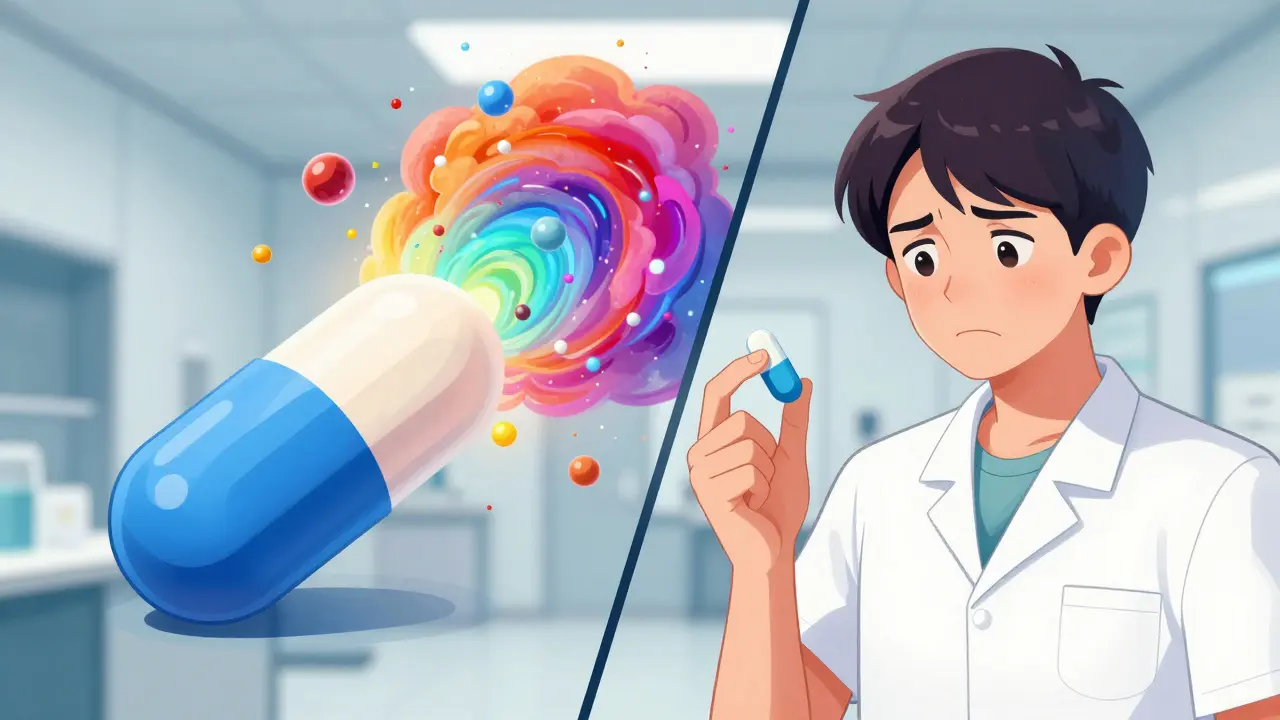
You've probably been there: your doctor switches you to a generic version of a medication to save money, and suddenly you're feeling nauseous, dizzy, or breaking out in a rash. You know the active ingredient is the same, so why is your body reacting differently? The culprit usually isn't the drug itself, but the "invisible" ingredients called excipients. While the main medicine does the heavy lifting, these additives can be the difference between a treatment that works and one that makes you feel sick.
The Gap Between "Same" and "Identical"
When we talk about generic drugs, the word "equivalent" gets thrown around a lot. In the eyes of the FDA, a generic is equivalent if it has the same active ingredient, strength, and dosage form. However, the law doesn't require the inactive ingredients to be the same. This is where the trouble starts for people with sensitivities.
Most people can switch between brands without noticing a thing. In fact, about 92% of generic drugs show equivalent clinical effectiveness. But for a small group, those fillers are a big deal. Imagine someone with a severe lactose intolerance taking a generic heart medication that uses lactose as a filler. They aren't reacting to the heart medicine; they're reacting to the milk sugar used to hold the pill together. This can lead to gastrointestinal distress that mimics a side effect of the actual drug.
When Small Differences Cause Big Problems
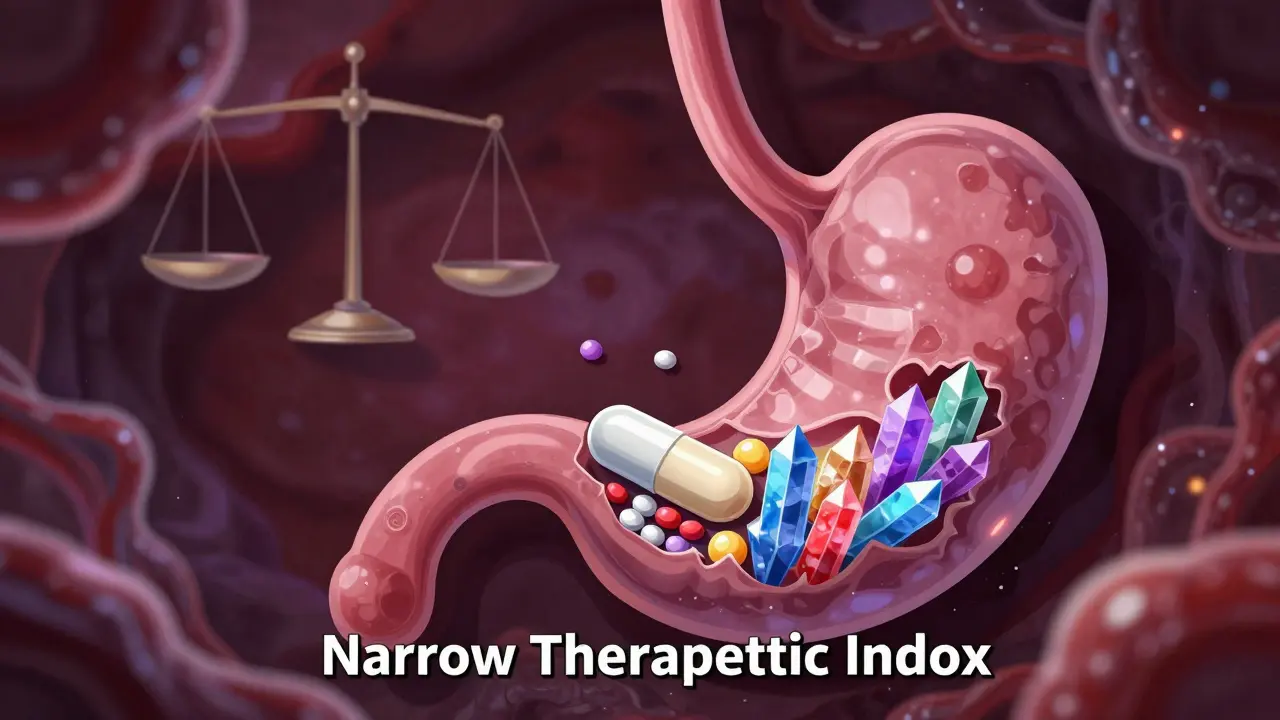
For most medications, a slight variation in how fast a drug hits your bloodstream doesn't matter. But some drugs have what's called a Narrow Therapeutic Index (NTI). This means there is a very thin line between a dose that works and a dose that is either toxic or useless. If a generic's excipients change the absorption rate by even a small percentage, it can trigger a flare-up or a new side effect.
Take Levothyroxine for thyroid issues or certain anti-epileptics. Because these are NTI drugs, the FDA actually applies stricter rules, requiring tighter bioequivalence. Even then, patients in communities like the Michael J. Fox Foundation have reported that generic versions of Parkinson's meds can lead to "off" periods where the drug simply stops working for a few hours because the tablet didn't dissolve at the exact speed the brand-name version does.
| Feature | Brand-Name Medication | Generic Medication |
|---|---|---|
| Active Ingredient (API) | Original Patented Formula | Must be Identical |
| Excipients (Fillers/Dyes) | Proprietary Mix | Can Vary by Manufacturer |
| Bioequivalence Range | Reference Standard | Typically 80-125% of Brand |
| Cost | Higher (R&D Recovery) | 20-90% Lower |
Common Excipient Culprits and Their Reactions
If you're experiencing new side effects after a pharmacy switch, it helps to know what you're actually looking for. You won't find these listed as "side effects" on the box, but they are listed in the package insert. Some of the most common triggers include:
- Lactose: Used as a filler in many tablets; causes bloating and diarrhea in lactose-intolerant patients.
- Croscarmellose Sodium: A disintegrant that helps the pill break apart; has been linked to rare allergic reactions in some patients.
- Artificial Dyes: Used for color coding; can cause hives or skin irritation in people with dye sensitivities.
- Gluten/Starch: Used as binders; can be problematic for those with Celiac disease or severe gluten allergies.
A real-world example involves patients switching to generic furosemide. While the diuretic active ingredient is the same, some patients reported allergic reactions specifically to the croscarmellose sodium used in the generic version-something they never experienced with the brand.

How to Handle a Bad Reaction
If you suspect your generic is the problem, don't just stop taking your medication. That can be dangerous, especially with NTI drugs. Instead, take a systematic approach to find the culprit.
- Track the Manufacturer: Not all generics are the same. Different companies use different excipients. Check the bottle for the manufacturer's name.
- Request "Dispense as Written": If you find that only the brand name works for you, your doctor can write "DAW" or "do not substitute" on the prescription. This tells the pharmacist not to switch it to a generic.
- Keep a Medication Diary: Note the exact date you switched brands and when the new symptoms started. This evidence is gold for your doctor.
- Ask for Consistent Sourcing: Ask your pharmacist to always provide the same generic manufacturer. This prevents the "pharmacy roulette" where you get a different version every month.
The Future of Transparent Labeling
For too long, excipient lists have been buried in fine-print inserts. However, the tide is turning. The FDA is working on a public database to make excipient contents transparent for both brand and generic drugs. This would allow patients to screen for triggers before they even leave the pharmacy.
We're also seeing a shift where generic companies are starting to market "clean excipient profiles." Much like how food companies remove artificial dyes to appeal to health-conscious buyers, pharmaceutical companies are realizing that reducing irritating fillers is a competitive advantage.
Are generic drugs less effective than brand-name ones?
For the vast majority of people, no. Generic drugs must prove bioequivalence, meaning they deliver the same amount of active ingredient into the blood at a similar rate. While about 8% of drugs might show different outcomes in specific conditions, most function identically to the brand.
Why does my generic medication feel different in my body?
This is usually due to excipients. Inactive ingredients like binders or coatings can change how quickly a pill dissolves or can cause an allergic reaction, even if the active medicine is exactly the same as the brand.
What is a Narrow Therapeutic Index (NTI) drug?
An NTI drug is a medication where a very small change in the dose or the speed of absorption can lead to a major change in how the drug works or cause toxicity. Examples include warfarin and levothyroxine.
How can I find out what fillers are in my medication?
Check the "Inactive Ingredients" section of the patient package insert (the paper leaflet that comes with the drug) or ask your pharmacist to print out the full formulation details for you.
Can my insurance force me to take a generic if I'm allergic to a filler?
Usually, no. If you can provide medical documentation of an allergy or intolerance to a specific excipient, your doctor can submit a "prior authorization" to your insurance to cover the brand-name version.
Goodwin Colangelo
April 4, 2026 AT 03:15Definitely worth looking into the manufacturer's name if you're feeling off. I've seen plenty of folks struggle with this, and the best move is usually to just call the pharmacist and ask if they have a different generic brand in stock before you even head to the store.
Will Baker
April 6, 2026 AT 02:13Oh wow, imagine believing the FDA actually cares about your well-being enough to make a database for you. Truly heartwarming.
Hudson Nascimento Santos
April 6, 2026 AT 20:14It is interesting to consider how the pursuit of affordability through generics creates a secondary layer of biological lottery for the patient. We prioritize the economic average over the individual biological anomaly, which reflects a broader societal shift toward utilitarian healthcare where the "standard" person is the only one who truly fits the mold. This tension between systemic efficiency and personal health is a fascinating intersection of ethics and chemistry.
Joey Petelle
April 8, 2026 AT 12:38Only in the States would we be surprised that the cheapest possible option is basically a chemical gamble. It's just peak American efficiency to save a buck and then spend ten more on a rash cream because some corporate suit decided lactose was a cheap filler. Absolute gold.
Sam Hayes
April 9, 2026 AT 05:12you can also ask for the package insert if they didnt give you one since the pharmacists usually just throw them away to save time
simran kaur
April 10, 2026 AT 00:45The "inactive" label is the biggest lie of all. They call them inactive so we don't question why the government is letting companies pump us full of synthetic dyes and mystery starches that probably alter our gut biome and brain chemistry over time. If they were actually harmless they wouldn't need to hide them in fine print in the first place. It's all about control and profit margins, not health.
angel sharma
April 10, 2026 AT 07:10This is exactly the kind of knowledge that empowers us to take charge of our own health journeys because once you realize that you have the power to advocate for a specific manufacturer you stop being a passive recipient of medicine and start becoming an active partner in your healing process which is honestly the most motivating part of modern medicine when you actually dive into the details of how things work and realize that a simple request to your pharmacist can literally change how you feel every single day of your life!
Vicki Marinker
April 11, 2026 AT 21:28The phrasing "most people can switch without noticing" is a classic example of anecdotal generalization used to dismiss the minority experience.
Lawrence Rimmer
April 13, 2026 AT 06:17Basically saying the system is broken but offering a "diary" as the solution is just typical of how we handle failure in the modern age. We're told to document our own suffering instead of fixing the formulation standards. It's a philosophical joke.
sophia alex
April 13, 2026 AT 20:10Ugh, I can't even imagine having to deal with this level of incompetence in a pharmacy! 🙄 It's literally a nightmare and frankly, some of these generic brands are just trash. We deserve better standards in this country! 💅
Dee McDonald
April 15, 2026 AT 14:36Get your diaries out everyone! Start tracking every single pill you take and don't let the pharmacy push you around. If you feel a difference, demand the brand name and fight your insurance company until they give in. You are the only one who knows your body, so be aggressive about your health! Let's all start sharing which generic brands are actually clean so we can help each other out!
Dipankar Das
April 17, 2026 AT 12:35I must strongly insist that all patients adopt these tracking methods with immediate effect. It is an absolute necessity to maintain a rigorous log of one's medicinal intake to ensure that the pharmaceutical providers are held to the highest possible standard of accountability. Do not allow your health to be compromised by mere convenience!