
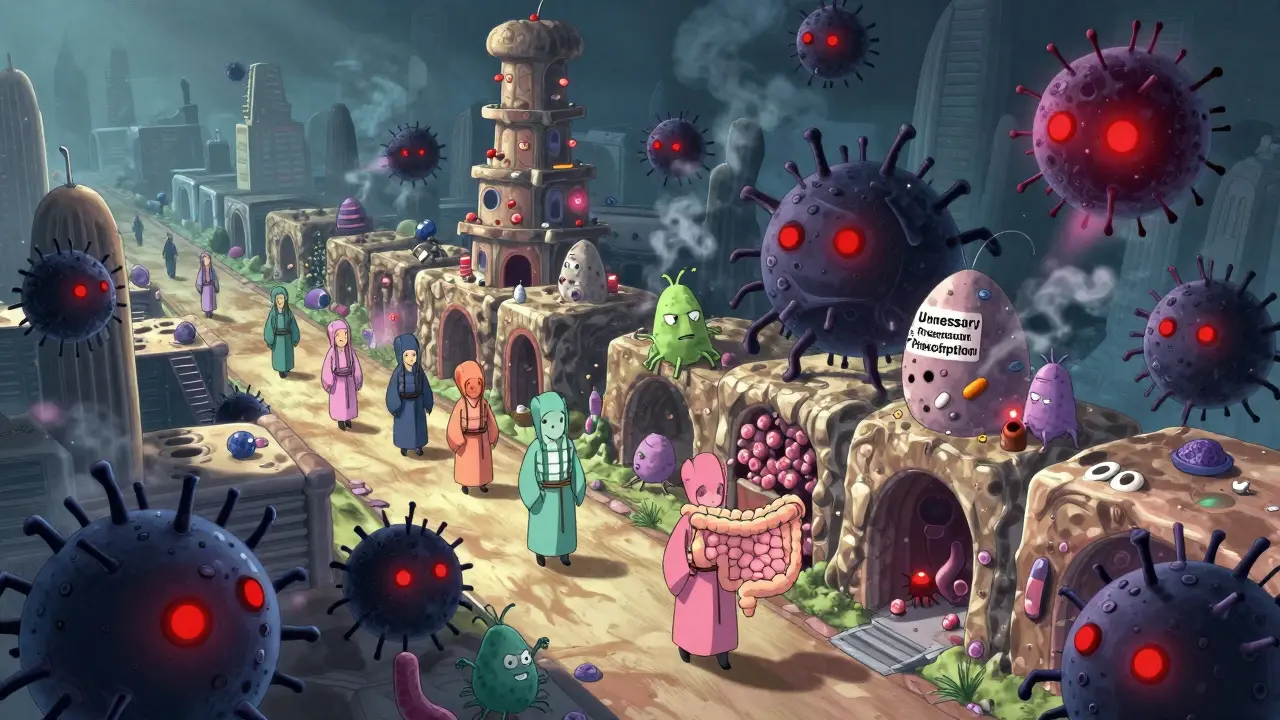
Every time you take an antibiotic when you don’t need it, you’re not just helping yourself-you’re helping bacteria become stronger. That’s the harsh truth behind the rise of antibiotic overuse and its deadly consequences: drug-resistant superbugs and life-threatening Clostridioides difficile (C. difficile) infections. This isn’t science fiction. It’s happening right now, in hospitals, nursing homes, and even in your own kitchen if you’ve ever saved leftover pills for the next cold.
What Happens When Antibiotics Don’t Work Anymore?
Antibiotics are powerful tools-when used correctly. But they’re not magic bullets for every sniffle or sore throat. Most colds, flu, and even many sinus infections are caused by viruses, not bacteria. Taking antibiotics for these won’t help you feel better faster. All it does is expose harmless bacteria in your body to drugs they don’t need, giving them a chance to adapt, mutate, and survive. By 2023, the World Health Organization found that one in six bacterial infections worldwide were already resistant to standard antibiotics. That means treatments that worked for decades are now failing. In some regions, like parts of South Asia and the Eastern Mediterranean, that number jumps to one in three. The culprits? Common pathogens like Escherichia coli, Klebsiella pneumoniae, and Staphylococcus aureus-bugs that now shrug off drugs like ampicillin, fluoroquinolones, and even last-resort carbapenems. This isn’t just about a few failed prescriptions. It’s about the collapse of modern medicine. Surgeries, chemotherapy, organ transplants, and even childbirth rely on antibiotics to prevent deadly infections. If those drugs stop working, these procedures become far riskier. Experts warn we could be heading back to a time when a simple cut or urinary tract infection could kill you.How C. difficile Turns Antibiotics Into a Danger
One of the most dangerous side effects of unnecessary antibiotic use isn’t resistance-it’s disruption. Your gut is home to trillions of bacteria, most of them harmless or even helpful. They keep your digestive system running and stop bad bugs from taking over. When you take antibiotics, especially broad-spectrum ones, you don’t just kill the bad bacteria. You wipe out the good ones too. That creates a vacuum. And in that vacuum, Clostridioides difficile-a tough, spore-forming bacterium-moves in. C. difficile doesn’t usually cause problems in healthy people. But once it takes root in a gut stripped of its natural defenses, it can cause severe diarrhea, colitis, and even death. In the U.S. alone, it caused nearly half a million infections in 2017. While exact global numbers are harder to track, the pattern is clear: antibiotic use is the single biggest risk factor for C. difficile infection. Hospital stays are the most common setting for outbreaks, but it’s also showing up in nursing homes and even in the community. People who’ve taken antibiotics within the past three months are at highest risk. And once you’ve had one C. difficile infection, your chances of getting another jump dramatically.The Silent Pandemic Killing Over a Million People a Year
The numbers are chilling. In 2019, antimicrobial resistance directly caused 1.27 million deaths worldwide and contributed to nearly 5 million more. That’s more than HIV/AIDS or malaria. And it’s not slowing down. Between 2018 and 2023, resistance rates rose in over 40% of the antibiotic-bacteria combinations tracked globally. Some of the most alarming trends include:- 42% of E. coli infections in some countries are now resistant to third-generation cephalosporins
- 35% of Staphylococcus aureus cases are methicillin-resistant (MRSA)
- Carbapenem resistance-the last line of defense-is doubling every decade
Why Are We Still Overusing Antibiotics?
You might think this is just about patients demanding pills. But the problem runs deeper. In many parts of the world, doctors don’t have access to quick, accurate tests to tell if an infection is bacterial or viral. So they prescribe antibiotics “just in case.” In low-resource settings, up to 70% of antibiotic use is empirical-guesswork, not science. Then there’s agriculture. Nearly 70% of all antibiotics produced globally are used in livestock-not to treat sick animals, but to make them grow faster and prevent disease in crowded, unsanitary conditions. These drugs enter the food chain, the water supply, and the soil. Resistant bacteria from farms end up in your groceries and your backyard. Even in places with better healthcare, pressure from patients plays a role. People expect a prescription. They’ve been told antibiotics cure everything. And when they don’t get one, they go online, buy them over the counter, or use leftovers from a previous illness. The result? A cycle that’s impossible to break without systemic change.What Can You Actually Do?
You don’t need to be a doctor or a policymaker to make a difference. Here’s what works:- Never take antibiotics unless prescribed-and never share them. If a doctor says you don’t need them, trust them.
- Don’t pressure your doctor. If you have a cold or flu, ask: “Is this bacterial? What else could help?”
- Finish the full course-even if you feel better. Stopping early leaves behind the toughest bacteria, which then multiply.
- Don’t save leftovers. Dispose of unused antibiotics properly. Don’t flush them down the toilet-take them to a pharmacy drop-off if available.
- Ask about alternatives. For ear infections, sinusitis, or bronchitis, sometimes watchful waiting works better than antibiotics.
Kathy McDaniel
January 27, 2026 AT 05:23just took my dog to the vet and they prescribed antibiotics for a sniffle 😅 i feel so guilty now
astrid cook
January 28, 2026 AT 23:31you people have no idea how irresponsible this is. you’re literally helping create the next pandemic by hoarding leftover pills like they’re candy. stop being lazy and get educated.
April Williams
January 30, 2026 AT 23:16my grandma died from C. diff after a simple sinus infection. they gave her antibiotics like it was nothing. now i don’t trust doctors. not one bit.
Anjula Jyala
February 1, 2026 AT 16:03antibiotic resistance is a classic example of evolutionary pressure amplified by anthropogenic intervention in microbial ecology. empirical prescribing in low resource settings exacerbates selection bias for MDR phenotypes. we need genomic surveillance and stewardship protocols not just handwaving
Paul Taylor
February 3, 2026 AT 13:31look i get it antibiotics are overused but you also gotta remember that in rural clinics or ERs they don’t have time to wait for cultures. if a kid’s fever is spiking and the parents are panicking they’re gonna get amoxicillin. it’s not about being careless it’s about triage in broken systems. we need better infrastructure not just guilt trips
also the ag industry thing? yeah it’s wild. 70% of antibiotics go to livestock. in the US we pump them into chickens just to make them grow faster. you think that doesn’t end up in your burger? it does. and then it ends up in your gut. and then your kid gets an infection and nothing works. this isn’t a conspiracy it’s just capitalism with bacteria
we need to stop treating antibiotics like aspirin. they’re not candy. they’re surgical tools. and we’re using them like hammers
and don’t even get me started on how we treat UTIs. 90% of the time it’s just a bladder irritation. drink water. stop taking pills. but nope we’ve been trained to expect a script like it’s a coffee refill
the real tragedy? we stopped investing in new antibiotics because pharma doesn’t make money off them. you take them for 7 days and you’re done. vaccines make lifelong money. antibiotics make a one-time payment. so the pipeline is dry. and now we’re paying the price
we need subsidies. we need public funding. we need to treat antibiotics like vaccines not luxury goods
John O'Brien
February 4, 2026 AT 19:14my cousin is an ER nurse and she says the same thing every day: ‘people come in with a sore throat and demand amoxicillin like it’s a right’
and then they get mad when you say no
it’s not their fault though. they’ve been sold this lie for decades. ‘antibiotics fix everything’
we gotta fix the messaging. not just the prescriptions
suhail ahmed
February 5, 2026 AT 09:34in india we call this ‘pharmacy culture’-you walk in with a cold and the guy behind the counter hands you a pack of ciprofloxacin like it’s gum. no script no questions. the shopkeeper knows more than the doctor sometimes
and the worst part? everyone thinks they’re being smart by saving pills for next time. but you’re not saving money-you’re saving death
my uncle took leftover antibiotics for a cough last year. got C. diff. spent 3 weeks in ICU. now he won’t even touch a pill unless a doctor holds it to his forehead
we need street-level education. not just WHO reports. talk to the chaiwalas. the auto drivers. the aunties at the market. they’re the real gatekeepers
and yeah the farms? same story. chickens in cages, cows in sludge, antibiotics in feed. it’s not agriculture-it’s bacterial roulette
we’re not fighting superbugs. we’re fighting our own laziness
Harry Henderson
February 5, 2026 AT 18:00enough with the doomscrolling. we can fix this. start small. ask your doctor. refuse the script. tell your friends. stop buying meat from factory farms. vote for policies that ban antibiotic growth promoters. this isn’t hopeless-it’s urgent. and urgency is power
Desaundrea Morton-Pusey
February 6, 2026 AT 04:07of course this is happening. we let big pharma and the USDA run everything. they don’t care if you die as long as they get paid. this is all planned. antibiotics are a cash cow. let the peasants rot
Kirstin Santiago
February 6, 2026 AT 12:05i used to think antibiotics were harmless. then i got one after a tooth extraction and ended up with 3 weeks of diarrhea. never again. now i ask ‘what if i just wait?’ and it’s crazy how often the body fixes itself
my mom’s a nurse. she says the most powerful thing you can say is ‘i trust your judgment.’
Kegan Powell
February 7, 2026 AT 13:22we’re all just tiny links in a giant chain of unintended consequences 🌍
that antibiotic you took for a cold? it didn’t just affect you. it affected the bacteria in your gut. the bacteria in your toilet. the bacteria in the water supply. the bacteria in the cow that ate your compost. the bacteria in your neighbor’s kid. the bacteria in the next pandemic
it’s not about blame. it’s about awareness
next time you reach for a pill… pause. breathe. ask: who else is paying for this?
we’re not just patients. we’re stewards
and maybe… just maybe… that’s enough
Murphy Game
February 8, 2026 AT 23:18you know who’s really behind this? the CDC. they’ve known for years that antibiotics cause C. diff. but they keep pushing them because they need the data. they need the infections to prove their funding is justified. it’s a feedback loop of fear and profit
they don’t want you to know. they need you sick. so they can keep selling tests. and drugs. and hospital beds
the truth? they’re not trying to save you. they’re trying to keep the system alive