
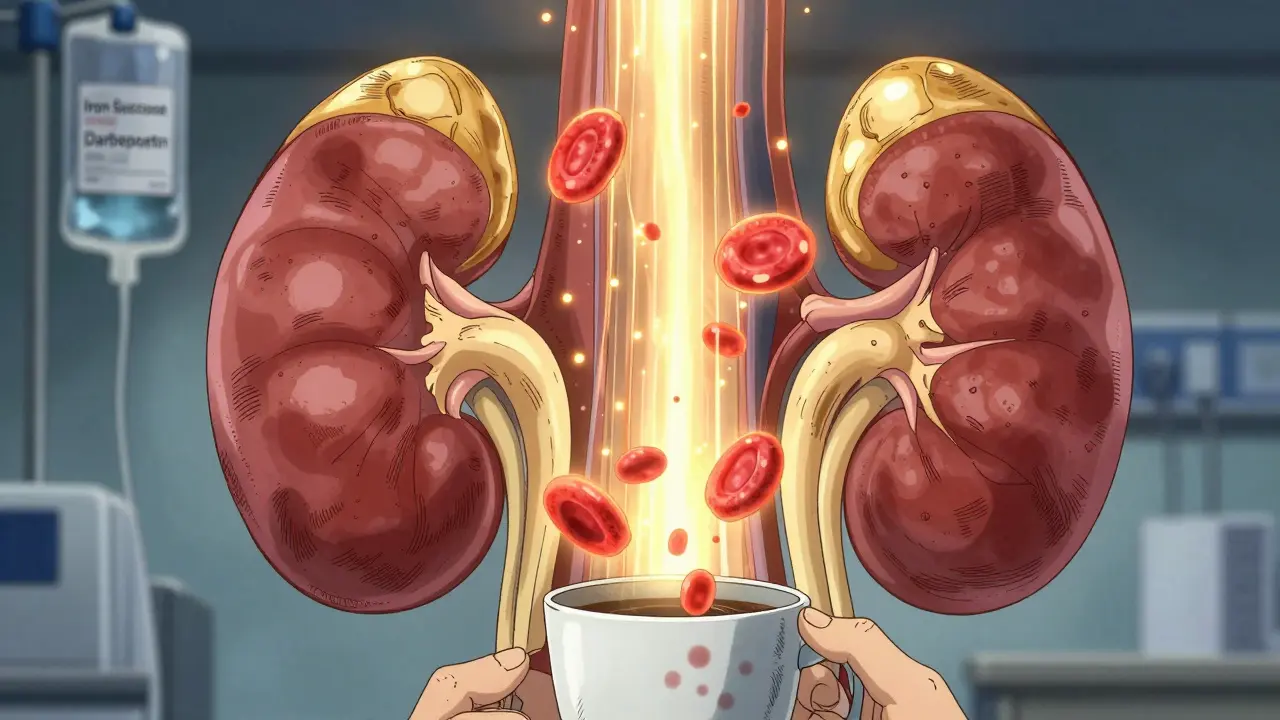
When your kidneys start to fail, they don’t just stop filtering waste-they also stop making a hormone your body needs to make red blood cells. That’s where anemia in kidney disease comes in. It’s not just feeling tired. It’s struggling to walk up stairs, feeling dizzy when you stand, or noticing your lips and nails look pale. For people with chronic kidney disease (CKD), this isn’t normal aging-it’s a medical problem that needs specific treatment. And the two biggest tools doctors use? Erythropoietin and iron.
Why Kidneys Cause Anemia
Your kidneys don’t just clean your blood. They also produce erythropoietin, a hormone that tells your bone marrow to make red blood cells. When kidney function drops below 30%, erythropoietin production falls. That means fewer red blood cells. But it’s not just about low hormone levels. Inflammation from kidney disease blocks iron from reaching your bone marrow, even if your body has enough. So you end up with low red blood cells, even when iron stores look okay on paper.This isn’t a simple fix. You can’t just take a vitamin B12 pill and call it done. The anemia here is called normocytic and hypoproliferative-meaning your red blood cells are normal size, but your body isn’t making enough of them. That’s why standard iron supplements often don’t work. Oral iron? It gets blocked by hepcidin, a protein that rises during kidney inflammation. Studies show only 30-40% of oral iron gets absorbed. That’s why doctors reach for IV iron instead.
Erythropoietin Therapy: What It Is and How It Works
Erythropoietin therapy means giving you a synthetic version of the hormone your kidneys can’t make anymore. These are called erythropoiesis-stimulating agents, or ESAs. Common ones include epoetin alfa, darbepoetin alfa, and newer biosimilars like Retacrit. They’re given either as injections under the skin (for non-dialysis patients) or into the vein (for those on dialysis).These drugs work fast. Most people see their hemoglobin rise by 1 to 2 grams per deciliter within 2 to 6 weeks. That’s the difference between barely getting through the day and being able to play with your grandkids without getting out of breath. A 62-year-old diabetic patient in a Mayo Clinic case report went from 8.2 to 10.5 g/dL in just eight weeks with weekly darbepoetin and IV iron. That’s not rare-it’s the expected result when treatment is done right.
But here’s the catch: pushing hemoglobin too high is dangerous. If you go above 11.5 g/dL, your risk of stroke, heart attack, and blood clots goes up. The TREAT trial in 2009 showed a 32% higher stroke risk when doctors targeted 13 g/dL instead of 9-11 g/dL. That’s why current guidelines, like the 2025 KDIGO draft, say to aim for 10-11.5 g/dL. No more. No less. It’s not about hitting a number-it’s about how you feel. Some patients feel fine at 10.2; others need 11.2 to have energy. That’s why treatment is personalized.
Iron Therapy: Why IV Beats Oral Every Time
Iron therapy isn’t optional-it’s the foundation. You can’t build red blood cells without iron. But in kidney disease, your body won’t use oral iron well. That’s why intravenous iron is the standard.IV iron sucrose is the most common form. For hemodialysis patients, 400 mg monthly is often used unless ferritin is above 700 mcg/L or transferrin saturation (TSAT) is over 40%. A total dose of 1,000 mg of IV iron can raise hemoglobin by about 1.5 g/dL in four weeks. That’s faster and more reliable than any pill.
How do you know if you need it? Two numbers matter: ferritin and TSAT. Ferritin below 100 mcg/L means you’re running on empty-absolute iron deficiency. Ferritin between 100 and 500 mcg/L with TSAT under 20-30% means functional iron deficiency. Your body has iron, but it’s stuck. IV iron unlocks it. That’s why KDIGO 2025 says to start IV iron before even thinking about ESAs if these levels are low.
Oral iron? It’s mostly useless here. Side effects like nausea and constipation affect 40% of users. IV iron causes fewer GI issues-only 15%. But it’s not perfect. Some patients get a metallic taste (45%) or flu-like symptoms (28%). Very rarely, there’s a serious allergic reaction (0.03-0.2% chance). But compared to the risks of untreated anemia-fatigue, heart strain, hospitalizations-it’s worth it.
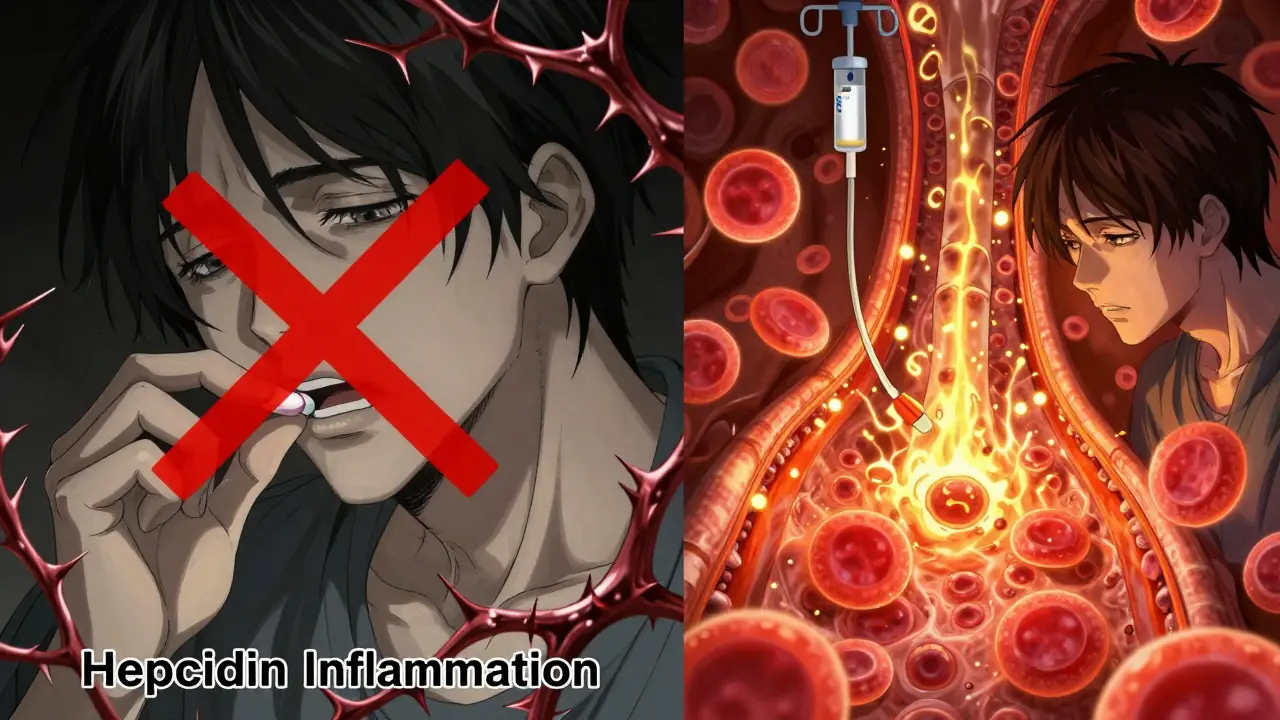
What Happens If Iron Isn’t Fixed First?
Starting an ESA without fixing iron deficiency is like trying to fill a car with gas while the tank has a hole. About 10% of CKD patients don’t respond to ESAs-and uncorrected iron deficiency is the top reason.That’s called ESA hyporesponsiveness. Your body ignores the hormone because it can’t make red blood cells without iron. You might get higher doses, but it won’t help. You’ll keep needing transfusions. You’ll feel worse. And you’ll spend more money. That’s why guidelines are so clear: check ferritin and TSAT first. Fix iron. Then start ESA.
Doctors use a simple algorithm: Step 1-confirm anemia (Hb <13 g/dL in men, <12 g/dL in women). Step 2-test iron (ferritin, TSAT). Step 3-give IV iron if levels are low. Step 4-if hemoglobin stays below 10 g/dL after iron, start ESA. Skip step 3, and you’re setting yourself up for failure.
New Hope: Oral HIF-PHIs
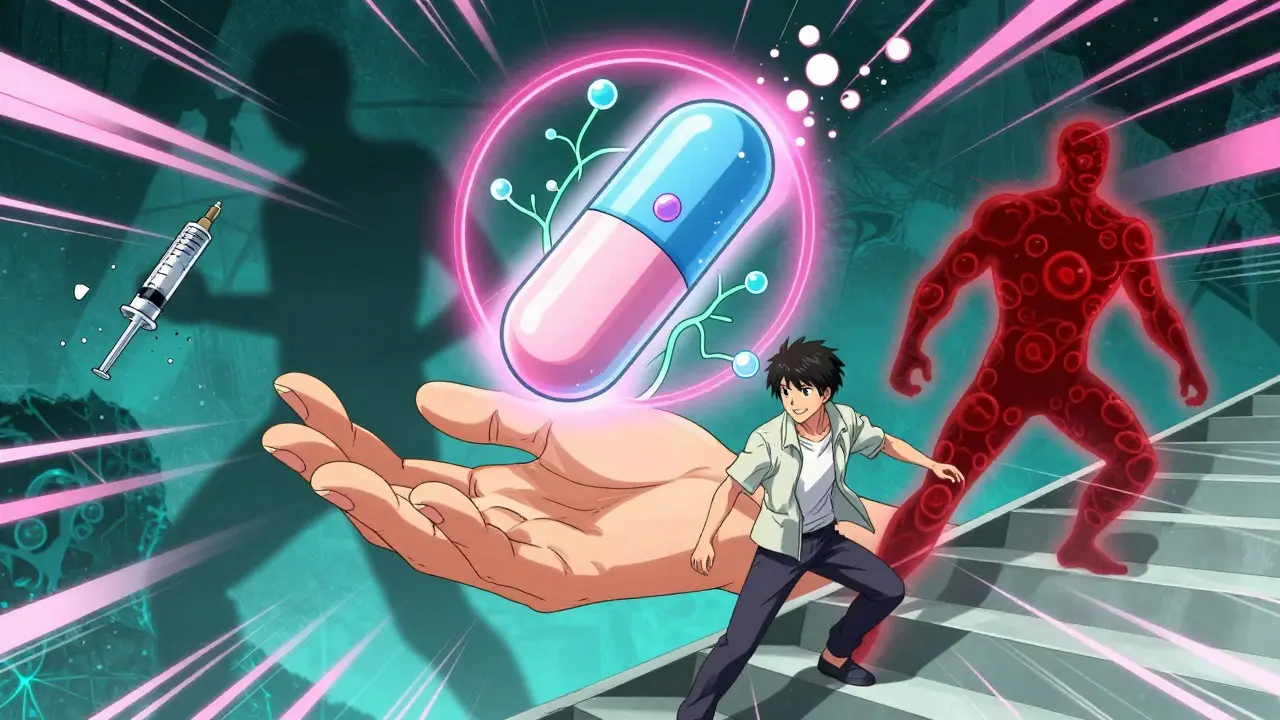
A new class of drugs called HIF-PHIs is changing the game. Roxadustat and daprodustat work differently. Instead of replacing erythropoietin, they trick your body into making more of it naturally by stabilizing a protein that senses low oxygen. They’re taken as pills. No injections. No IVs.Approved in Japan in 2019 and China in 2020, roxadustat got FDA approval in December 2023. Early data shows it raises hemoglobin as well as ESAs, with fewer spikes in blood pressure. Some studies even suggest it might be better for the heart. But it’s not without risks. The FDA put it on hold from 2018 to 2020 over concerns about tumor growth in cancer patients. That’s why it’s not for everyone. But for those without cancer, it’s a game-changer.
Market analysts predict HIF-PHIs could hit $3.5 billion in sales by 2028. That’s big. But ESAs still dominate-75% of the market. IV iron is growing fast too, from 48% of dialysis patients using it in 2010 to 87% in 2022. The shift is real. The goal isn’t just to treat anemia-it’s to treat it safely, simply, and sustainably.
Real Patient Experiences
In patient forums, the stories are clear. Sixty-eight percent say they feel more energy within four weeks of starting ESA therapy. One Reddit user wrote, “I can finally play with my grandchildren without getting winded.” That’s the goal.But it’s not all good news. Thirty-two percent report worsened high blood pressure. Twenty-five percent get painful injection sites. IV iron brings metallic taste and fatigue for many. But when you compare that to the alternative-constant fatigue, needing transfusions, or ending up in the hospital-the trade-offs make sense.
And the biggest mistake? Over-treating. A 2018 JAMA commentary pointed out that 22% of U.S. dialysis patients still have hemoglobin above 11 g/dL-even though guidelines have warned against it for years. Doctors still reach for higher numbers because they want to “fix” the anemia. But the data says: less is more.
What You Need to Know Right Now
If you have kidney disease and feel tired, ask for a hemoglobin test. Then ask for ferritin and TSAT. Don’t assume oral iron will help. Ask if IV iron is right for you. If your hemoglobin is below 10 g/dL after iron, ask about ESAs or HIF-PHIs. Don’t let your doctor push you above 11.5 g/dL. That’s not better-it’s riskier.Monitoring matters. Hemoglobin should be checked every month. Dose adjustments? Usually 25% up or down every four weeks, based on trends, not one number. If you’re not responding after 12 weeks, look for hidden causes: inflammation, aluminum toxicity, or vitamin B12 deficiency.
This isn’t a one-size-fits-all disease. The old days of pushing hemoglobin to 12 g/dL are over. The new standard is individualized care: your symptoms, your risks, your life. That’s what KDIGO 2025 is pushing for. And it’s working.
Can I treat anemia in kidney disease with iron pills alone?
No. Oral iron is rarely effective in chronic kidney disease because inflammation blocks its absorption. Studies show only 30-40% of oral iron gets used by the body. IV iron is the standard because it bypasses this block and delivers iron directly into the bloodstream. Even if you take iron pills, you’ll likely still need IV iron to correct the deficiency.
Why is my hemoglobin target 10-11.5 g/dL and not higher?
Higher hemoglobin levels (above 11.5 g/dL) increase the risk of stroke, heart attack, and blood clots. Large studies like the TREAT trial found a 32% higher stroke risk when targeting 13 g/dL. Current guidelines from KDIGO and other major organizations recommend staying between 10 and 11.5 g/dL because it improves energy and quality of life without raising serious risks. It’s about balance-not perfection.
What’s the difference between epoetin and darbepoetin?
Both are erythropoiesis-stimulating agents (ESAs), but darbepoetin lasts longer in the body. Epoetin usually needs to be given weekly or even more often. Darbepoetin can be given every 1-4 weeks. That means fewer injections. Darbepoetin is also more expensive, but for many patients, the convenience and stable hemoglobin levels make it worth it. Your doctor will choose based on your dialysis schedule, insurance, and how your body responds.
Can I avoid injections if I’m on dialysis?
Yes-new oral drugs called HIF-PHIs (like roxadustat) are now available in the U.S. These pills stimulate your body to make its own erythropoietin naturally. They’re approved for adults with CKD on dialysis and may replace ESAs for some patients. But they’re not for everyone, especially if you have cancer or certain heart conditions. Talk to your nephrologist to see if you’re a candidate.
How do I know if my iron therapy is working?
Your doctor will check your ferritin and transferrin saturation (TSAT) before and after treatment. If your hemoglobin rises by at least 1 g/dL within 4-6 weeks, and your ferritin stays above 100 mcg/L with TSAT above 20%, your treatment is working. If not, your team will look for other causes-like ongoing inflammation or inadequate dosing. Regular blood tests every month are key.
Is IV iron safe long-term?
Yes, when monitored. IV iron is safe for long-term use in kidney disease patients, but ferritin levels must be checked regularly. If ferritin goes above 800 mcg/L, you risk iron overload, which can damage the liver and heart. Most dialysis centers cap monthly doses at 400 mg unless ferritin is low. Side effects like metallic taste or flu-like symptoms are common but temporary. Serious allergic reactions are rare (less than 0.2%). The benefits of avoiding transfusions and improving energy far outweigh the risks.
Angel Molano
January 12, 2026 AT 20:37This is why so many patients get screwed over-doctors ignore the basics and go straight for the expensive drugs. IV iron isn't magic, it's just the only thing that works when your body's broken. Stop treating symptoms and fix the damn root cause.
Vinaypriy Wane
January 13, 2026 AT 00:16I've seen this firsthand-my uncle, CKD stage 4, was on oral iron for a year… nothing. Then IV iron, and within six weeks, he was walking to the park again. It’s not just science-it’s life. Ferritin below 100? That’s a red flag. Don’t wait.
Diana Campos Ortiz
January 14, 2026 AT 00:56i just read this and cried a little. my mom’s been on epo for 3 years and we thought she was just getting older… turns out she was just starved for iron. thank you for explaining this so clearly.
ps: i spelled ‘erythropoietin’ wrong three times while typing this. forgive me.
laura Drever
January 14, 2026 AT 10:12So we spend billions on synthetic hormones and IV iron just to fix a system that could’ve been preserved with early intervention? Classic healthcare. Also, typo in ‘hemodialysis’-it’s ‘hemodialysis’ not ‘hemodialysis’.
jefferson fernandes
January 16, 2026 AT 09:54Let me be clear: this isn’t a ‘treatment’-it’s a lifeline. And if your doctor isn’t checking ferritin and TSAT before prescribing ESAs, you need a new doctor. Period.
IV iron isn’t ‘expensive’-it’s cheaper than hospitalizations, transfusions, and heart failure. We’re talking real money here, not just clinical numbers.
James Castner
January 17, 2026 AT 05:47There’s a profound philosophical truth here: the human body is not a machine with interchangeable parts. When the kidneys fail, they don’t just ‘stop working’-they cease to be the architects of homeostasis. Erythropoietin isn’t merely a hormone-it’s the whisper of life, the silent contract between organ and cell. And iron? It’s the raw clay from which blood is molded.
Modern medicine, in its haste to quantify and optimize, often forgets that biology is poetry written in cells. We treat hemoglobin levels like a thermostat setting, but the soul of the patient-their fatigue, their dignity, their ability to hold their grandchild’s hand-cannot be measured in g/dL.
And yet… we must measure. Because without numbers, we lose the thread. The tension between the mechanistic and the human… that’s where healing truly happens.
Adam Rivera
January 18, 2026 AT 12:17Just had my first IV iron session last week-metallic taste was wild, but honestly? I haven’t felt this awake in years. My wife said I stopped napping after lunch. Small wins, y’all.
Also, shoutout to the nephrologist who actually listened. Too many docs treat CKD like a checklist.
lucy cooke
January 19, 2026 AT 09:04Oh, so now we’re all supposed to be experts on KDIGO guidelines? How quaint. I mean, really-do you think the pharmaceutical industry is just handing out IV iron out of the goodness of their hearts?
Let’s not pretend this isn’t a billion-dollar racket dressed up as ‘science.’ The real tragedy? We’ve turned human suffering into a protocol. And now we pat ourselves on the back for ‘optimizing’ hemoglobin like it’s a spreadsheet.
Trevor Davis
January 20, 2026 AT 20:18My cousin’s on dialysis and she’s been on darbepoetin for 18 months. She’s got a 10.8 now. Feels like a new person. But here’s the thing-she also has diabetes, heart issues, and her husband left her last year.
So yeah, the numbers matter. But what really matters? Someone showing up. Even if it’s just to sit with her while she gets the IV.
mike swinchoski
January 21, 2026 AT 09:53Oral iron is useless. Everyone knows that. Why do doctors even prescribe it? They’re lazy. Or they don’t care. You want results? IV iron. End of story. Stop wasting people’s time.
Kimberly Mitchell
January 22, 2026 AT 02:02Functional iron deficiency is a misnomer. It’s not ‘functional’-it’s inflammatory suppression of iron mobilization via hepcidin upregulation. And the KDIGO 2025 draft? Still too conservative. We should be targeting TSAT >35% and ferritin >300 in all CKD patients on ESA, regardless of dialysis status. The evidence supports it.
John Tran
January 23, 2026 AT 04:32You know, when I first got diagnosed with stage 3 CKD, I thought anemia was just part of getting older. Like gray hair. Or forgetting where I put my keys.
Then I started reading-really reading-and realized it wasn’t aging. It was my kidneys screaming. And the IV iron? It didn’t just raise my hemoglobin-it gave me back my mornings. I can walk my dog now without stopping three times.
And yeah, the metallic taste? I just chew gum. Worth it.
But here’s the thing no one talks about: the loneliness of this disease. You’re not just fighting low iron-you’re fighting the silence. People don’t get it. They say, ‘You look fine.’
So I write this. Not for the guidelines. Not for the numbers. For the next person who’s sitting in that chair, wondering if they’ll ever feel like themselves again.
Pankaj Singh
January 25, 2026 AT 00:18Of course you’re gonna respond poorly to ESAs if you’re still on oral iron. That’s like trying to start a car with a dead battery and a broken alternator. The fact that this even needs to be said is pathetic.